All Lanes Reopen on U.S. 45 in Mobile County After Commercial Vehicle Crash
ALEA troopers cleared all lanes of U.S. 45 near the 13-mile marker in Mobile County after a single-vehicle crash involving a commercial motor vehicle shut down the roadway.
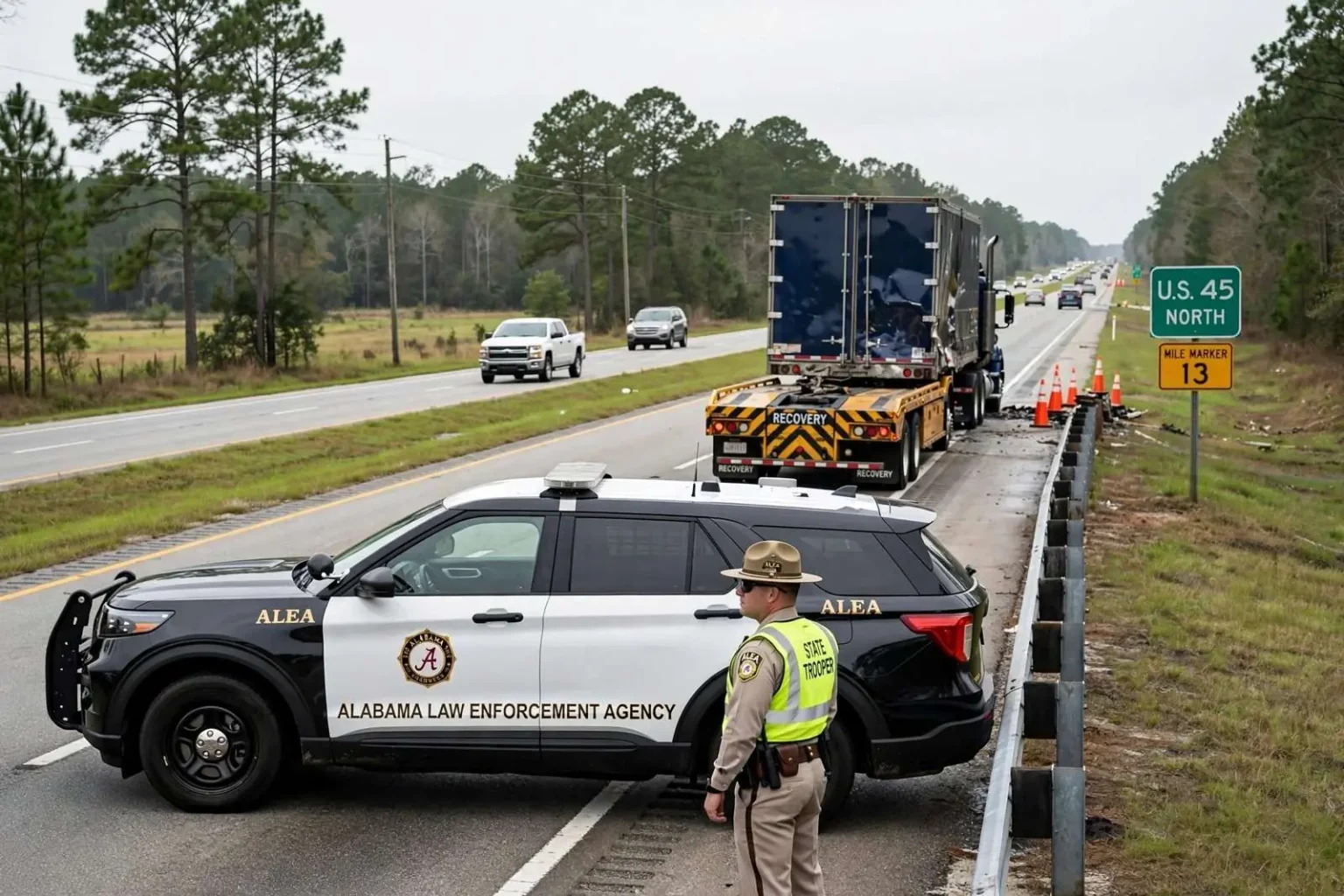
All lanes of U.S. 45 near the 13-mile marker in Mobile County have reopened after a single-vehicle crash involving a commercial motor vehicle forced troopers with the Alabama Law Enforcement Agency to shut down the roadway, according to ALEA. The closure prompted an active law enforcement response before crews were able to clear the scene and restore normal traffic flow.
What ALEA Reported
According to a post from the agency’s Highway Patrol Division, troopers received a report at approximately 7:55 a.m. of a single-vehicle crash involving a commercial motor vehicle that had caused a road closure on U.S. 45 in Mobile County. In its initial update, ALEA said all lanes near the 13-mile marker were closed and that the closure would remain in effect for an undetermined amount of time while troopers worked the scene.
“MOBILE POST — At approximately 7:55 a.m. Troopers of the Alabama Law Enforcement Agency’s (ALEA) Highway Patrol Division received a report of a single-vehicle crash involving a commercial motor vehicle that has caused a road closure,” the agency said in its post. “ALEA Troopers are currently on scene and will continue to monitor the situation and provide updates accordingly.”
ALEA later confirmed that all lanes had been cleared, allowing traffic on U.S. 45 to return to normal in the area near the 13-mile marker.
Why Commercial Vehicle Crashes Often Mean Longer Closures
Crashes involving commercial motor vehicles frequently require longer closure times than crashes involving only passenger vehicles, both because of the vehicles’ size and weight and because of the additional steps investigators and cleanup crews must take at the scene. Depending on the nature of a crash, responders may need specialized heavy-duty towing or recovery equipment to move a disabled commercial vehicle, and investigators typically document the scene in greater detail when a commercial vehicle is involved, given the additional regulatory framework — including federal motor carrier safety rules — that governs commercial trucking operations.
Single-vehicle crashes involving commercial vehicles can result from a range of factors, including mechanical failure, road conditions, driver fatigue, or a sudden need to avoid another hazard on the roadway. ALEA’s public statements on this incident did not specify a cause, and the agency’s Highway Patrol Division typically continues to investigate contributing factors after a roadway has reopened to traffic.
U.S. 45’s Role in Mobile County
U.S. Highway 45 runs through Mobile County as a key north-south corridor, connecting communities in the northern part of the county to the Mobile metropolitan area and linking into the broader regional highway network used by both commuter and commercial traffic. Because the route carries a significant volume of trucking traffic moving freight through the region, closures on U.S. 45 — even temporary ones — can create ripple effects for both local commuters and longer-haul freight movement passing through the corridor.
ALEA’s Highway Patrol Division is responsible for monitoring and responding to crashes on state and federal highways throughout Alabama, including U.S. 45, and routinely posts real-time updates on significant crashes and closures through its public communications channels. Those updates typically progress from an initial report of a closure, as conditions are first assessed, through follow-up posts confirming when lanes have reopened, giving drivers a way to plan alternate routes while a roadway remains impassable.
Officials have not indicated whether any injuries resulted from the crash. Motorists traveling through the area are reminded that conditions on rural highway corridors can change quickly following a crash, and drivers are encouraged to follow ALEA’s public safety updates for the latest information on any active roadway incidents in Mobile County and the surrounding region.
ALEA’s Role Across Alabama’s Highway Network
The Alabama Law Enforcement Agency’s Highway Patrol Division is responsible for traffic enforcement and crash investigation across the state’s federal and state highway system, a network that spans thousands of miles connecting Alabama’s urban centers, rural communities, and interstate commerce routes. In rural stretches of highway like the section of U.S. 45 where this crash occurred, ALEA troopers often serve as the primary law enforcement presence, since many rural areas lack the dedicated traffic units that larger municipal police departments maintain in more urbanized areas.
ALEA’s public communications strategy for significant crashes typically follows a consistent pattern: an initial post describing the incident and any resulting closure, followed by periodic updates as conditions change, and a final confirmation once the roadway has been fully reopened. That structure gives the traveling public actionable, real-time information without requiring troopers to divert attention from the scene itself to answer individual inquiries about conditions.
\n
Commercial Trucking Safety Oversight
\n
Crashes involving commercial motor vehicles also typically trigger additional regulatory scrutiny beyond a standard crash investigation. The Federal Motor Carrier Safety Administration maintains safety rating and inspection systems for commercial trucking operations nationwide, and a crash involving a commercial vehicle can prompt a closer look at factors specific to that regulatory framework, including the driver’s hours-of-service compliance, the vehicle’s maintenance records, and the carrier’s overall safety history. Whether any of those factors played a role in this particular crash on U.S. 45 has not been disclosed, and ALEA’s Highway Patrol Division typically completes that fuller investigative picture over a period of days or weeks following an incident, well after a roadway itself has already reopened to traffic.
Federal Rules Governing How Long Truckers Can Drive
Any crash involving a commercial motor vehicle inevitably raises questions about driver fatigue, one of the most heavily regulated aspects of the trucking industry. The Federal Motor Carrier Safety Administration enforces a detailed set of hours-of-service rules designed to limit how long commercial drivers can remain behind the wheel without rest. Under the core federal framework, most property-carrying drivers are limited to 11 hours of driving time within a 14-hour on-duty window, after which they are required to take at least 10 consecutive hours off duty before driving again. Drivers are also generally required to take a 30-minute break after eight cumulative hours of driving time, and weekly limits cap the total number of hours a driver can spend on duty across a rolling multi-day period before a mandatory extended rest period kicks in. Since late 2017, most commercial carriers have been required to track those hours using electronic logging devices rather than paper logs, a change federal regulators adopted specifically to make hours-of-service violations easier to detect and harder to falsify. Investigators examining a commercial vehicle crash routinely pull a driver’s electronic logs as a matter of course, since fatigue-related driving remains one of the most commonly cited contributing factors in serious truck crashes nationally, even though ALEA has not indicated whether fatigue played any role in the U.S. 45 incident.
Why Rural Two-Lane Highways Carry Distinct Risks
U.S. 45’s character as a rural, largely two-lane federal highway also shapes the kind of crash risk it presents compared with a divided interstate. Undivided rural highways typically lack a physical median separating opposing lanes of traffic, meaning that a vehicle that leaves its lane for any reason — mechanical failure, a tire blowout, a driver reacting to a road hazard, or fatigue — has a shorter margin before it can cross into oncoming traffic or run off the roadway entirely. Traffic safety researchers have long identified rural two-lane corridors as disproportionately dangerous relative to their traffic volume compared with limited-access highways, a pattern attributed to a combination of higher speed limits, less roadway lighting, narrower shoulders, and the absence of the barriers and wider recovery zones built into most interstate design. Commercial trucks add another layer of risk calculus on corridors like this because of their size, weight, and longer stopping distances; a loaded tractor-trailer requires substantially more distance to come to a stop than a passenger vehicle traveling the same speed, which is part of why single-vehicle commercial crashes can still produce significant roadway blockages even when no other vehicles are involved. State transportation departments across the country have increasingly prioritized targeted safety improvements on rural highway corridors, including rumble strips, wider shoulders, and improved signage, specifically to address the elevated crash severity these roads tend to produce compared with more heavily engineered interstate routes.
ALEA’s Structure and Statewide Reach
The Alabama Law Enforcement Agency itself is a relatively recent creation, formed in 2015 when the state consolidated several previously separate public safety functions — including the former Department of Public Safety, the State Bureau of Investigation, and other specialized units — into a single cabinet-level agency. That reorganization was intended to streamline law enforcement operations and improve information-sharing across functions that had previously operated under separate command structures. The Highway Patrol Division, the ALEA component responsible for responding to crashes like the one on U.S. 45, is one of several divisions operating under the agency’s umbrella alongside units handling homeland security, driver licensing, and specialized investigations. Because Highway Patrol troopers are the primary state-level law enforcement presence on rural federal and state highways throughout Alabama, they routinely serve not just as first responders to crashes but as the main point of public communication during active incidents, a role reflected in the same kind of real-time social media updates ALEA issued while U.S. 45 remained closed near the 13-mile marker.
The Role of Social Media in Modern Crash Reporting
ALEA’s use of a public post to announce both the initial closure and the eventual reopening of U.S. 45 reflects how state law enforcement agencies across the country have shifted much of their real-time public communication onto social media platforms over the past decade. Before that shift, drivers typically had to rely on radio traffic reports, dedicated state transportation hotlines, or word of mouth to learn about an active roadway closure, information that often lagged well behind conditions on the ground. Posting directly from the scene, or shortly after troopers arrive, allows an agency like ALEA to reach commuters and freight dispatchers simultaneously, giving trucking companies and logistics coordinators a chance to reroute vehicles before they reach a closed corridor rather than discovering the closure only after arriving at the back of a stopped line of traffic. That same channel also allows the agency to close the loop once a scene has been cleared, as it did in this case, reducing the number of drivers who continue avoiding a route out of caution long after it has already reopened. For a rural corridor like U.S. 45, where alternate routes may add significant time and distance for both commuters and commercial freight, that kind of timely, direct public update carries practical value well beyond simple public curiosity about the incident.