Employees Call 911 After Ax-Carrying Man Refuses to Wear Mask at West Pensacola Grocery Store
West Pensacola grocery employees called 911 after a man with an ax refused to wear a mask and threatened staff on Lillian Highway.
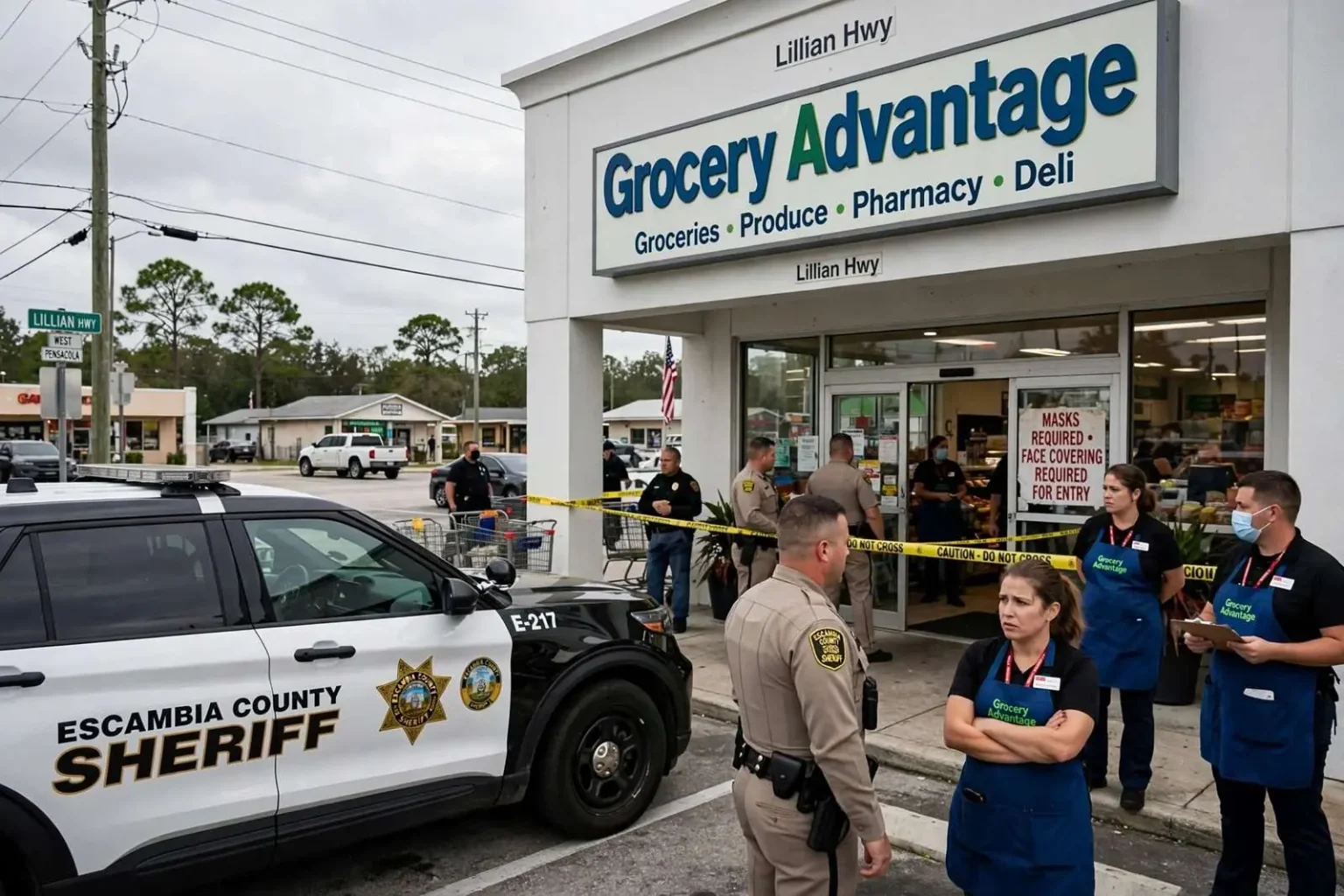
Deputies were called to a West Pensacola grocery store after a man carrying an ax allegedly threatened employees who asked him to wear a face mask — a confrontation that turned an ordinary shift at the Grocery Advantage on Lillian Highway into the kind of pandemic-era incident that has left retail workers across the Gulf Coast on edge. According to the Escambia County Sheriff’s Office, an employee asked Michael Bevans and the woman accompanying him to put on masks inside the store, and when the pair refused, the employee told them to leave. That is when deputies say Bevans became belligerent and yelled racial slurs.
According to the arrest report, Bevans kept arguing with employees and repositioned his hand on the ax he was carrying, leading workers to fear he was about to swing it at them. Employees called 911 during the confrontation, and Escambia County deputies responded to the store on Lillian Highway, the main east-west corridor running through the West Pensacola area toward the Perdido Bay community of Lillian.
What deputies say happened
The account laid out in the arrest report traces a familiar arc from request to confrontation. An employee of the Grocery Advantage asked Bevans and the woman with him to put on masks, as store policy and, at the time, public health guidance required for indoor retail spaces. When the pair refused, the employee told them to leave the store. Rather than exit, deputies say, Bevans escalated — becoming belligerent, directing racial slurs at employees and continuing to argue as the standoff wore on.
The detail that transformed an argument into an emergency was the ax. Bevans was carrying the tool into the store, and as the argument continued, the arrest report states, he repositioned his hand on the ax. To the employees watching, the movement read as a man preparing to swing, and that fear — recorded in the account workers gave deputies — is what prompted the 911 call while the confrontation was still unfolding.
Deputies took Bevans into custody, and the case moved from the store into the Escambia County justice system, where the arrest report’s allegations will be weighed by prosecutors and, ultimately, a court. The woman who accompanied Bevans was identified in the report as having refused the mask request alongside him; the Sheriff’s Office account does not indicate she was arrested.
Retail workers on the front line
The incident illustrates the position grocery and retail employees occupied through the pandemic, when enforcing mask policies became an informal duty layered onto stocking shelves and running registers. Workers across Florida and Alabama described the same pattern throughout that period: a request to mask up met with refusal, then shouting, then the fear that an argument could turn physical. Industry groups and unions documented thousands of episodes nationwide in which customers threatened or assaulted workers over mask rules, capacity limits and social distancing.
Grocery workers could not do their jobs from home. While office employees shifted to remote work, grocery staff kept reporting to stores that stayed open through the worst of the pandemic, interacting with hundreds of customers a day in an enclosed space. Enforcement of store policies fell to those same workers — often the youngest and lowest-paid people in the building — backed by nothing but company policy and, when things went badly, a phone call to deputies.
Stores along the Lillian Highway corridor and across the Pensacola area adopted a range of approaches during the mask period, from posted signage at the entrance to dedicated staff stationed at the door. The Grocery Advantage confrontation became a case study in what can happen when a request escalates: an employee does the uncomfortable work of enforcing the policy, the situation outruns their training, and the safe resolution depends entirely on whether violence actually occurs before deputies arrive.
The Grocery Advantage on Lillian Highway serves a working stretch of West Pensacola where residential neighborhoods meet the commercial corridor that runs toward Lillian and the Alabama line. Stores in this part of Escambia County anchor daily life for communities west of Pensacola’s urban core, and the grocery in particular is the kind of neighborhood market where employees know regulars by name — the very dynamic that makes confrontations inside it feel personal, both to the staff and to the customers watching.
The Escambia County Sheriff’s Office handles law enforcement for the unincorporated areas around Pensacola, including West Pensacola, and its deputies respond to everything from traffic crashes to the kind of armed-subject call that came in from the grocery that day. The agency, like sheriff’s offices across the Florida Panhandle, saw its share of pandemic-era disputes, as mask requirements and business restrictions became flashpoints in stores, restaurants and government buildings across the region.
The mask era in Panhandle stores
The confrontation at the Grocery Advantage fits into a period when Florida’s retail landscape became contested ground. State and local leaders shifted mask guidance repeatedly through the pandemic, and retailers were left to set and enforce their own store policies — with no uniform rule to point to and no uniform consequence for refusing. In practice, that left a cashier or a store manager to deliver whatever the policy was, face to face, to customers who sometimes arrived ready for a fight.
Business groups urged customers during that stretch to remember that store employees were simply carrying out the policy, and several major retailers banned customers who threatened staff. Law enforcement agencies, including the Escambia County Sheriff’s Office, generally treated refusal to wear a mask as a business’s decision to enforce through trespass warnings rather than a criminal matter by itself — meaning the path from a mask dispute to a deputy’s report usually ran through something more, like the threats and weapon conduct alleged in this case.
The Lillian Highway corridor, meanwhile, sits close enough to the Alabama line that its stores serve customers from both sides of the state line, and news of the incident traveled quickly across community pages in both Pensacola and southern Baldwin County. Neighborhood grocery confrontations resonate differently from big-box incidents; residents who shop at the store weekly read the report and recognized the aisles, the staff and the stakes.
What happens to the people involved
For Bevans, the immediate consequence was a ride in a deputy’s car and a booking at the Escambia County Jail, with the allegations in the arrest report setting up whatever charges prosecutors choose to pursue. The consequences of a conviction in a case involving a weapon and threats against multiple victims can include jail or prison time, probation and fines, depending on how the charges are filed and how the case resolves.
For the employees, the aftermath tends to be quieter but real: statements to deputies, conversations with store management, and the ordinary difficulty of returning to work in the aisles where the confrontation happened. Retail workers who live through armed-threat incidents often describe lingering vigilance on the job, and employee assistance programs and coworkers become the main support structure most of them have access to.
For the community, the case stands as a reminder of how fast an ordinary errand can go wrong — and of the line that store employees held, at modest wages, through the whole period when the simplest requests in a grocery aisle could end with sirens on Lillian Highway.
Escambia County deputies who answered the 911 call arrived to sort out a scene that had been moving quickly: a store still open for business, employees shaken by the threat they believed they had faced, and a man in custody who had allegedly carried a weapon into the middle of a mask dispute. Deputies documented the employees’ accounts, collected the arrest report’s narrative of what happened, and booked Bevans into custody, where the allegations became part of a court file rather than a store’s internal incident log.
The legal road ahead
An arrest report is the starting point of a prosecution, not its conclusion. The allegations in the Grocery Advantage case — that Bevans became belligerent, yelled racial slurs and repositioned his hand on an ax in a way that made employees fear he was about to swing it — will be reviewed by the State Attorney’s Office for the First Judicial Circuit, which handles prosecutions for Escambia County. Prosecutors will decide what charges, if any, to formally file, weighing the employees’ statements, any store surveillance footage, and Florida’s statutes covering assault, which hinge in part on whether victims had a well-founded fear of imminent violence.
That legal standard matters in cases like this one. Florida law distinguishes between an assault — a threat coupled with the apparent ability to carry it out — and a battery, which requires actual physical contact. No one was reported struck in the Grocery Advantage incident, but the employees’ fear that Bevans was about to swing the ax is precisely the kind of allegation an aggravated assault charge is built on, particularly when a weapon is involved. The racial slurs deputies say Bevans yelled could also factor into how prosecutors and judges view the case, even where hate-crime enhancements require specific findings.
Bevans, like any defendant, is presumed innocent unless and until the state proves the allegations in court. The woman who was with him was not arrested, according to the Sheriff’s Office account, and her presence as a witness may figure in the case as it develops.
Why weapons and short tempers don’t mix
The ax is the element that lifts this incident above the ordinary catalog of pandemic retail disputes. Hardware stores, yard crews and hurricane-season homeowners give axes a mundane presence along the Gulf Coast, and people sometimes carry them in and out of stores without incident. But a bladed tool in the hands of an angry customer changes the calculus for everyone in the building — the employees deciding whether to keep talking, the customers deciding whether to leave, and the deputies deciding how to approach the scene.
Law enforcement training treats any armed subject as a potential use-of-force situation, which is why deputies responding to the Grocery Advantage call would have been instructed to locate the weapon first and contain the situation before it spread. The employees’ 911 call, made while the confrontation was still in progress, gave dispatchers the details that shape a response: the store’s location on Lillian Highway, the description of a man with an ax, and the warning that workers feared violence was imminent.
For the employees of the Grocery Advantage, the episode ended the way the vast majority of such calls do — with deputies taking the suspect into custody and no one physically hurt. But the arithmetic of the incident is sobering: a mask request, a refusal, a slur, a hand repositioned on a tool, and a store full of people relying on the hope that a phone call brings help faster than a bad decision brings a swing. Workers across West Pensacola and the rest of the Gulf Coast carried the same calculation through every shift of the pandemic, and the ones who called 911 on Lillian Highway did exactly what they were supposed to do.