Old Photo Complicates Baldwin Commissioner’s Stand Against School Tax
A December photo of Baldwin County Commissioner Frank Burt backing a school tax campaign resurfaced after he voiced doubts about the March 31 vote.
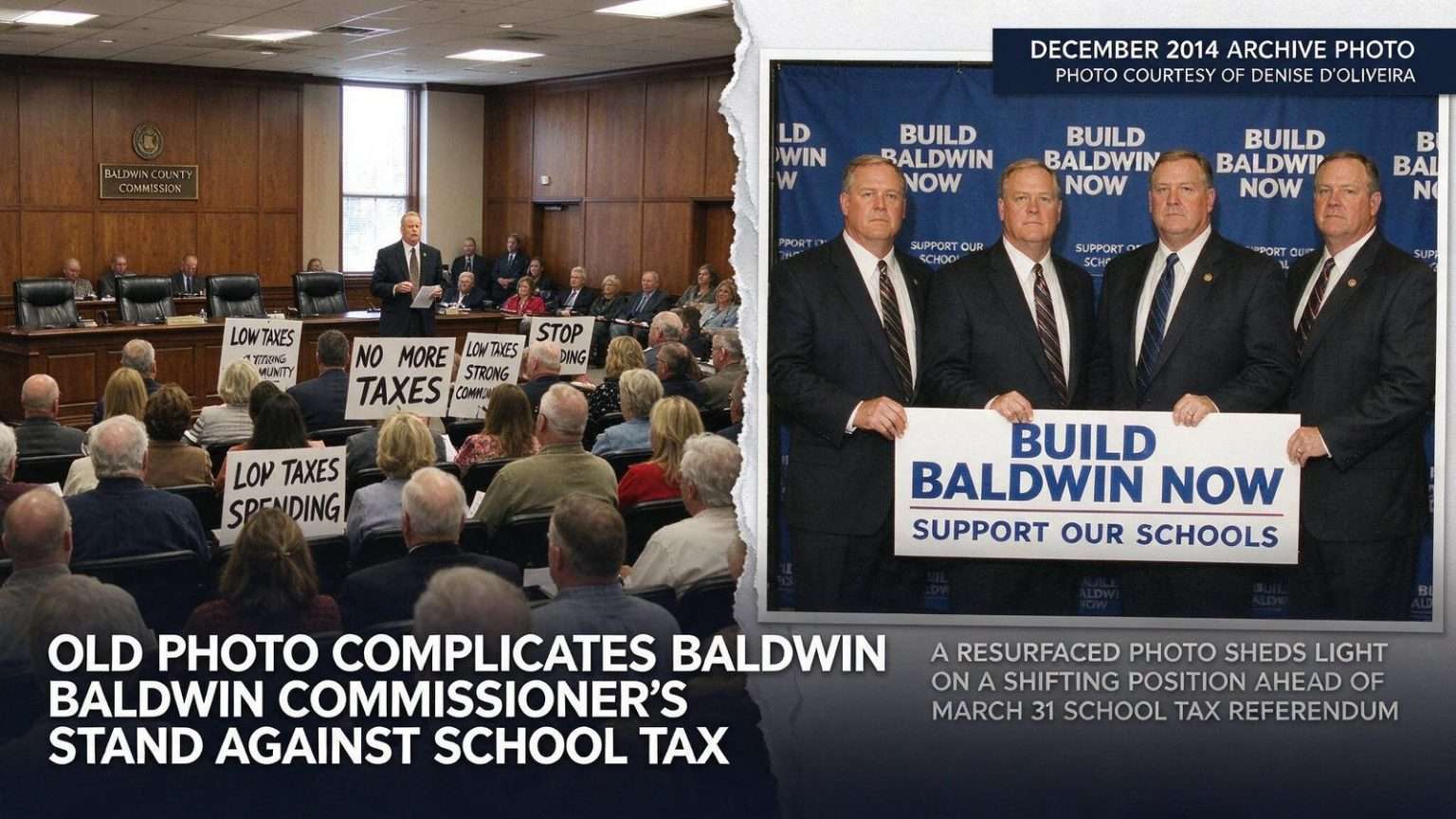
A resurfaced photograph is drawing attention to an apparent shift in Baldwin County Commissioner Frank Burt’s position on a school property tax referendum, just weeks before voters decide the measure on March 31. The image, circulated among parents and tax opponents in the run-up to the vote, has become a small but pointed piece of evidence in a debate that has split the county’s political leadership down the middle. At stake is an 8-mill increase that would fund the “Build Baldwin Now” school construction campaign — a proposal whose fate may rest on exactly the kind of voter persuasion now playing out at public meetings.
The photo and the applause
Burt was the only member of the Baldwin County Commission to receive applause from a crowd of mostly tax opponents during a commission meeting on Tuesday, March 17, after he raised concerns about the proposed 8-mill increase tied to the “Build Baldwin Now” school construction campaign. In a dais of four, the distinction was hard to miss: one commissioner aligning himself with a packed room of skeptics while his colleagues defended the referendum. For tax opponents, the moment transformed Burt into the board’s most quotable ally.
But a photo from December 2014, taken by Denise D’Oliveira, past president of the Daphne Education Foundation, shows Burt standing with the county’s other three commissioners while holding a sign supporting the same campaign, well before organized opposition to the tax had emerged. The timing matters: December’s event captured a united commission at the campaign’s optimistic launch, months before the opposition organized, packed meetings and turned the referendum into a fight.
When shown the photo after Tuesday’s meeting, Burt pushed back on the idea that it represented an endorsement. “It wasn’t an endorsement and I’ve made it clear that I wasn’t going to tell folks to vote for it or against it,” Burt said, adding that he had said the same at civic meetings. The distinction he drew — appearing at an event versus advocating a vote — is a narrow one, but it is the space many elected officials occupy when a referendum splits their constituents.
Burt’s case against the tax
During the public comment portion of the meeting, Burt argued that many Baldwin County residents are struggling financially, citing job losses and pay cuts. “People are really, really hurting,” Burt said. “People move to Baldwin County not just for the schools, but they also move down here because we have low taxes. When taxes go up, it hurts people.” The argument leans on the county’s founding economic appeal: a Gulf Coast climate, strong schools and a tax burden historically lighter than neighbors across the bay or the state line.
He also criticized the length of the proposed tax, invoking his own childhood during the Great Depression, and said he was troubled that students had been involved in campaigning for the tax increase, calling the effort “absolutely for the employees.” The objection to student participation touched a nerve with parents on both sides — supporters saw civics in action, critics saw schools lobbying for their own budget line with children as the messengers.
Fellow commissioners struck a different tone. Commissioner Chris Elliott, who along with Commissioner Tucker Dorsey voiced support for the referendum, said afterward that his comments weren’t aimed at winning applause. “Leadership is to do what you know is be right regardless of who is in the room looking at you,” Elliott said, defending the school board’s efforts to inform the public and pointing to Baldwin County’s rapid growth as a driving factor behind the district’s facility needs. His framing was a direct answer to the applause line that had preceded it — a suggestion that popularity in the moment is the wrong measure of a public official’s duty.
Dorsey called the school system’s plan “logical, reasonable.” The two commissioners’ united front reflected the political reality on the dais: with Burt opposed and Commission President Charles “Skip” Gruber recovering from back surgery and absent from the meeting, the referendum’s county-level advocates were outnumbered in the room even as they argued the merits. The absence of Gruber, the board’s longtime president and a steady voice on school funding questions, removed one of the more experienced arbiters from the evening’s exchange.
What the referendum actually does
The March 31 referendum asks voters to raise the county’s property tax rate from 12 mills to 20 mills, while also renewing an existing 7-mill levy. Each mill generates roughly $3.6 million for the school system. The arithmetic makes the stakes concrete: an 8-mill increase translates to nearly $29 million a year in new revenue, and the renewal’s failure would subtract roughly $25 million more from a budget already stretched across dozens of campuses.
County Attorney David Conner noted that if voters reject the renewal, state equity funding rules could require the commission to ensure at least a 10-mill minimum levy stays in place, a scenario that could still cost the district roughly $7 million if rates fall from the current 12 mills. In other words, a “no” vote is not a free option: state law’s floor provisions mean Baldwin could end up paying more per mill of protection than the renewal itself would cost, while losing the flexibility the current levy provides.
School officials have pointed to their own data in defending the request, noting the district ranks 110th out of 134 Alabama systems in per-pupil spending and has cut 561 positions since 2007 even as enrollment grew by 6,158 students, a 25 percent increase, over the past decade. Those numbers are the heart of the district’s argument: Baldwin is not an extravagant spender asking for luxury, but a fast-growing system that has already absorbed a decade of contraction while its classrooms kept filling. The ranking places the county near the bottom third of the state in spending per student, a striking position for one of Alabama’s wealthiest and fastest-growing counties.
The growth statistics carry their own weight in the debate. Every new roof along the Highway 181 corridor or in the Foley and Spanish Fort zones eventually becomes a kindergarten class, and districts cannot defer the buildings the way they can defer a bus replacement. Supporters of the referendum argue that the county is choosing between building ahead of its population or sending students to overflowing schools and portable classrooms while the waitlist grows.
What happens next
The photograph, for all the attention it drew, is unlikely to decide the election by itself. What it did was sharpen the question voters are already asking about the people asking for their vote — whether the county’s leadership speaks with one voice, and whether that voice changes with the audience. Burt’s explanation preserved his standing with the anti-tax crowd that applauded him; Elliott’s and Dorsey’s defenses kept the administration’s case on the record; and the board’s split now mirrors the split it is asking the county to resolve.
Between the March 17 meeting and the March 31 vote, both campaigns will spend their remaining days doing what referendum campaigns do: mailing, calling and mailing again, with the school system’s allies focused on turnout among parents and teachers, and opponents betting that a low-turnout, single-issue election favors the side with the strongest convictions rather than the largest roster. Property owners, meanwhile, can do their own math — the proposed increase works out to a few dollars a month on a typical home, weighed against a school system that says it has run out of places to cut.
Whatever the outcome, the episode has already clarified the county’s politics. A referendum that began as a united commission’s recommendation has become a test of trust — in the school board’s numbers, in the county’s economic story, and in the consistency of the four men who will sign off on whatever the voters decide.
The bigger picture for Baldwin schools
However the vote falls, Baldwin County’s school construction question is not going away. The district’s enrollment curve, driven by one of the sustained population booms in the Southeast, guarantees that the debate over how to pay for classrooms will return in one form or another — through this referendum, a revised one, or the annual budget squeeze that growth imposes regardless. County commissioners, who must certify whatever levy the schools rely on, will remain in the middle of that conversation whether they campaign on it or not.
The meeting itself offered a snapshot of how that conversation now runs. A packed chamber, applause for the skeptic and pointed defenses from the supporters, a photograph making the rounds on social media between agenda items — the mechanics of a local tax fight in the era when every public meeting is recorded, clipped and shared before the gavel falls. Burt’s December picture became, in that environment, an argument that traveled faster than any position paper the campaign could produce.
For voters, the last two weeks before March 31 are the time to separate the claims from the math: 8 mills proposed, 7 mills up for renewal, roughly $3.6 million per mill for the schools, and a state law that keeps a floor under the county’s levy either way. The rest — the photographs, the applause, the question of who stood where and when — is the human politics wrapped around it.