Orange Beach Offers Cash Rewards to Curb Wave of Vandalism, Petty Crime
Orange Beach leaders approved a $10,000 reward fund after vandals damaged a donated dolphin sculpture and the Waterfront Park pier.
A Breaking Point at the Arts Center
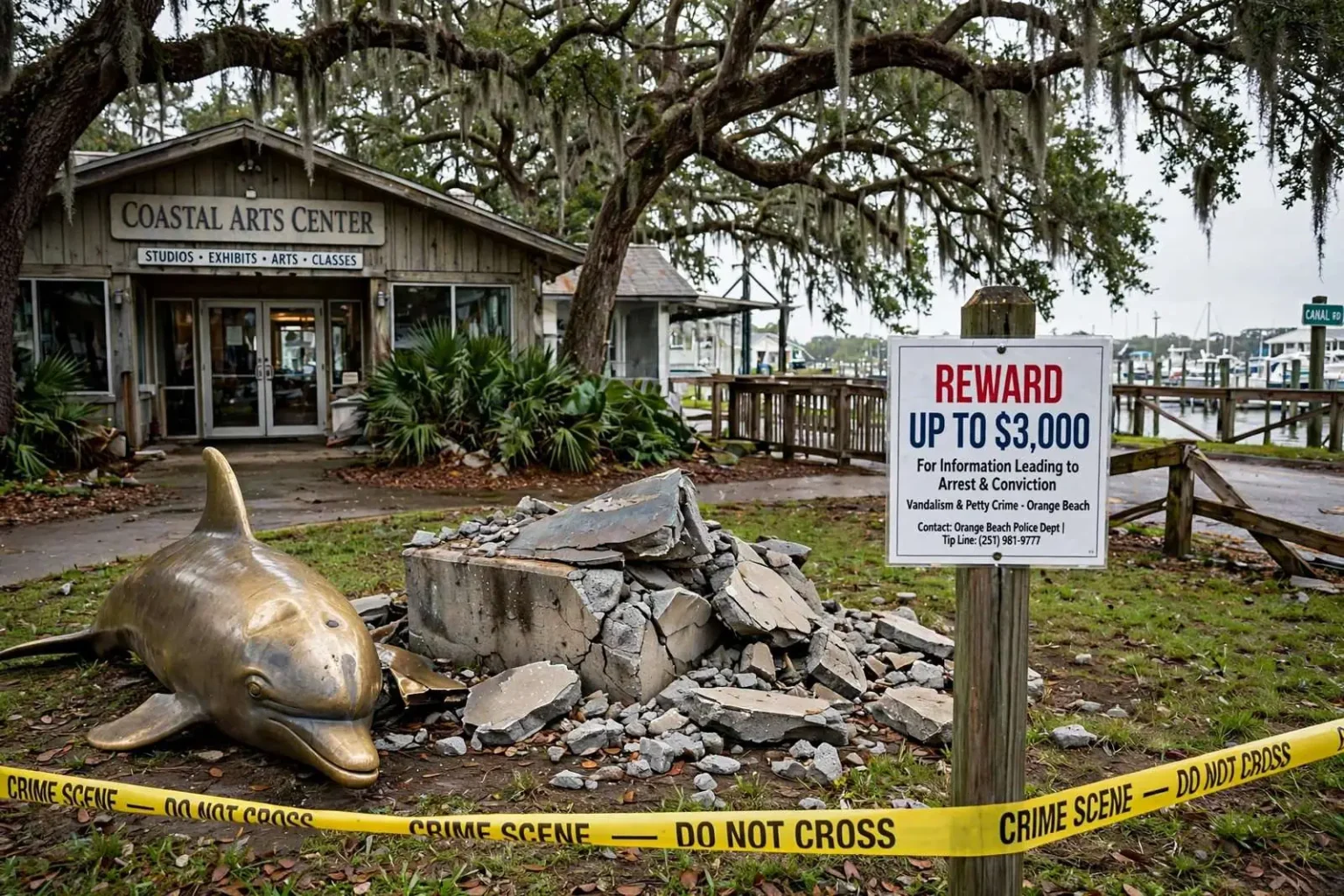
Orange Beach city leaders have set aside $10,000 to reward anyone who provides information leading to the arrest of vandals and petty criminals who have been targeting property around the city, following a string of incidents that culminated in the destruction of a donated public art piece. Mayor Tony Kennon brought the proposal to the City Council after what he described as the breaking point: the vandalism of a brass dolphin sculpture on the grounds of the Coastal Arts Center along Canal Road.
The sculpture, a gift from a California artist installed in 2014, had its pedestal smashed, and the nearby Waterfront Park pier was also damaged in the same incident. The damage to the dolphin — knocked from its base in what appeared to be a deliberate act — landed particularly hard in a community that had watched the piece go up as a symbol of renewal after hard years on the coast.
“We’ve had umpteen dozen different types of crimes, whether it be break-ins of cars, break-ins of garages, boat sheds, fishing tackle storage,” Kennon told the council. He said the pier at Waterfront Park has been a recurring target, with spindles kicked out and lights broken on a regular basis.
The list the mayor recited reads like an inventory of small-town aggravations: cars rifled in marina lots, storage sheds pried open, tackle and gear walking away from boat slips. Individually, none of it rises to the level of news. Together, and repeated over months, it built into the sense among residents and officials alike that someone — or several someones — was working over the city’s public spaces with little fear of consequences.
A Symbol Worth More Than Brass
The dolphin sculpture, created by San Diego-based artist Rick Harmetz, was intended as an uplifting symbol for the city following the economic and emotional toll of the 2010 BP oil spill. Its damage appeared to be the final straw for city officials frustrated by months of smaller-scale property crimes.
The timing of the gift mattered to how the city received it. In the years after the spill, when oil cleanup crews worked the beaches and tourism dollars evaporated across the Alabama coast, Orange Beach poured energy into projects that said something about the city’s resilience and its identity beyond the summer season. Public art along Canal Road and the waterfront was part of that effort, and the brass dolphin became one of the small landmarks residents pointed visitors toward.
Its smashed pedestal sent a different message, and the mayor took it personally. “It’s just always something small. It’s petty but it’s unacceptable in our town, so that’s why we put this in place,” Kennon said.
How the Reward Fund Works
The council voted unanimously to approve the reward fund, which allows the mayor to authorize payouts of up to $3,000 per incident for information that leads to an arrest and conviction. The structure gives the city flexibility — the full $10,000 can be spread across multiple cases as they develop, and payouts are triggered by results rather than tips alone, protecting the fund from false leads.
The arrest-and-conviction standard is deliberately strict. Reward programs built around tips alone invite noise; tying payment to a conviction means the money goes only when the justice system has done its work. The mayor’s office administers the fund, so officers investigating a case know they can promise a potential informant that real money waits at the end of a successful prosecution.
Kennon said he hopes the financial incentive will loosen tongues in a tight-knit community where people often know more than they initially let on. That dynamic — a resort town full of year-round neighbors who recognize each other’s cars and habits — cuts both ways for investigators. Someone knows who is kicking the spindles out of the Waterfront Park pier rail and smashing pedestals along Canal Road; the city’s bet is that a few thousand dollars helps that someone decide to come forward.
A Proven Model on the Coast
He pointed to a similar effort late last year, when the city contributed $3,000 toward a collective reward that helped lead to the arrest of a Florida teenager who admitted to shooting a bottlenose dolphin with a hunting arrow. The case drew attention well beyond Orange Beach, and it demonstrated for local officials exactly the sequence they are hoping to repeat: outrage over a senseless act, a reward pool, a tip, an arrest and an admission.
That dolphin case also showed how the reward mechanism operates in practice. The city’s contribution joined money from others who wanted to see the case solved, multiplying the incentive beyond what the city could offer on its own. The result — an identified suspect who admitted the act — gave the council a template for the standing fund it approved this week, and gave the mayor an answer for anyone who doubted the money would produce results.
For the police department, the fund adds a tool to cases that are often the hardest to crack. Property crimes and vandalism rarely leave witnesses willing to talk, and detective hours spent canvassing a marina after a string of boat-shed break-ins can end without a single lead. A standing reward changes the economics of silence, in the direction the council intends.
The Cost of Petty Crime
The damage that prompted the fund is small only in dollars. Vandalized lights and broken spindles on a public pier cost real money to repair and, more corrosively, degrade the experience of the parks and waterfront that anchor the city’s quality of life and its tourism economy. Orange Beach has invested for years in public amenities — the arts center, the parks along the waterway, the recreational facilities that serve residents through the seasons — and every broken fixture is a withdrawal from that investment.
There is also the cumulative message vandalism sends. A community that tolerates petty destruction invites worse, a principle city officials across the coast have cited for years. The council’s unanimous vote reflected a consensus that the response needed to be collective and public: the city will pay for information, and it will keep paying until the pattern stops.
The Coastal Arts Center itself occupies a special place in that calculation. Home to studios, exhibits and programs that connect residents and visitors with working artists, the center sits on a wooded campus along Canal Road where the sculpture garden is part of the experience. Damage at its front door is damage to one of the city’s cultural anchors, which is why the mayor reached for it as the example when he pitched the fund.
What Residents Can Do
City officials are encouraging anyone with information about recent vandalism or break-ins to contact the Orange Beach police department, noting that tips can now carry a financial reward when they lead to an arrest and conviction. The mayor’s office administers payouts under the fund, with up to $3,000 available per incident from the $10,000 pool.
The fund has no expiration, meaning it will remain available case by case as investigations develop. Officials describe it as a standing commitment rather than a one-time gesture — an acknowledgment that the crimes prompting it were a pattern, not an event, and that the answer needs to outlast any single incident.
For now, the brass dolphin’s pedestal along Canal Road stands as the fund’s most visible emblem. Whether the person responsible for that night’s damage is identified through a tip, a patrol or a chance admission, the city has made clear it is willing to pay to find out — and that the destruction of a symbol meant to lift the town up after its hardest year will not pass quietly.
Vandalism and the Visitor Economy
Orange Beach officials also weigh these crimes against the city’s economic engine. The barrier island city welcomes waves of visitors whose impression of the community is formed by what they see along the canals, at the parks and on the waterfront. Petty crime that goes unanswered shows up in the way a place feels — a pier with kicked-out spindles and dark lamps tells visitors something, and that something costs the city in return visits and reputation.
The mayor’s frustration, repeated in his remarks to the council, was less about any single dollar figure than about the pattern’s persistence. Vandalism that repeats at the same pier month after month suggests the perpetrators feel no risk, and the reward fund is designed to change exactly that calculation. Someone who might never call the police on a neighbor’s teenager may think differently when an arrest and conviction carries a $3,000 payout.
The unanimous vote also signaled to the police department that its request for tools has council backing. Investigators can now mention the reward in canvassing and public appeals, adding a persuasive line to every conversation they have around a damaged site. For a city of Orange Beach’s size, the $10,000 fund is a modest budget line with a outsized message attached: the destruction stops, or the city starts paying for names.