Massive Orange Lift Vessel Spotted on Mobile Bay Draws Curious Onlookers
The VB 10,000, among the largest lift vessels ever built, has been docked in Mobile for repair work and will depart the Port City later this month.
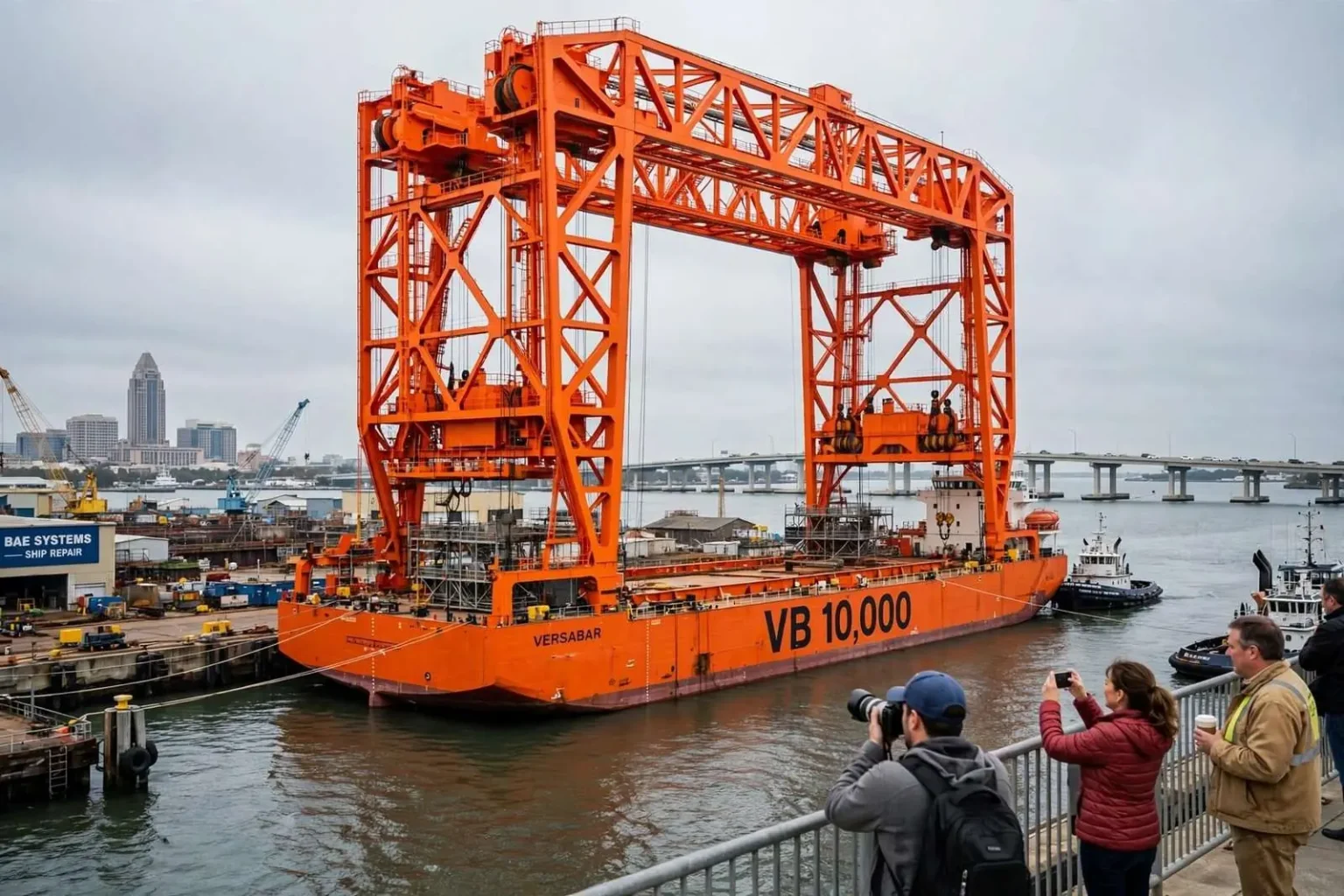
Drivers crossing the Bayway in Mobile over the past week may have spotted an unmistakable sight looming on the horizon: a garishly orange arch-shaped structure that, from a distance, appeared even larger than Government Plaza downtown. The structure turned out to be the VB 10,000, described by its owner, offshore construction company Versabar, as the largest lift vessel ever built in the United States. For commuters used to cargo ships and tankers crowding the Mobile River, the vessel’s profile — a pair of enormous trusses straddling a barge deck, painted a shade of orange that reads almost neon against the water — stopped traffic on the causeway and drew photographers to the waterfront.
According to the company, the vessel is a barge-mounted dual-truss system engineered to perform single-piece topside retrievals — essentially, removing massive platform structures in one continuous lift rather than dismantling them piece by piece. In simpler terms, it is an enormous piece of marine equipment built to lift extraordinarily heavy loads, often used in offshore oil and gas decommissioning work. Traditional decommissioning requires platforms in the Gulf of Mexico to be cut apart underwater and brought up in sections, a slow and expensive process; the VB 10,000 was designed to grip an entire platform topside and raise it from the sea in a single motion.
The vessel is currently docked in Mobile for maintenance. “We are doing some repair work on the vessel,” said John Measell, a spokesperson for BAE Systems, which operates a ship repair facility in the port. Measell said the VB 10,000 is expected to undock and depart Mobile by March 21. Officials did not provide additional details on the specific repairs being performed during the vessel’s stay, and Versabar did not respond to inquiries about where the vessel is headed next. Its presence at the BAE yard, however, fits a long pattern of specialized Gulf of Mexico work vessels pulling into Mobile for upkeep between jobs.
Built for the Heaviest Lifts at Sea
According to Measell, the vessel has unique capabilities that make it valuable for deepwater construction projects, including the ability to operate in water depths up to 10,000 feet. That figure — nearly two miles of water — places the vessel in territory where only a handful of specialized craft can work. The deepwater Gulf, where drilling and production moved into water depths beyond what earlier generations of platforms could reach, requires equipment that can handle structures anchored far below the surface, and lift capacity of the VB 10,000’s scale is rare anywhere in the world.
Some versions of the design also incorporate a large mechanical claw system that allows crews to retrieve equipment or structures without requiring divers to enter the water, reducing safety risks during complex offshore operations. The claw — a set of massive hydraulically operated jaws suspended from the trusses — was engineered for the decommissioning market, where pulling entire platform topsides in one lift eliminates weeks of underwater cutting. Keeping divers out of the water matters as much as speed: commercial diving at depth is among the most hazardous work in the offshore industry, and any system that removes humans from the lift zone improves the safety equation.
The vessel’s dimensions and lift capacity have made it a fixture of heavy offshore projects since it entered service, and its arrivals in Gulf ports routinely generate curiosity from people who have never seen anything like it. Versabar, the New Orleans-based offshore construction firm that owns the vessel, built its reputation on heavy-lift solutions for the energy industry, and the VB 10,000 remains the company’s signature piece of equipment — a craft purpose-built for jobs no conventional crane barge can perform.
Why Mobile Draws Vessels Like This One
Mobile’s deepwater port and ship repair facilities have long made the city a stopover point for specialized marine vessels serving the offshore energy industry along the Gulf Coast. The Port of Alabama sits roughly 30 miles up the Mobile River from the Gulf, close enough to offshore work sites to be convenient, far enough inland to offer protected harborage and a deep industrial base. Shipyards along the river handle everything from routine drydocking to complex structural repair, and vessels working the Gulf’s oil and gas fields routinely cycle through the city between projects.
BAE Systems’ Mobile shipyard regularly handles repair and maintenance work for a range of commercial and specialized vessels, contributing to the local maritime economy. The yard, located along the Mobile River just south of downtown, is one of the city’s longstanding industrial employers, with dry docks and trades capable of taking on vessels far larger than typical coastal traffic. Work on a vessel as unusual as the VB 10,000 — with its twin trusses and custom lift machinery — involves structural inspections, mechanical maintenance and systems checks that only a full-service yard can perform.
The arrival of unusual, oversized equipment like the VB 10,000 periodically draws attention from residents and commuters unfamiliar with the vessel’s purpose, prompting questions about the bright orange structure visible from the causeway and downtown waterfront. The Bayway — the elevated stretch of Interstate 10 that crosses the Mobile Delta — offers one of the best vantage points on the Gulf Coast for watching port traffic, and regular commuters quickly learn to spot vessels that do not belong to the everyday parade of container ships, bulk carriers and tugs. Local photographers and maritime watchers documented the vessel’s arrival as it made its way upriver.
What Comes Next for the VB 10,000
Once repairs are complete, the vessel is expected to return to service supporting offshore construction and decommissioning projects elsewhere along the Gulf Coast and beyond. The decommissioning market has grown steadily as older platforms in the central and western Gulf reach the end of their productive lives and operators are required by federal regulation to remove them. Federal law requires decommissioned structures to be removed within a set period after a lease ends, which guarantees a steady stream of removal work for vessels with the capacity to perform it, and the VB 10,000’s single-lift method has positioned it well for that demand.
For Mobile, the visit is a modest but visible reminder of the port’s role in the Gulf energy economy. While the city’s headline maritime news in recent years has centered on container shipping and aerospace manufacturing, the repair trades and specialized vessel traffic remain a quieter constant — work that brings unusual craft like the VB 10,000 up the river for weeks at a time and sends them back out to sea. Every such stopover means dockside trades, tug services, suppliers and shipyard workers earning wages that ripple through the local economy.
By March 21, Measell said, the orange arch that has dominated the waterfront view should be gone — undocked and headed for its next job. Until then, commuters crossing the Bayway can expect the questions to continue, and the vessel’s owner and repair yard can expect the same curiosity that follows every oversized arrival in one of the Gulf’s busiest working ports.
A One-of-a-Kind Machine in a Working Port
The VB 10,000’s design is unlike anything else in the American commercial fleet, which is part of why its visits generate so much attention. Rather than a revolving crane mounted on a flat deck, the vessel uses two massive trusses connected at the top, forming an arch that towers over the barge beneath it. Lift blocks and hoisting machinery run along the trusses, allowing the craft to raise loads vertically between its legs. The configuration gives the vessel stability under loads far heavier than conventional floating cranes of comparable size can handle, and it was conceived specifically for the offshore industry’s heaviest removal and installation jobs.
Vessels of this class do not appear in Mobile often, and their stays are usually dictated by work schedules hundreds of miles away. A repair window like this one — booked at a full-service yard with the dock space to accommodate the vessel’s beam — represents a brief pause in a work cycle measured in projects rather than days. The BAE yard’s ability to take on such a craft reflects the range of the Mobile port’s industrial capacity, which supports not just the cargo trade but the offshore construction fleet that works the Gulf’s producing fields year-round.
For now, the practical facts for residents are simple: the orange structure on the waterfront is not a construction project, not a new bridge element and not a permanent addition to the skyline. It is a working vessel in for scheduled maintenance, expected to leave by March 21, owned by a company that specializes in lifting some of the heaviest objects ever moved at sea. When it departs, the Mobile River’s familiar procession of container ships and tankers will resume its usual rhythm — until the next oversized visitor arrives to stop traffic on the Bayway once again.