Orange Beach Approves $4.5 Million Purchase of Waterfront Property Near The Wharf
Orange Beach council approved buying 32 acres of waterfront land near The Wharf for $4.5 million, calling it a smart long-term investment.
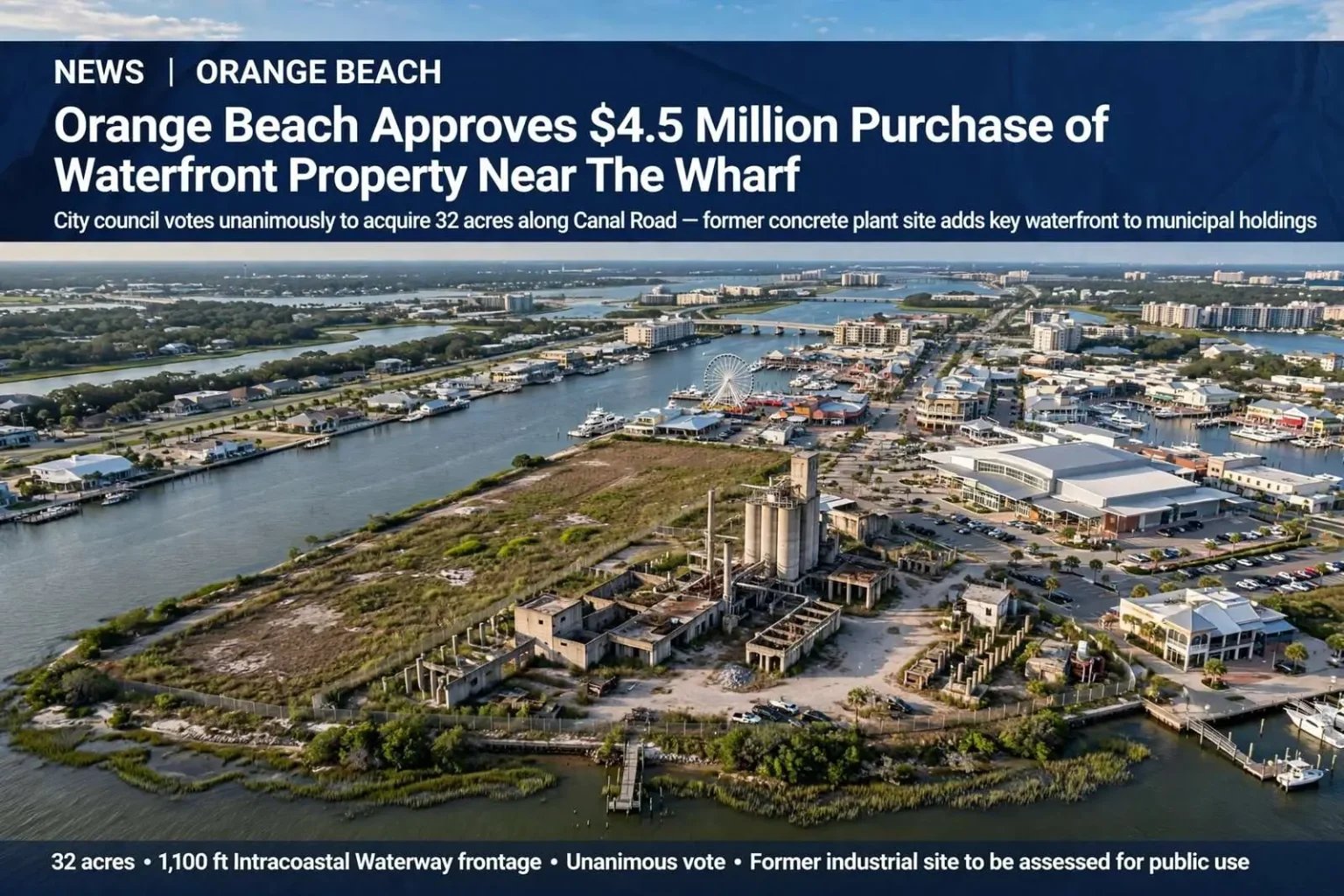
Orange Beach city leaders have signed off on a multimillion-dollar land deal that adds a large stretch of waterfront property to the city’s holdings near The Wharf. The council voted unanimously this week to approve the $4.5 million purchase of roughly 32 acres along Canal Road, just behind the Orange Beach Event Center. The property, a former concrete plant site, includes about 1,100 feet of frontage on the Intracoastal Waterway, making it one of the largest remaining undeveloped waterfront tracts inside city limits.
The purchase puts the city in control of a parcel that few private buyers could assemble at this point. With Orange Beach’s waterfront largely built out — lined with condominium towers, marinas, restaurants and resort developments — tracts of undeveloped land with direct water access have become rare enough that their availability draws attention across the coastal real estate market. City officials pointed to that scarcity as a central reason to act while the property was available.
A Strategic Move for City Finances
City officials described the acquisition as a strategic move to diversify municipal assets rather than let cash reserves sit largely idle. Mayor Tony Kennon told the council the city already holds an equity advantage by acting early on the purchase. He noted that undeveloped upland acreage of this size is increasingly rare within Orange Beach, and owning the parcel outright gives the city flexibility for future use, whether that means holding onto it, trading it, selling portions, or developing it down the road.
According to the mayor, the city currently holds around $30 million in reserve funds earning minimal interest, making a land purchase with long-term appreciation potential an attractive alternative use of those funds. He framed the deal as a sound business decision rather than a specific development plan, leaving open multiple possibilities for how the land could eventually be used.
That framing reflects a broader question facing fast-growing coastal cities across the Gulf: what to do with cash reserves that earn almost nothing while land values keep climbing. In Orange Beach’s case, city leaders have concluded that tangible property — particularly property with water frontage in a supply-constrained market — offers better protection of public money than savings accounts or short-term investments yielding fractions of a percent.
How the Purchase Is Structured
The transaction is structured as two separate purchases from different property owners. One entity holding about 15 acres of the site will receive just under $2 million, while a joint ownership group holding the remaining roughly 17 acres will be paid just over $2.5 million, together totaling the $4.5 million price tag.
Splitting the acquisition into two contracts allowed the city to move on both portions of the site at once while accounting for the fact that the land had been held by separate ownership groups. The per-acre cost works out to roughly $140,000 across the full tract, a figure city leaders appear to view as reasonable given the property’s direct frontage on the Intracoastal Waterway and its position in the heart of the city’s entertainment district.
Due Diligence on a Former Industrial Site
Before the sale is finalized, the city plans to conduct a full property inspection along with an environmental survey of the former industrial site, standard due diligence steps given its prior use as a concrete mixing operation.
Those steps are more than paperwork. Industrial operations that handled concrete, fuel and heavy equipment can leave behind contaminants in soil and groundwater, and a documented environmental assessment protects the city both financially and legally. The survey results will shape what the land can support in the future — a waterfront park has very different site requirements than a commercial development — and any remediation costs that surface now can be weighed against the purchase price rather than discovered after closing.
The inspection will also catalog what structures and improvements remain on the 32 acres, giving city planners a complete picture of the asset they are acquiring. That information will feed whatever planning process the council ultimately chooses for the property, whether that involves public input sessions, professional master planning, or an appraisal of what portions of the tract might be worth if the city ever elects to sell or trade part of it.
A Near-Unanimous Council Vote
Only one council member was absent for the vote, with the remaining members giving unanimous approval. That level of agreement is notable for a purchase of this size, and it reflects the extent to which the city’s leadership has converged on the view that reserves should be converted into tangible assets while opportunities remain.
The purchase adds to a string of recent moves by Orange Beach officials to invest city reserves in tangible assets rather than letting the money sit in low-yield accounts, a strategy the mayor has pointed to as a broader trend in the city’s approach to managing its finances heading into future growth.
What the Land Could Become
City officials have deliberately avoided committing the property to any single use. With 1,100 feet of Intracoastal Waterway frontage and a location directly behind the Orange Beach Event Center, the tract sits within walking distance of one of the area’s most heavily trafficked commercial and entertainment districts, The Wharf. Its position likely makes the property a draw for future civic or recreational use as the city considers its next steps.
Possible directions for a waterfront tract of this size typically include public access features such as parks, green space and boat or kayak launches; civic facilities; or a mix of public and revenue-generating uses that help the land pay its own way. Because the city owns the parcel outright and has no development clock running, officials can afford to let the environmental survey, market conditions and community input shape the decision rather than rushing to a plan.
The proximity to The Wharf matters as well. The district already draws visitors from across the Gulf Coast for concerts, festivals and shopping, and any improvement to the adjacent waterfront acreage would plug directly into that existing foot traffic. Even held undeveloped, the land gives the city control over what happens — or does not happen — along one of the most visible stretches of the Canal Road corridor.
A Growing City Managing Its Wealth
With its substantial water frontage and proximity to one of the area’s most heavily trafficked commercial and entertainment districts, the property is likely to draw interest for future civic or recreational use as the city considers its next steps.
The deal is the latest chapter in Orange Beach’s evolution from a small fishing village into one of Alabama’s most prosperous coastal cities, a community whose revenues from tourism, property sales and hospitality have swelled alongside its population. Managing that wealth has become a central task of city government, and the council’s willingness to spend reserves on land — rather than on one-time spending or deeper tax relief — signals how it intends to balance present needs against long-term position.
For residents, the immediate practical effect is limited: the property changes hands on paper, and the environmental review proceeds. The larger significance will emerge over years, as the city decides whether the former concrete plant site becomes a park, a civic anchor, a negotiated trade, or simply a held asset whose value climbs with the rest of the coast. What the vote makes clear is that Orange Beach intends to own its shoreline future rather than watch it be sold to someone else.
Context: The Wharf and the Canal Road Corridor
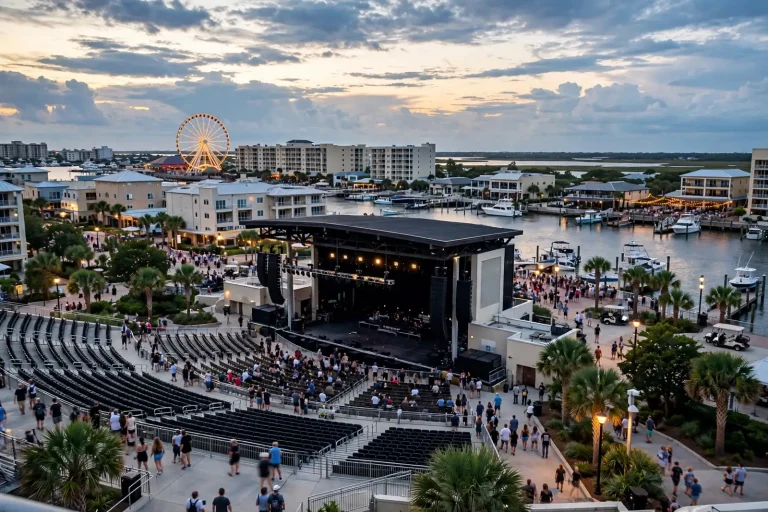
The Wharf, the large mixed-use development along the Intracoastal Waterway near the property, includes an amphitheater, marina, shopping and dining venues that make it a regional destination. The Orange Beach Event Center next door hosts conventions, tournaments and community events that fill hotels and restaurants throughout the year. City ownership of the acreage behind those facilities effectively gives the municipality a seat at the table for any future growth of the district, rather than leaving the remaining land entirely in private hands.
Canal Road itself is a critical east-west artery, carrying traffic between the Foley Beach Express area and the heart of Orange Beach. Development decisions along the corridor affect traffic patterns, drainage and the character of the city’s central district, which is one more reason municipal ownership of a 32-acre parcel there carries value beyond the acreage itself.
With the vote complete, the city’s next steps are procedural: completing the inspection and environmental survey, closing on the two purchase contracts, and adding the parcel to the city’s asset inventory. From there, any specific proposal for the land would come back before the council — and likely before the public — as officials weigh what the largest remaining undeveloped waterfront tract in the city should become.