$98 Million Apartment Portfolio Sale Tops Mobile Bay Real Estate News
An out-of-town firm paid $98 million for five Mobile apartment complexes in what may be the city's largest real estate sale, as new restaurants and a Foley entertainment complex drew fresh interest.
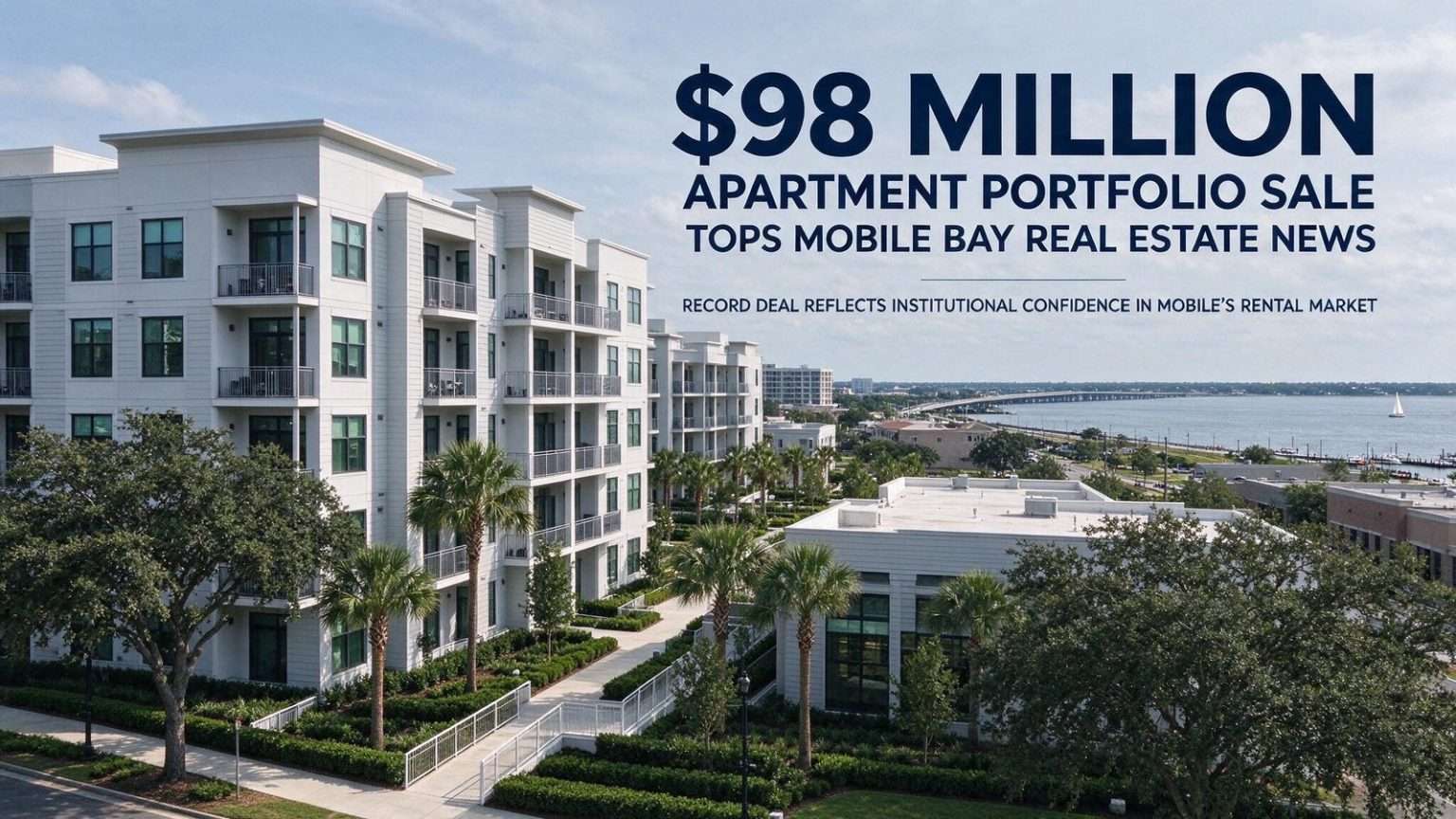
An out-of-town investment firm paid $98 million for five apartment complexes in Mobile owned by the Delaney family, in what may rank as the largest real estate sale in the city’s history, according to Richard Weavil of The Weavil Company in Mobile, who brokered the transaction. The sale put a national investor’s stamp on Mobile’s rental market and dwarfed the commercial deals that typically lead the region’s real estate news.
A Landmark Apartment Deal
The Delaney portfolio totaled more than 2,000 apartment units across five properties: Cabana on Michael Boulevard, Pathways Place on Pathway Place, Sandpiper on Government Boulevard, Windsor Place on Airport Boulevard and Yester Oaks Townhouse Apartments on Yester Oaks Drive. The properties span the corridors where Mobile’s rental demand is concentrated — Government and Airport boulevards among the city’s principal east-west arteries — giving the buyer immediate scale in a single transaction.
A portfolio of more than 2,000 units changing hands at once is a rarity in any market of Mobile’s size. Transactions of that scale usually involve institutional buyers and sellers, lengthy diligence on thousands of leases and unit conditions, and financing packages assembled from multiple lenders. That a single family had assembled and held the five properties long enough to sell them whole made the deal as notable on the seller’s side as on the buyer’s.
The buyer was Colony Hills Capital, based in Wilbraham, Massachusetts, and Surety Land Title in Mobile handled the closing. Weavil, who worked the deal in conjunction with Delaney Land and Realty, said the transaction took two years to complete. A two-year timeline reflects the realities of a sale that size: portfolio valuation, buyer vetting, financing contingencies and due diligence across five separate properties, each with its own management records and capital needs.
The $98 million price works out to a substantial per-unit figure that signals outside confidence in Mobile’s rental fundamentals. Institutional apartment investors weigh population growth, employment, rent trends and replacement costs when they price a market; a commitment of that magnitude suggests the firm saw Mobile’s combination of steady demand and comparatively low acquisition costs as an attractive long-term position. For renters, the immediate impact is likely to be continuity of operations — institutional buyers typically retain professional management — while capital improvement programs at the five properties become a question worth watching.
Commercial Activity Across the Bay
In Fairhope, local investors paid $3.1 million for 45,020 square feet of space in the Eco Rouge Shopping Center off U.S. 98, according to Joey McCullough of McCullough Realty, who represented the sellers. The space is leased long-term by CPSI, Computer Programs & Systems Inc., the Mobile-based health care software company whose long-term lease anchored the investment.
McCullough said the center’s owners had converted the commercial spaces into three condominium spaces, which allowed them to sell the office space leased by CPSI. About 12,002 square feet remained in the center, with Agave Cocina Mexicana & Tequila Bar occupying 4,800 square feet of it. The condominium conversion — splitting a shopping center into separately saleable units — let the owners monetize the strongest piece of the asset while retaining flexibility with the rest, a strategy made possible by the creditworthiness of a single-tenant corporate lease.
Elsewhere in Mobile, the former Orchard Retirement Community at 6411 Howells Ferry Road had been leased to a company planning to open an assisted living facility, according to Tim Herrington of Herrington Realty and Ron LaGrange of Helix Properties. The lease gave a purpose-built senior living property a second life and added capacity in a segment of the market — assisted care — that Mobile’s aging population continues to grow faster than its inventory.
Gulf Professional Services, a cleaning and flooring specialist, leased a 2,680-square-foot building at 780 Zeigler Circle East, according to Angela McArthur of Prudential Cooper and Co.’s commercial division. The deal fit the pattern of trade and service businesses occupying the flexible buildings around Zeigler Circle, where contractors and specialty firms find warehouse-adjacent space convenient to both the airport area and the city’s main commercial corridors.
A New Eatery and a Big Foley Venture
At The Wharf on the Intracoastal Waterway off Canal Road in Orange Beach, Bimini Bob’s Cabana Cafe was opening this week, according to owner Bob Baumhower. The former Crimson Tide and Miami Dolphins defensive lineman described the new restaurant as an open-air, flip-flop-casual spot overlooking the marina.
Baumhower already operated two other restaurants at The Wharf, the Compleat Angler and Baumhower’s, and he and his wife, Leslie, had also opened an art gallery there called The Compleat Studio. The additions made the former football star one of The Wharf’s most significant individual tenants, with a portfolio spanning dining and the arts within the resort development. His concept — a waterfront, casual venue aimed at boaters and beach visitors alike — matched the Intracoastal setting, where diners arrive by car and by water in equal measure.
In Foley, developers of the Blue Collar Country entertainment complex had set up a construction trailer and office at the site on Baldwin County 20 and the Foley Beach Express. The Tennessee-based investors, who paid more than $12 million for 520 acres, planned an amphitheater for live performances, along with hotels, restaurants, retail and an RV resort, and were already fielding inquiries from major theme park operators around the country.
The Blue Collar Country project represented one of the largest single developments ever proposed in Foley, a city better known for its outlet retail than for destination entertainment. An amphitheater, hotel rooms and RV sites together create a multi-day visitor draw, and the developers’ outreach to national theme park operators signaled ambitions well beyond a regional attraction. The land purchase — more than $12 million for 520 acres along the growing Baldwin County 20 corridor — put the project among the county’s biggest land deals of the period.
The flurry of deals, from a record apartment sale to a marquee entertainment project, pointed to renewed momentum across the Mobile and Baldwin county markets. Institutional capital was buying Mobile apartments at a record scale, Fairhope investors were carving up a shopping center around a corporate anchor lease, senior living and service businesses were filling Mobile spaces, a veteran restaurateur was expanding on the Orange Beach waterfront, and Foley was positioning itself for a development that could redraw the county’s entertainment map.
What the Record Sale Says About Mobile
The Delaney sale’s scale invites a longer view of Mobile’s apartment market. A local family assembling more than 2,000 units across five properties, and holding them long enough to command a $98 million exit, traces the arc of the city’s rental sector over decades — from scattered garden-style complexes to an institutional-quality portfolio. The buyer’s willingness to pay a record price for that portfolio suggests the next chapter will be written with the same confidence.
Apartment markets attract institutional capital when the underlying economy supports rent growth without speculative risk. Mobile’s employment base — the Port of Alabama’s docks, aerospace and defense contractors, health care systems, shipbuilding and the petrochemical corridor — provides the steady, diversified demand that apartment investors prize. A portfolio concentrated on Government Boulevard, Airport Boulevard and the surrounding corridors sits precisely where that workforce rents.
The transaction also demonstrated the depth of the region’s professional real estate community. A Mobile brokerage steering a two-year, $98 million negotiation, a local title company handling the closing, and a family’s own land and realty operation coordinating the seller’s side: institutional-scale deals of this kind depend on local expertise at every step, and their completion adds the region to the list of markets where such transactions are done routinely.
Small Deals, Big Signals
Around the record sale, the quarter’s smaller transactions carried their own messages. The Fairhope condominium conversion showed owners repositioning mature retail assets for a new era — splitting a shopping center so that a corporate-leased office building could be sold on its own merits while the restaurant and remaining spaces continued trading. CPSI’s long-term lease made the strategy possible; a credit tenant turns real estate into something closer to a bond, and investors will pay for that certainty.
The Howells Ferry Road lease answered a different need. Senior care properties require specialized construction — wide corridors, accessible bathrooms, kitchen and common facilities — and leasing an existing retirement community rather than building new lets an operator bring assisted living capacity online far faster. With the baby boom generation moving into the ages assisted living serves, demand across Baldwin and Mobile counties has outrun supply, and every converted bed matters.
The Bimini Bob’s opening extended a familiar Gulf Coast success story. Baumhower’s restaurants grew from a post-football venture into one of the coast’s most recognizable hospitality brands, and his expanding presence at The Wharf — three restaurants and a gallery, all within one development — shows how owner-operators with local credibility anchor destinations that depend on repeat visitors as much as tourists.
And in Foley, Blue Collar Country’s construction trailer marked the earliest, most tentative phase of a project whose ultimate scale remained uncertain. Entertainment developments of that ambition — amphitheater, hotels, RV resort, possible theme park partner — take years to move from land purchase to opening day. But the investor group’s land acquisition and the inquiries from national park operators made the project the county’s most watched long-term bet, capping a season in which nearly every major commercial market from downtown Mobile to the Baldwin County beach corridor registered a signal of momentum.