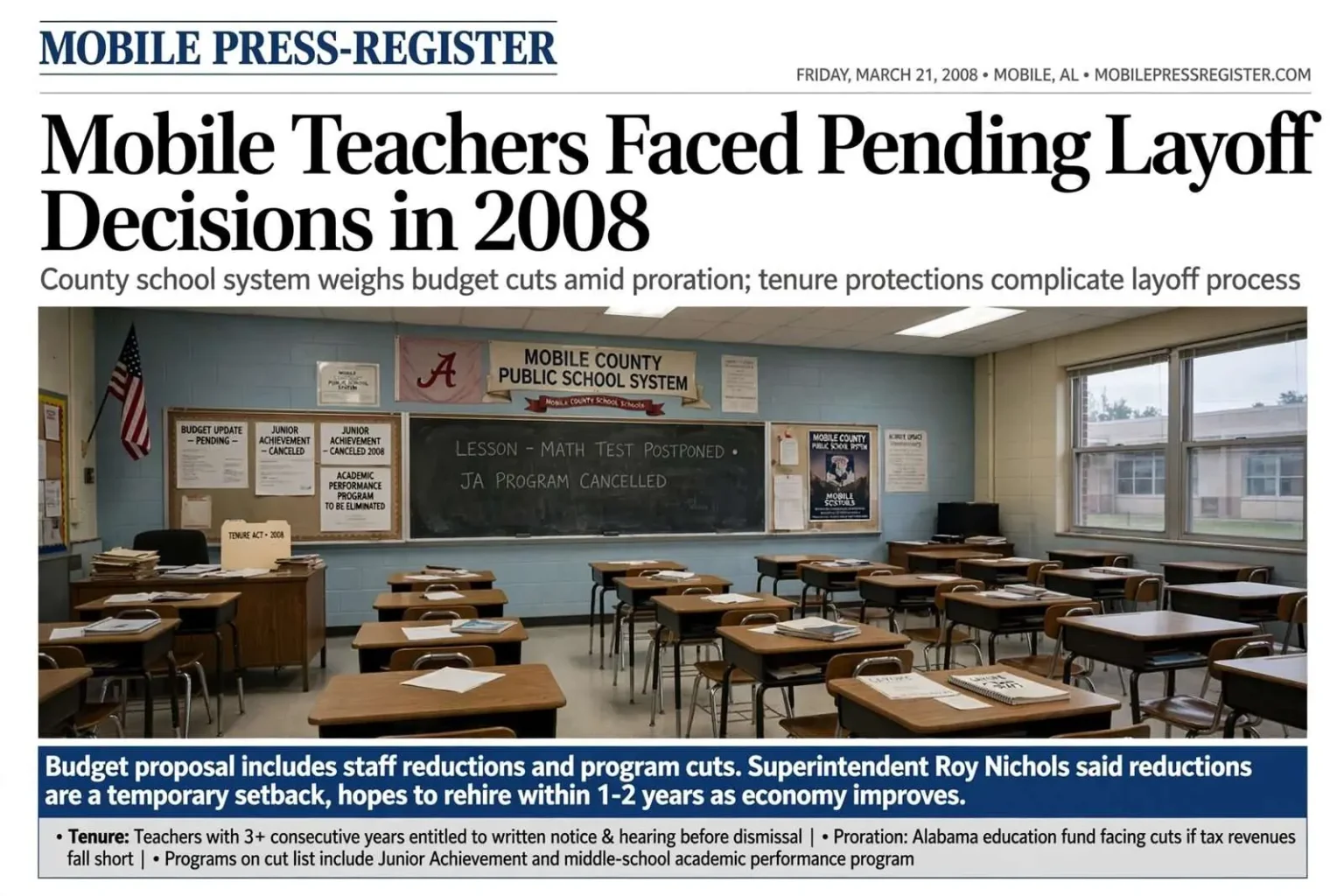
Public school classroom in Mobile CountyMobile County schools faced budget-related staffing decisions in 2008.

Historical report preserved from an archived 2008 local news story.

Mobile County teachers could learn their employment fate by Friday as the school system worked through a budget-cut proposal in 2008, according to an archived local news report. The proposal put educators across Alabama’s largest school district on edge, with personnel decisions looming for teachers whose positions were slated for elimination and a narrow window for resolving who stayed and who went.

The report said decision-makers were facing a complicated legal landscape because some employees had tenure protections while others did not. In Alabama’s public schools, tenure status determines much of how a reduction process works: teachers who have earned continuing-service status hold procedural rights that non-tenured employees do not, and a district trimming its workforce must sort through which positions and which employees fall under which rules. That sorting process is part of what made the timeline so tight, with decisions expected by the end of the week.

A speaker in the report said officials would continue the process if questions were not answered adequately, but had to do what was right.

The Budget Pressure of 2008

The Mobile County Public School System entered 2008 as Alabama’s largest school district, serving tens of thousands of students across more than a hundred schools spread from the city of Mobile to the county’s suburban and rural communities. Like districts across the state, it drew heavily on state education funding, and when state revenue collections weakened — as they did through 2008 as the national recession took hold — school systems faced the prospect of proration and forced spending cuts. Personnel, the largest share of any school budget, becomes the unavoidable target in such circumstances.

The proposal under consideration in the report reflected that pressure. Beyond staffing reductions, it included eliminating several programs, among them Junior Achievement and a middle-school academic-performance program. Program eliminations of that kind illustrate how budget crises reach past payroll into the enrichment and support services that operate alongside core instruction — partnerships and initiatives that serve students but sit outside the state-mandated curriculum.

Junior Achievement, a national nonprofit organization, delivers work-readiness, entrepreneurship and financial literacy programming to students through partnerships with schools and business volunteers. Its elimination represented the loss of a longstanding bridge between Mobile’s classrooms and its business community. The middle-school academic-performance program targeted a level educators often describe as decisive in a student’s trajectory, making its proposed elimination particularly consequential.

Superintendent Roy Nichols and the Path Back

Superintendent Roy Nichols said he viewed the reductions as a temporary setback and expected that the system could begin rehiring when the economy improved, possibly within one or two years. Nichols, who led the Mobile County system for more than a decade, framed the cuts as a district protecting its core while awaiting better revenue conditions — a stance common among Alabama superintendents during the downturn.

See also  Bail Denied for Mobile County Man Awarded New Trial in 2000 Killing

The rehiring timeline Nichols described carried real complications. An economy that recovers within one or two years would allow the district to restore positions before too many displaced teachers leave the profession or relocate; a longer downturn would mean the system loses experienced educators to other districts and other careers. For the teachers facing Friday’s decisions, the promise of future rehiring offered little certainty about their own circumstances, since restored positions do not necessarily return to the same schools, departments or employees.

The tenure distinction highlighted in the report shaped those outcomes. Non-tenured teachers — typically those with fewer years in the system — faced the most direct risk, while tenured teachers were entitled to due-process protections that constrain how and whether their employment can be terminated. A reduction plan in a district the size of Mobile County therefore moves on two tracks at once, and the final makeup of the workforce reduction depends heavily on the tenure profile of the positions being cut.

How Alabama Districts Handle Reductions

Alabama’s employment framework for public school teachers gives the tenure question real teeth. Teachers earn continuing-service status after a probationary period, and from that point the state’s fair-dismissal laws and state board rules require notice, stated causes and appeal rights before employment can be ended. A district cutting positions must typically begin with non-tenured staff and, where tenured positions are affected, follow procedures that can stretch the process across weeks or months.

That structure explains the “by Friday” urgency in the report. Districts confronting mid-year budget gaps must issue notices within prescribed windows, and failing to do so can carry legal and financial consequences. For the affected teachers, the pace meant days rather than months to learn where they stood — and for principals and central-office administrators, it meant difficult conversations compressed into a single work week.

The stakes extended beyond individual jobs. Workforce reductions of the kind proposed in 2008 ripple through a district: class sizes rise where positions go unfilled, programs disappear, and remaining teachers absorb extra duties. In a system the size of Mobile County’s — with schools spanning urban Mobile, the western communities, and the fast-growing suburbs to the west and south — the effects land unevenly, and school communities feel them for years.

Junior Achievement and the Programs on the Chopping Block

The proposed eliminations named in the report give a picture of what a district trims when money gets short. Junior Achievement is not a school-system employee program; it is a partnership, with business volunteers bringing lessons on financial literacy, work readiness and entrepreneurship into classrooms. Cutting it saves the district’s contribution but ends a service that schools alone do not replicate — and it severs, at least temporarily, one of the connections between Mobile’s business community and its students.

See also  Dredge, Pipeline and Support Vessels: Boaters Told to Slow Down Near Fowl River Through November

The middle-school academic-performance program raises different concerns. Middle school is widely recognized as the stretch where students either solidify the habits that carry them through high school or begin to fall behind, and targeted programs at that level are aimed precisely at the students at risk of drifting. Eliminating such a program to save money trades a modest near-term budget line for potential long-term costs in achievement — the kind of calculation districts make reluctantly and only when the alternatives are deeper personnel cuts.

That, in the end, is the context for the 2008 proposal: every elimination on the list was chosen because the alternative was worse. When state revenue stalls, a district’s legally required obligations — salaries, benefits, debt service, mandated instruction — consume most of the budget, and discretionary programs and positions are what remain to cut. The report captured a district working through that arithmetic in public.

What the Report Does and Does Not Say

This article records the status and expectations reported at the time; it does not state the final employment decisions or current school-system policy. The archived account preserved the essentials — the Friday deadline, the tenure split, the speaker’s insistence on doing right, Superintendent Nichols’s rehiring outlook, and the named program eliminations — but the outcome of the process, the number of positions actually cut and the eventual rehiring record lie outside the preserved text.

What the report does capture is a moment familiar to school districts everywhere: the point at which a budget crisis stops being a projection and becomes a list of names and programs. Mobile County’s educators in 2008 spent a week waiting on that list, and the district’s leadership spent the same week balancing legal obligations, financial reality and the promise — voiced by Nichols — that the setback was temporary and that the system would hire again when the economy turned.

The District Behind the Cuts

Understanding the scale of the 2008 decision requires a sense of what the Mobile County Public School System is. It operates as Alabama’s largest district, with an enrollment spread across a geographic area that includes the city of Mobile, the suburbs of West Mobile, the communities down to the Bayou La Batre coastline and the rural stretches of the county’s northern end. A district of that size employs thousands of teachers, operates hundreds of buses and runs the full range of elementary, middle and high schools — which means even a percentage-level budget reduction translates into hundreds of positions and programs.

Its scale also shapes how budget decisions get made. Decisions that a small district’s superintendent can make quickly require coordination across the system in Mobile County: central-office review of every position, legal evaluation of tenure status school by school, and communication with a school board that represents a county-wide constituency. The Friday deadline described in the report compressed all of that into a matter of days.

See also  Mobile Police Investigate Reported Attempted Assault Near Moffett Road

The Broader Recession Context

The 2008 school-budget crisis did not happen in isolation. The national financial collapse of that autumn hit Alabama’s education trust fund — which draws on state sales and income taxes — as consumers pulled back, and districts across the state spent the following years absorbing proration, the state’s mechanism for cutting education budgets mid-year when revenue falls short of forecasts. Mobile County’s 2008 proposal was part of that first wave, arriving before the worst of the multiyear squeeze that followed.

For local educators, the sequence compounded anxieties that had been building through the year. Teacher hiring slowed statewide, districts canceled programs and deferred maintenance, and classroom teachers watched budget news the way families watch news of layoffs at a major employer — with the knowledge that the effects would reach into every school building in the county.

Nichols’s framing of the cuts as temporary reflected the district’s hope as much as its forecast. Education funding in Alabama is cyclical, tied to the state economy, and districts that survive downturns by cutting staff face a rehiring challenge when conditions improve: the newest teachers have often moved away, and experienced ones have found stable posts elsewhere. Whether the system could, as Nichols suggested, begin rehiring within one or two years depended on an economic recovery no one could guarantee in 2008.

Why the Archive Preserves This Moment

Archived reports like this one serve as the public record of how a community’s institutions behaved under pressure. The 2008 episode in Mobile County — the Friday deadline, the tenure calculations, the elimination of Junior Achievement and a middle-school academic program, and a superintendent’s promise of better days — is a small piece of the larger history of public education’s response to the Great Recession, preserved here as it was reported at the time.

The article records the status and expectations reported at the time; it does not state the final employment decisions or current school-system policy. Readers seeking the ultimate outcome of the 2008 proposal — how many positions were cut, which programs were restored, and when rehiring resumed — would need records beyond this archived summary. What the report preserves is the texture of the moment: a large school district, a shrinking budget, a one-week deadline and educators waiting on decisions that would shape their careers and their classrooms.