A Strip-Mall Kitchen on University Boulevard Lays Claim to Mobile’s Best Gumbo
After years of searching, a Mobile dining critic said in April 2008 that he had finally found a gumbo worth the hunt, at an unassuming po-boy shop at University Boulevard and Cottage Hill Road.
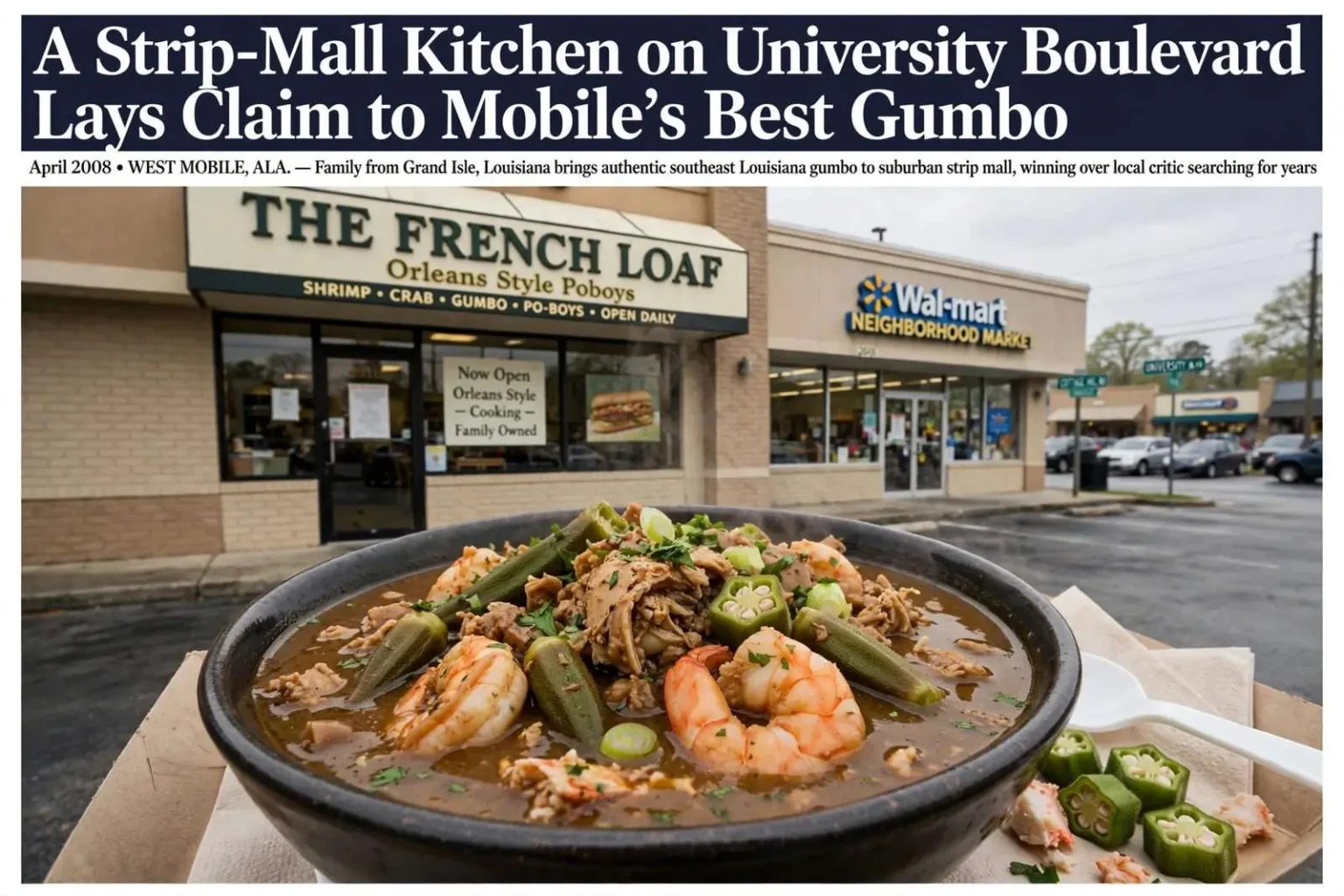
It is an article of faith along the Gulf Coast that the best food is rarely found where the signage is grandest. In April 2008, a Mobile dining critic offered a fresh piece of evidence: the gumbo he had been hunting for years, he wrote, was being ladled out of a strip mall at the intersection of University Boulevard and Cottage Hill Road in west Mobile, two doors up from a Wal-Mart Neighborhood Market.
The restaurant was The French Loaf, then open about a year, advertising “Orleans Style Poboys” and run by principals from Grand Isle, Louisiana. The critic, who wrote under a pen name and dined at his own expense, considered that provenance a promising sign before he ever lifted a spoon. Anyone from the lower Jefferson, Lafourche and St. Charles parish country, he reasoned, is expected to produce good food — the bayou country south and west of New Orleans where gumbo is not a menu item but a birthright.
Grand Isle itself is a barrier island at the end of Louisiana 1, a shrimping community whose families have worked the Gulf for generations. Cooks who grew up there measure their roux by color and their crabmeat by the hour it came off the boat. When such cooks open a kitchen in a Mobile strip mall, the smart money takes notice.
The gumbo that ended the search
The critic ordered a bowl of the shrimp, crabmeat and okra gumbo, and it exceeded every expectation he had brought through the door. For several years, he wrote, he had searched the Mobile area for a genuinely good gumbo. He found it here.
His description was precise. This was not Old Mobile style gumbo, he said; it was better than that. The distinction matters to anyone who has eaten seriously along the northern Gulf Coast. Mobile’s own gumbo tradition, descended from the city’s colonial creole kitchen, runs thinner and soupier, often built with tomatoes and a lighter hand with roux. The southeast Louisiana version is a darker, denser, more concentrated thing — a roux cooked to the color of chocolate, stock deepened with shells, okra added not as an afterthought but as a structural ingredient.
The taste surpassed anything he had eaten on the Causeway or on Dauphin Street — the two corridors where Mobile’s seafood houses and tourist-friendly kitchens compete for the gumbo trade. The consistency was right. The seasoning was on target. You could actually see the shrimp, whole and identifiable, rather than the shreds and bits that cheaper kitchens stir into a heavily thickened base.
And there was a welcome presence of garlic, which he singled out as the note that lifted the bowl above its competitors. Garlic is a quiet signal in Gulf cooking: cooks confident in their stock and roux can afford it, and cooks hiding shortcuts cannot.
The highest compliment he could pay was personal. The flavor and texture came closest, he said, to the gumbo his late Aunt Tecy made from scratch years ago. He promised to return for more — the only verdict that matters in the restaurant business, where one good meal is an accident and the return visit is the test.
An oyster po-boy, and a lecture on bread
The gumbo was not alone on the critic’s table. The oyster po-boy was good as well. The oysters were not over-fried and were seasoned appropriately — no small thing, since the over-fried oyster is the commonest failure of Gulf Coast sandwich shops, producing a gray, tough pellet where a fried oyster should shatter crisply and yield.
The only failing, in his judgment, was the bread. The French Loaf served its sandwiches on Gambino’s bread, trucked in from Baton Rouge. The critic was careful to be fair: Gambino’s, he said, is far superior to the ordinary loaves most sandwich shops settle for. But for a restaurant advertising Orleans-style po-boys, the bar he set was the real New Orleans French bread — the crackling-crusted, cloud-interior loaf that shatters when you bite it and shreds the filling onto the paper.
Bread is the quiet obsession of po-boy culture. In New Orleans, bakeries have supplied the sandwich trade for generations, and a po-boy made on bread that has gone soft in transit is a different food entirely. The best Louisiana loaves begin losing their crackle within hours of baking, which is why the distributors who run them fresh across Lake Pontchartrain and across the state line into Alabama perform a service most diners never think about. Mobile’s po-boy shops live at the far edge of that delivery map, and the critic’s lecture on bread was really a note on logistics: the closer a Gulf Coast kitchen sits to a working bakery, the better its sandwiches.
Why a strip mall was the right place to look
The setting of the discovery — a strip mall on University Boulevard, two doors from a Wal-Mart Neighborhood Market — was not incidental to the story. The critic’s governing principle, that the best food rarely sits behind grand signage, has long governed eating along the Gulf Coast. The region’s most celebrated dishes were developed in shrimp docks, gas station kitchens, church fair booths and family houses, not in dining rooms with linen and a wine list.
West Mobile, where University Boulevard meets Cottage Hill Road, is a landscape of commercial strips serving the city’s fastest-growing suburban corridors. Real estate is cheaper there than downtown, rents fit a small family operation, and the traffic — commuters, students from the nearby university area, families running errands — rewards a kitchen that turns out good food fast rather than one that turns a profit on ambiance.
For immigrant and migrant cooks, the strip mall is the traditional point of entry into a new market. A Louisiana family transplanting itself to Mobile faces the same arithmetic as any newcomer: find a cheap box, put a short menu of the dishes you know by heart on the line, and let word of mouth do the advertising. The French Loaf’s one-year-old operation was exactly that model in motion.
The pen name and the personal check also say something about how food criticism worked in Mobile at the time. A critic who pays his own way and writes under a pseudonym cannot be comped into kindness, and readers came to trust the columns precisely because the praise had to be earned bowl by bowl. When such a critic declares a strip-mall gumbo better than anything on the Causeway, the declaration carries weight.
Gumbo’s two coastlines
The critic’s comparison between Old Mobile style gumbo and the southeast Louisiana bowl he found at The French Loaf rests on a real historical divide. Mobile’s creole cooking is older than New Orleans — the French landed here in 1702 — and its gumbo reflects an older creole pantry: thinner, tomato-touched, closer to a soup, served over rice in the style of the city’s oldest family kitchens. Southeast Louisiana’s version, carried west and south by Acadian and Caribbean influences, cooks its roux darker, leans on okra or filé as a thickener, and builds a bowl dense enough that a spoon nearly stands in it.
Neither style is wrong; they are different answers to the same question, shaped by different settlements. But a critic hunting for gumbo along the Gulf Coast learns quickly that the two do not compete on equal terms in the public imagination. The southeast Louisiana bowl is the one tourists carry home and try to reproduce, which is why a Mobile kitchen staffed by Grand Isle cooks starts with a built-in advantage — and a built-in measuring stick.
Okra in the pot is its own regional signature. Cooked properly from raw sliced pods in the stock, okra thickens and flavors simultaneously, and the stringy, slimy disaster that deters some diners never appears when the technique is right. The presence of okra alongside both shrimp and crabmeat in the French Loaf’s bowl marked it as a three-ingredient gumbo — the kind that requires good stock and careful roux, because there is nowhere to hide a shortcut behind a heavy filé dusting.
What the search means for Mobile eaters
The critic’s multi-year hunt for a good bowl is a familiar story in Mobile, a city proud of its food heritage but often navigating between two traditions: the old creole kitchens downtown and the seafood houses spread from the Causeway across the Eastern Shore. Between them lies the fast-growing suburban strip, where transplanted families from south Louisiana have been quietly raising the floor on what Mobile expects from its casual kitchens.
The lesson the column left with readers was practical. Look for provenance — a cook from the parishes is worth a detour. Look for a short menu mastered rather than a long one managed. Look for whole shrimp, honest seasoning and the garlic that tells you the stock behind it is real. And take the bread seriously, because a po-boy is only as good as the loaf that carries it.
Above all, the story affirmed the strip mall. Mobile diners trained to judge a restaurant by its address will drive past the best gumbo in the city on their way to a parking deck downtown. The April 2008 verdict on University Boulevard and Cottage Hill Road argued, with a spoon, that the search should end in the most ordinary place of all — two doors up from a Wal-Mart, where a family from Grand Isle was cooking the way it always had.