Federal Judge Dismisses Honduras Fraud Suit Over Collapse of Mobile Company a Second Time
A federal whistleblower lawsuit claiming Honduras defrauded the U.S. and destroyed a Mobile company that employed 300 people has been dismissed again, ending a six-year legal battle that briefly reached the U.S. Supreme Court.
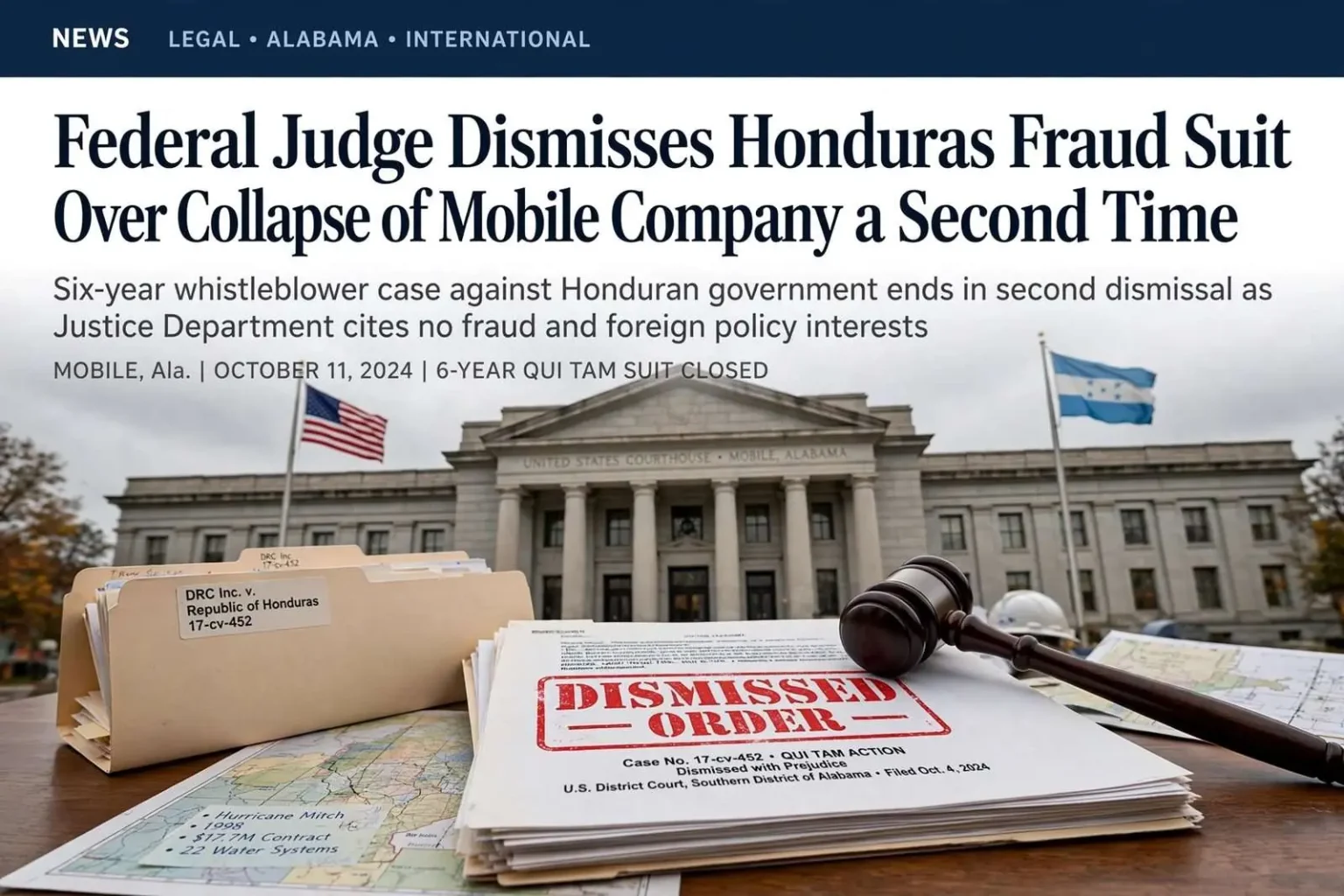
A long-running federal lawsuit that blamed the collapse of a Mobile-based company on fraud by the Honduran government has ended in dismissal for a second time, closing out a legal fight that stretched across more than six years and briefly drew the attention of the U.S. Supreme Court. The final ruling closed the book on an unusual effort to hold a foreign nation accountable, in American court, for the destruction of an Alabama business.
How the Case Began
The case traces back to 2017, when three individuals filed a whistleblower lawsuit accusing Honduras of defrauding the United States in a way that ultimately destroyed DRC Inc., a Mobile company. The lawsuit was brought under a federal law that allows private citizens, known as relators, to sue on behalf of the government and share in any damages recovered if the case succeeds.
At the center of the dispute was a $17.7 million contract DRC received in 2000 through a U.S. aid program established to help Honduras recover after Hurricane Mitch struck in 1998, one of the deadliest storms in Central American history. Under that contract, DRC built 22 water and sewer systems serving roughly 300,000 people affected by the hurricane.
The contract made DRC a small but meaningful part of one of the largest post-disaster reconstruction efforts of its era. Mitch had devastated Honduras — washing out roads, bridges and entire villages — and American aid programs channeled recovery money through American contractors, of which DRC was one. For a Mobile company, the work meant hiring engineers and crews, procuring materials, and deploying them to Central America to build infrastructure that had to function for decades.
According to the lawsuit, Honduras failed to honor its side of the agreement, a breach the relators claimed forced DRC to be sold off in pieces for a fraction of its value and cost roughly 300 Mobile employees their jobs. The suit sought to hold the Honduran government accountable and recover damages tied to that collapse.
The Government’s Position
The U.S. Department of Justice, however, maintained throughout the litigation that no fraud had occurred. U.S. District Judge Kristi DuBose, who oversees federal cases in Mobile, dismissed the lawsuit in 2020, siding with the government’s position. “The United States is adamant that it has not been defrauded,” DuBose wrote at the time, adding that the government’s disbelief in the merits of the case made its decision to seek dismissal a rational one.
That stance was the case’s central obstacle. In a qui tam suit, the private relators prosecute the case, but the government holds the keys: it may intervene and take over, or it may decline and let the relators proceed — and its view of the merits weighs heavily with the court. Here, the government did not merely decline to join the suit against a foreign sovereign. It affirmatively denied that any fraud on the United States had occurred, and asked the court to throw the case out.
The relators appealed, and in 2021 the Atlanta-based 11th U.S. Circuit Court of Appeals upheld DuBose’s ruling. That appeared to be the end of the case — until the U.S. Supreme Court, ruling in an unrelated matter, held that the federal government must formally intervene in a whistleblower lawsuit before it can ask a judge to dismiss it — a procedural requirement the government had not completed in the DRC case.
That ruling gave the litigation new life. The 11th Circuit sent the case back to Mobile, the federal government formally sought and received permission to intervene, and the case returned to DuBose’s courtroom to be reconsidered under the corrected procedure.
Dismissed Again
After completing that formality, DuBose again granted the government’s request to dismiss the case last week, writing that the complaint “still lacks merit in the face of the United States’ position that it has not been defrauded.” She noted a second reason for dismissal beyond the case’s merits: the government’s interest in maintaining good relations with Honduras.
The second rationale carried real weight in this kind of litigation. Suing a foreign government in an American court implicates foreign policy as much as law, and courts give the executive branch substantial deference when it says a suit would complicate its diplomatic relationships. A private relator’s theory of fraud, however sincerely held, could not outweigh the State Department’s institutional judgment about how the United States manages its affairs with a Central American neighbor.
The dismissal brings a formal close to a case that highlighted the complexities of pursuing fraud claims against a foreign government through U.S. courts, even when the outcome directly affected an Alabama employer and hundreds of local jobs. The relators spent more than six years and an appeal to Atlanta, reached the edge of Supreme Court procedure, and still could not get past the fact that the government whose money was allegedly taken wanted no part of the claim.
It also illustrates how a single Supreme Court ruling in an unrelated case can reshape the procedural path of litigation working its way through federal courts years after it was first filed. The DRC relators did not win on the merits — far from it — but they briefly benefited from a national decision that corrected a step the Justice Department had skipped, earning the case two more years of life before the same judge reached the same conclusion.
The Whistleblower Framework
Whistleblower suits like this one, formally known as qui tam actions, are a tool Congress created to encourage private citizens with inside knowledge of fraud against the government to come forward, with the incentive of sharing in any recovery. The structure dates to the Civil War era, when Congress responded to contractors selling the Union Army shoddy goods by allowing private informers to sue in the government’s name — and it remains the primary legal engine for prosecuting fraud on federal spending.
They are rarely simple, often taking years to resolve as courts weigh the government’s own assessment of whether fraud occurred against the claims of the individuals who brought the case. Most never reach the merits at all: the government declines to intervene in the overwhelming majority of qui tam cases, and many of those are dismissed without the kind of hearing relators hope for. Suing a foreign sovereign — with the diplomatic complications that follow — made the DRC case harder still.
For Mobile, the ending is a modest postscript to a larger loss. Three hundred jobs and a company built to deliver clean water to hurricane survivors left the city’s economy years ago, and no verdict would have brought them back. The lawsuit promised accountability and, its filers hoped, a share of damages. What it ultimately produced was a demonstration of the limits: the United States said it was not defrauded, a federal judge agreed twice, and the case closed where six years of litigation had found it — in Mobile, with the government on the other side.
Hurricane Mitch and the Aid Program Behind the Contract
The context of the DRC contract explains why it existed at all. Hurricane Mitch struck Central America in late 1998 and stalled over the region for days, dropping rains that killed thousands, erased whole hillside villages, and set Honduras — one of the poorest countries in the hemisphere — back by years. The international response was one of the largest reconstruction undertakings of the decade, with the United States directing hundreds of millions of dollars in relief and rebuilding aid.
Water and sewer systems were among the most urgent needs. Floodwaters had contaminated wells and destroyed distribution lines across entire municipalities, and rebuilding them was a precondition for resettling displaced families and preventing disease. DRC’s contract to build 22 such systems serving roughly 300,000 people placed the Mobile company at the center of that public-health work — a Mobile-area payroll and a Central American construction mission in the same enterprise.
That profile made the company’s later collapse, in the relators’ telling, a story of an American contractor crushed between a foreign government’s broken promises and the aid program’s bureaucratic machinery. The government’s answer, sustained through two dismissals, was that no fraud on the United States ever happened — and that whatever went wrong for DRC, it was not the product of a scheme to cheat American taxpayers.
What Six Years of Litigation Produced
The procedural history is worth retracing, because it shows how many separate doors had to open for the case to survive as long as it did. First, the 2020 dismissal on the government’s motion. Then the 2021 affirmance from the 11th Circuit, which seemed final. Then the Supreme Court’s unrelated ruling on the intervention requirement, which changed the rules for every qui tam case in the country where the government had sought dismissal without formally intervening. Then the remand to Mobile, the government’s corrected intervention, and the second dismissal.
Each step was decided largely on procedure, not facts. No court ever held a trial on whether Honduras breached the agreement, whether the breach destroyed DRC, or what the company’s losses were. The case lived and died on a single institutional fact: the United States, the real party in interest in any fraud-on-the-government claim, insisted it had not been defrauded and wanted the case gone.
That is not an unusual outcome in qui tam litigation — it is the ordinary one. What made the DRC case unusual was the defendant. Most qui tam suits target government contractors who allegedly overbilled the taxpayer; here, the relators tried to invert that structure and sue a foreign government for conduct that allegedly destroyed a private company. The theory asked American courts to convert an Alabama business failure into a fraud on the U.S. Treasury, and neither the Justice Department nor the district court found the connection persuasive.
With the second dismissal, the framework finally closed around the case. The six-year fight is over, the Supreme Court’s procedural detour has run its course, and the last chapter of DRC Inc.’s story is a court order in Mobile explaining why, in the eyes of the United States, there was nothing left to try.