
Alabama Health Officials Urge Caution on Reports Linking Prenatal Fentanyl to New Birth Defect Syndrome
Alabama health officials say more research is needed on a possible new syndrome seen in babies exposed to fentanyl in the womb.
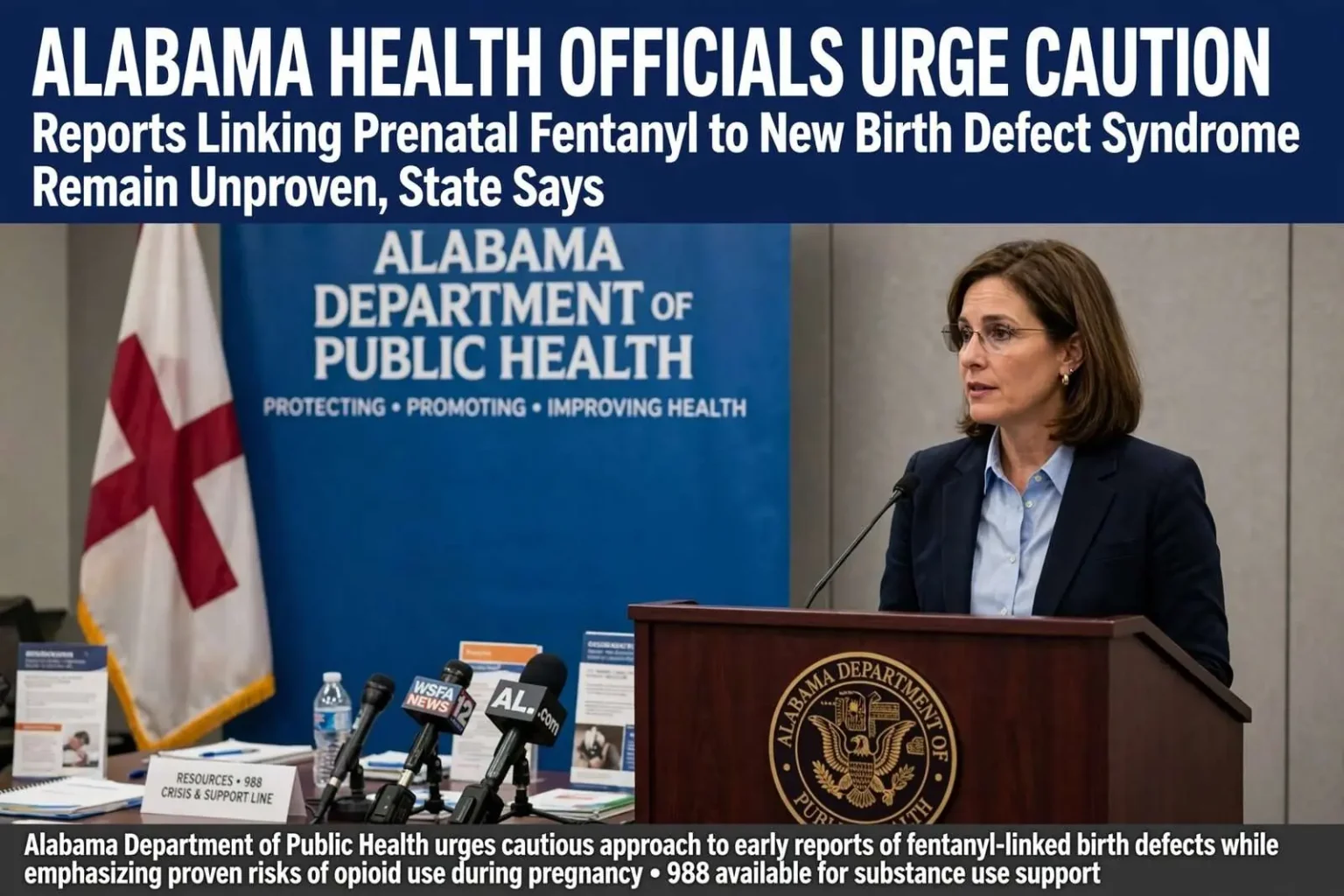
Alabama’s top health agency is urging caution about early reports that fentanyl exposure in the womb may be behind a cluster of unusual birth defects, even as the crisis of opioid use during pregnancy continues to grow across the state and nation. The advisory comes from the Alabama Department of Public Health, which wants families and providers to understand both the seriousness of prenatal opioid exposure and the limits of what the early research actually shows.
Researchers elsewhere in the country have identified ten babies whose mothers said they used fentanyl while pregnant and who were born with striking abnormalities — cleft palate, webbed toes, drooping eyelids, and unusually small heads. The cluster, described in medical literature by physicians treating the infants, has drawn national attention because the combination of physical features had not previously been tied to a single drug exposure. Some officials elsewhere have suggested the pattern could point to an entirely new syndrome tied to the drug.
The reports have sparked intense interest among pediatricians and birth defects researchers precisely because fentanyl has become so pervasive in the illicit drug supply. The synthetic opioid, many times more powerful than heroin, now contaminates most street drugs in much of the country, meaning many women who use drugs during pregnancy are exposed to fentanyl without ever seeking it out directly.
Too Early to Draw a Line
In Alabama, state health officials say it is simply too soon to make that connection. Dr. Wes Stubblefield of the Alabama Department of Public Health noted that opioid exposure during pregnancy is already known to carry serious risks, including poor fetal growth, stillbirth, and neonatal abstinence syndrome, in which newborns go through withdrawal after birth. Those harms are well documented across thousands of births and are the basis for long-standing medical guidance that no amount of opioid use in pregnancy is considered safe.
The question with these ten cases, he explained, is whether fentanyl — now such a widespread contaminant in illicit opioids — could be linked to fetal anomalies not previously seen. That is a much higher scientific bar. With so few cases identified, he said researchers must rule out random chance before drawing any conclusion, adding that further study is needed and that a significant future problem is possible.
That caution reflects how birth defects research works. Rare physical features can cluster together by coincidence, by shared genetic causes, or by other exposures the mothers had in common. To establish a true syndrome, researchers must identify a consistent pattern across many more cases, document the timing and dose of exposure, and systematically rule out alternative explanations — work that takes years and requires physicians across the country to report similar infants to a central registry.
Stubblefield stressed that pregnant women struggling with opioid abuse should seek treatment for their own health and their baby’s. Medication-assisted treatment, prenatal care and counseling are available through providers across Alabama, and health officials emphasize that stopping suddenly without medical supervision can itself endanger a pregnancy. The message to mothers, he said, is not to panic about the headlines but to get connected to care.
Local Guidance for Expecting Mothers
Mobile County Health Officer Dr. Kevin Michaels echoed that advice, saying the best course for mothers-to-be is to avoid fentanyl, opioids, alcohol, and tobacco entirely during pregnancy. He encouraged anyone who needs help to talk with their healthcare provider or connect with peer counselors in the community by calling 988.
The 988 line, best known as the national Suicide & Crisis Lifeline, also serves as a gateway to substance use support, connecting callers with trained counselors who can point pregnant women and their families toward treatment programs, peer recovery groups and community resources without judgment. For many women, that first call is the hardest step, and health officials want residents to know it can be made confidentially at any hour.
The Broader Opioid Picture in Alabama
Alabama, like the rest of the country, has seen fentanyl transform its drug landscape. The synthetic opioid has become the dominant driver of overdose deaths nationwide, and Alabama public health agencies have responded with expanded naloxone distribution, fentanyl test strip programs and increased treatment capacity. For pregnant women, the stakes are compounded: untreated opioid use disorder during pregnancy carries risks for both mother and child, while evidence-based treatment has been shown to improve outcomes substantially.
Neonatal abstinence syndrome, the withdrawal condition Stubblefield referenced, has been diagnosed in a growing share of Alabama births in recent years. Babies with the condition may experience tremors, feeding difficulties, irritability and prolonged hospital stays after birth. Hospitals across the state have developed protocols for caring for affected newborns, many of which favor keeping mother and baby together and supporting breastfeeding when the mother is in stable treatment.
Health officials also urge pregnant women to be candid with their prenatal providers about any substance use. Doctors stress that disclosure is not an invitation for punishment but the starting point for a care plan that protects both mother and baby — a principle that has become central to modern obstetric practice as the opioid crisis has touched communities in every Alabama county.
For now, Alabama’s health department is watching the national research on the reported fentanyl cluster as it develops. Should researchers confirm a distinct syndrome, pediatricians and birth defects registries would need to add the findings to their screening and reporting practices. Until then, the state’s guidance remains what it has always been: avoid opioids and other harmful substances during pregnancy, seek treatment early if use is a struggle, and lean on the support lines and providers positioned to help.
How Researchers Confirm a New Syndrome
The process of establishing a new medical syndrome is deliberately slow, and for good reason. A single physician’s series of similar cases — however striking — is only the first step. Researchers must next cast a wide net, asking neonatologists, geneticists and birth defects registries across the country whether they have seen infants with the same combination of features and the same reported exposure. Only when the pattern repeats across a much larger group can investigators begin to separate a genuine drug effect from coincidence.
Even then, more work follows. Epidemiologists compare the affected children with infants who had similar exposures but no anomalies, looking for what else might differ — nutrition, other substances, genetics, prenatal care, environment. Toxicologists study how fentanyl and its byproducts cross the placenta and at what stages of development. Geneticists rule out inherited conditions that could explain webbed toes or small head size. The ten reported cases will eventually be tested against all of these alternatives, and the conclusions may well change as the evidence grows.
That same rigor has played out before with other suspected teratogens — agents that cause birth defects. Historical examples, from thalidomide to alcohol, show both sides of the process: real hazards that took years to confirm, and early scares that later research could not sustain. Alabama officials say their cautious stance reflects that history rather than any dismissal of the reports.
What Parents and Providers Should Know
For families, the practical takeaways are unchanged. Women who are pregnant or planning pregnancy should review every medication and substance they use with a healthcare provider, including prescription opioids, herbal products and over-the-counter drugs. Women with an opioid use disorder should not attempt to quit on their own mid-pregnancy; supervised treatment is safer for mother and baby and is available throughout Alabama.
Providers, meanwhile, are encouraged to ask every pregnant patient about substance use in a routine, nonjudgmental way — a practice shown to improve disclosure and connect more women to care. Pediatricians who encounter infants with unusual patterns of anomalies are asked to document exposures carefully and report cases to state birth defects surveillance, which is how rare patterns like the current one come to light at all.
Community resources remain the front line. Along with the 988 crisis line, county health departments, federally qualified health centers and recovery programs across southwest Alabama offer prenatal support, counseling and treatment referrals. Health officials say the goal is to make sure every expecting mother struggling with opioids knows that help exists, that it works, and that seeking it is the best thing she can do for her child — whatever the research ultimately concludes about fentanyl’s rarer effects.
The Road Ahead for the Research
The ten reported cases are expected to anchor further study in the months ahead, with clinicians encouraging any provider who has cared for a similar infant to come forward. Each additional confirmed case strengthens the statistical picture, and each documented exposure history helps narrow the variables researchers must consider. Federal birth defects surveillance programs and pediatric specialty networks have channels for exactly this kind of crowdsourced case-finding, and they have been used successfully in past investigations of rare conditions.
In the meantime, Alabama’s health department plans to keep its advisory in place, pairing caution about the unproven syndrome with urgency about the proven harms of opioid use in pregnancy. Officials describe the two messages as complementary: families should not be alarmed by speculation, but neither should the novelty of the headlines distract from the well-established risks already documented in thousands of births.
For Mobile County and the rest of the Gulf Coast, where opioid overdose rates have climbed alongside the rest of the nation, the episode is a reminder of how quickly the drug landscape changes — and how public health must respond both to what is proven and to what is still being studied. The department’s guidance to expecting mothers remains simple and consistent: avoid fentanyl, opioids, alcohol and tobacco, and call 988 or a trusted provider the moment help is needed.


