Orange Beach Police Warn Residents About Alleged Towing Scam
The Orange Beach Police Department is warning motorists about an unlicensed wrecker company, Earl's Towing Service, that has allegedly been overcharging customers in the community.
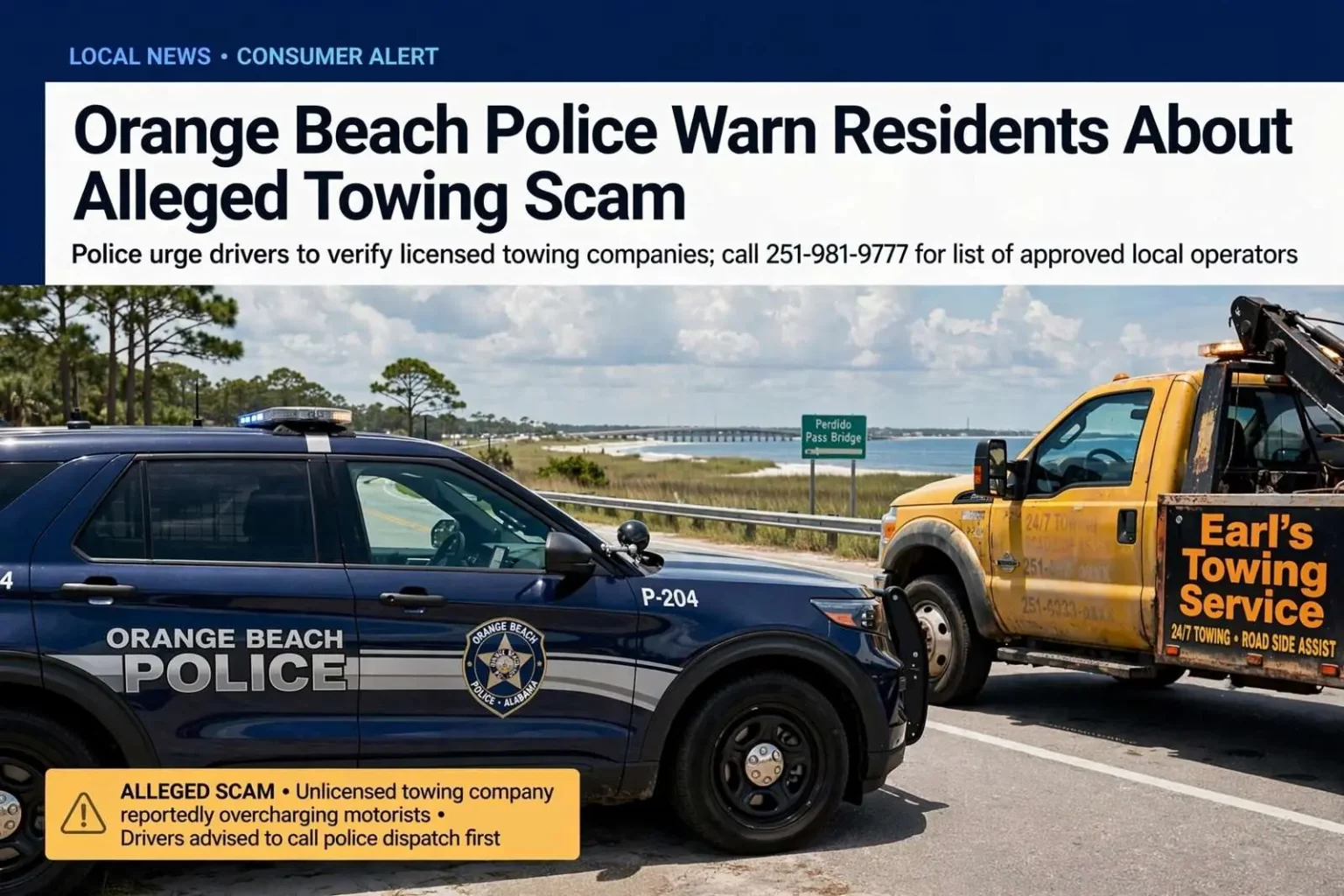
The Orange Beach Police Department is urging motorists to be cautious after receiving reports of an alleged scam involving a local wrecker service. The department took to social media to issue the warning, cautioning residents and visitors against using a company called Earl’s Towing Service. According to a statement the department posted on Facebook, the company claims to operate a business in Orange Beach but does not actually hold a business license within the city. Police said they have received reports that the company has been operating in the community while overcharging customers for towing services.
The warning is particularly significant in a beach community like Orange Beach, where the seasonal influx of visitors means unfamiliar drivers on unfamiliar roads, towing needs that spike with traffic volumes, and customers who may have no local knowledge of which towing companies are reputable. A driver whose vehicle breaks down along Perdido Pass or the Foley Beach Express corridor has little ability to comparison-shop, which is precisely the situation unlicensed operators exploit.
Wrecker and towing scams can be especially costly for drivers who are already dealing with the stress of a breakdown or an accident, since they often have little time or leverage to shop around for a fair price once a vehicle is already hooked up. Once a tow truck has a car on its bed or on its hook, the balance of power shifts almost entirely to the operator. The vehicle must go somewhere; the driver is frequently standing on a roadside in summer heat or on the shoulder of a busy highway; and refusing service at that point can mean additional fees, a standoff with the operator or a long wait for another company.
Because towing operators frequently arrive quickly to roadside emergencies, unlicensed or unscrupulous companies can take advantage of drivers who are not in a position to negotiate. The speed that makes a towing service genuinely valuable is also what makes the arrangement ripe for abuse: a driver in distress waves down the first truck that appears, authorizes a tow with little more than a nod, and learns the price only after the service has been rendered. In tourist towns, where many drivers are miles from home and unfamiliar with normal rates, that dynamic repeats all summer long.
How to protect yourself
The Orange Beach Police Department is encouraging anyone who needs a wrecker service to instead contact police dispatch directly for a list of legitimate, locally licensed companies. Residents can reach dispatch at 251-981-9777 for recommendations. The referral list is drawn from companies that hold proper city licenses, giving callers a layer of accountability that a random roadside encounter cannot provide. Licensed operators in Orange Beach answer to the city’s regulatory framework, and problems with a licensed company can be pursued through official channels in a way that complaints against an unlicensed one cannot.
Verifying that a towing company holds a proper business license before agreeing to service is one of the simplest ways drivers can protect themselves from being overcharged. Business licensing exists precisely to establish accountability: a licensed company has a registered owner, a fixed place of business and a stake in maintaining the city’s good standing. A company that claims an Orange Beach location but holds no city license operates outside that framework — no local oversight, no straightforward complaint path and no assurance of insurance or pricing standards. Police asking the public to check that detail reflects how effective the simple question “are you licensed here?” can be in screening out bad actors.
The alleged scheme described in the department’s statement follows a pattern familiar to consumer-protection officers across tourist destinations. An operator advertises or claims a local presence, responds to service calls or picks up vehicles, and then charges rates well above market — betting that stranded customers will pay rather than fight, and that visitors will be back home in another state before any dispute can be resolved. Credit card charges, cash payments and vehicle storage fees can pile up quickly, and recovering money after the fact requires the kind of documentation and persistence that many victims never pursue.
What to do if you are towed or scammed
Consumers who believe they have been overcharged by a towing operator in Alabama have several avenues. The transaction can be disputed with the payment provider, especially where no written rate disclosure was provided. Complaints can be filed with local police when fraud is suspected, and with the Alabama Attorney General’s Consumer Interest Division, which handles deceptive trade practices across the state. Documentation helps enormously in every one of those channels: the name on the truck, the receipt or lack of one, the amount charged, photos of the scene and the names of any witnesses. Drivers who call police dispatch for a licensed referral before a tow begins rarely need any of it — which is the point of the department’s advice.
For Orange Beach residents, the episode is also a reminder of how the city’s licensing system works to their benefit. Business licenses fund municipal services, but they also serve as the public’s first filter: a company willing to skip a few hundred dollars in local licensing fees to operate in a beach town is signaling exactly how it will treat the other obligations that come with doing business there. Checking the license takes one question, and the police department’s dispatch line — 251-981-9777 — puts that check one phone call away.
Visitors can add a few habits that serve them anywhere along the Gulf Coast. Before a roadside emergency ever happens, save the local police non-emergency number in your phone. If your vehicle must be towed, ask where it will be taken and what the tow will cost before the truck lifts it. Ask for the operator’s business name and license information, and request a receipt with the company’s details. Photograph the vehicle’s condition before it leaves. None of these steps takes more than a minute, and each one closes a door that predatory operators count on being open.
The broader lesson travels well beyond one company or one city. Along the entire Gulf Coast — from Mobile Bay to the Florida line and across the panhandle — the same summer dynamics apply: heavy visitor traffic, unfamiliar drivers, limited alternatives on the roadside and a towing industry that operates largely out of public view until something goes wrong. The drivers who fare best are the ones who treat a breakdown as a two-step process — first get to safety, second make an informed call — rather than an emergency that must be resolved with whoever is standing nearest. Orange Beach police, by publishing the warning and the dispatch number together, gave every driver reading it that second step.
Police departments in coastal Alabama communities monitor the towing industry closely because it sits at the intersection of public safety and consumer protection. Wreckers clear crash scenes, remove storm debris and disabled vehicles from evacuation routes, and keep the roads functioning during the heavy traffic of summer and holidays. When an unlicensed operator works those same roads, the problems compound: questionable pricing harms consumers, but unvetted operators can also complicate crash scenes, damage vehicles during improper tows or leave them in lots where recovering them becomes its own ordeal. That dual harm is why a licensing issue rises to the level of a public social media warning rather than a quiet referral.
Social media has become a primary tool for this kind of consumer alert along the Gulf Coast. A Facebook post from a police department reaches residents and the large seasonal visitor population simultaneously, travels quickly through community groups, and allows the department to update the warning as reports come in. Tourists who might never see a bulletin board notice at City Hall are often connected to local pages before their trips, and posts like the Earl’s Towing Service warning tend to spread among vacation-rental groups where the practical advice — call dispatch for a licensed wrecker — does the most good.
The Orange Beach Police Department’s message contained two essential instructions: avoid the named company, and call dispatch at 251-981-9777 for a list of legitimate, locally licensed operators. Everything else — the explanation of how the alleged overcharging worked, the caution about being stranded without leverage, the reminder to verify licensing — serves to help drivers understand why those two instructions matter. Consumer warnings succeed when people understand the mechanism of the scam well enough to recognize it in a variant form later, and the department’s statement walked through that mechanism in plain terms.
For now, the department’s guidance stands as the community’s best protection: if you need a wrecker in Orange Beach, make one call before the truck arrives. The alleged scheme involving Earl’s Towing Service remains under scrutiny based on the reports police have received, and anyone who believes they were charged improperly by the company — or who encounters an unlicensed operator working the area — is encouraged to add their report to the department’s file. The pattern only works on drivers who don’t ask questions; the dispatch line, the license check and the receipt are the three questions that shut it down.