
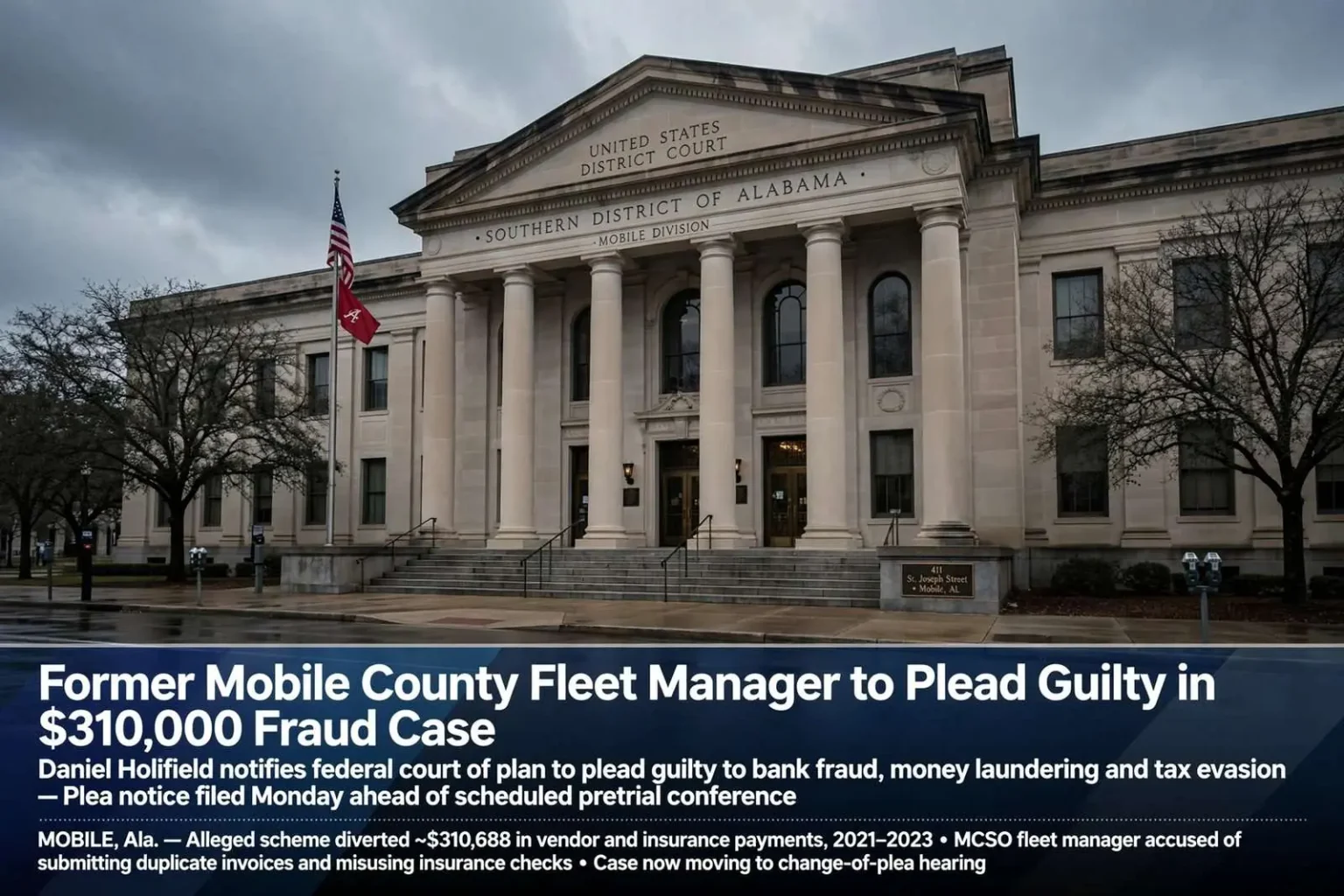
MOBILE, Ala. — Former Mobile County Sheriff’s Office fleet manager Daniel Holifield has notified federal court that he intends to plead guilty to bank fraud, money laundering and tax evasion, resolving three of the 14 federal charges brought against him earlier this year. Holifield filed the notice Monday in U.S. District Court, a day before he was scheduled to appear before U.S. Magistrate Judge Katherine P. Nelson for a pretrial conference.
As of Tuesday morning, no plea agreement had yet been filed with the court, and it remains unclear how prosecutors intend to handle the 11 remaining federal counts. A defendant’s notice of intent to plead guilty sets a change-of-plea hearing in motion, but the terms of any deal with prosecutors — including whether remaining counts would be dismissed, consolidated, or taken into account at sentencing — are typically laid out in a written agreement filed just before the plea is entered.
The filing marks a significant turn in a case that has drawn attention across Mobile County government since the indictment was announced earlier this year. Holifield held a position with broad control over purchases, vehicle dispositions, and vendor payments for the Sheriff’s Office, and prosecutors allege that control became the mechanism for a scheme that funneled public and insurance money into his personal accounts over a three-year span.
The Alleged Scheme
Federal prosecutors allege Holifield used his position as MCSO fleet manager to divert roughly $310,688 in vendor and insurance payments into his personal bank accounts between 2021 and 2023. According to the indictment, he submitted duplicate invoices to both MCSO and the Mobile County Commission — allowing vendors to collect one payment while he deposited the duplicate himself.
The duplicate-invoice method is a recognized pattern in procurement fraud. Because county purchase approvals flow through multiple offices, a document that looks like a routine vendor invoice can pass review twice if the two paying offices do not compare their payment records against each other. Investigators cited about 80 transactions involving 11 vendors, totaling $236,332 in deposits, along with roughly $74,356 from 18 insurance checks tied to sheriff’s office vehicles.
The insurance-check portion of the allegations points to a second stream of money: payments connected to vehicles operated by the Sheriff’s Office. A fleet manager sits at the center of paperwork for damaged, totaled, and salvaged vehicles, including title transfers and insurance settlements, which gave Holifield both access to the checks and the ability to control the documentation surrounding them, according to the charges.
The bank fraud count Holifield plans to plead guilty to centers on an $8,051 check deposited into his Wells Fargo account in April 2021. The money laundering charge involves a $15,487.88 deposit made in March 2023 that prosecutors say was derived from the fraud scheme. The tax evasion count relates to his 2023 income; the indictment alleges Holifield’s amended return reported $179,729 in taxable income despite knowing his actual income was higher.
What a Guilty Plea Would Mean
A guilty plea to the three federal counts would resolve a portion of Holifield’s exposure, but the financial figures at issue mean sentencing remains consequential. Federal sentencing for fraud offenses is calculated under guidelines that weigh the total loss attributable to the scheme, and prosecutors routinely present the full scope of a defendant’s conduct — including counts that are dismissed as part of a plea — at the sentencing hearing. That means the roughly $310,688 in total alleged diversions, not just the three transactions tied to the counts of conviction, could factor into how much prison time the guidelines recommend.
The tax evasion count carries its own practical consequences. A conviction for evading taxes on unreported income typically brings an obligation to make the IRS whole, and restitution in fraud cases of this kind generally extends to the institutions whose money was taken — here, potentially Mobile County government and the vendors whose payments were intercepted. Judges in the Southern District of Alabama also routinely order forfeiture of proceeds traced to the offense as part of fraud judgments.
How the remaining 11 federal counts are resolved will become clearer when a plea agreement is filed. Prosecutors have several standard options: dismissing counts as part of the deal, agreeing to dismissal at sentencing, or leaving them pending. The pretrial conference before Magistrate Judge Katherine P. Nelson would ordinarily have set a path toward trial; instead, the change of plea shifts the case toward sentencing, with the still-unresolved counts looming as a bargaining point between the defense and the U.S. Attorney’s Office.
Separate State Charges Still Pending
Additional felony charges remain pending against Holifield in state court, including theft-by-deception allegations tied to money and wages he received from MCSO, the University of South Alabama Police Department and TNT Security. Those charges followed a 2025 grand jury indictment on 13 theft and forgery counts related to allegations he forged titles and sale documents while impounding vehicles as fleet manager.
The parallel state and federal prosecutions reflect different legal theories aimed at overlapping conduct. The federal case centers on the banking and tax system — transactions that crossed financial institutions and tax filings — while the state case targets the underlying acts of theft and forgery under Alabama law. It is common for a defendant facing charges in both systems to resolve one before the other, since admissions in one proceeding can shape the strategy in the second, and a state trial can proceed on charges that a federal plea agreement leaves untouched.
The state indictment’s focus on impounded vehicles adds a detail to the public picture of the alleged conduct: forging titles and sale documents is precisely the kind of paperwork manipulation that can go undetected for years in a fleet operation, where the manager controls both the vehicles and the records that describe what happened to them. The state case names three separate employers or payers — the Sheriff’s Office, the University of South Alabama Police Department, and private security firm TNT Security — indicating that the alleged conduct extended beyond a single agency’s payroll.
Legal observers note that cases combining procurement fraud with tax charges tend to move quickly toward resolution once defendants face the accumulated weight of documentary evidence. Bank records, invoices, and payroll data leave a trail that is difficult to explain away at trial, and the overlapping state and federal cases multiply the risk of proceeding to a jury. The decision to plead guilty to the three federal counts, before any plea agreement was even on file, suggests both sides recognized where the case was headed.
How the Case Came to Light
The case traces back to a news investigation into Holifield’s overtime hours. Payroll records showed he earned $213,696 in fiscal year 2022, including nearly $149,000 in overtime — more than 2,600 hours, the equivalent of roughly 90 hours a week. A review of his timecards found overlapping overtime entries and instances suggesting he was working outside security jobs while also billing MCSO for his time.
Those payroll figures are what elevated the case from an internal personnel matter to a public scandal. Ninety hours a week sustained across a full fiscal year would leave little room for anything else, and the overlapping entries suggested the hours could not all have been worked at the Sheriff’s Office. The news inquiry prompted scrutiny of Holifield’s broader financial dealings, which ultimately produced the vendor-invoice and insurance-check allegations now at the center of the federal indictment.
The path from public records reporting to federal charges illustrates the role of payroll transparency in county government. Salary and overtime figures for public employees are public records in Alabama, and journalists routinely examine them for anomalies. In this instance, the records themselves — timecards, deposits, and invoices — became the evidentiary backbone of both the state and federal cases, showing how routine financial documentation can expose a scheme that might otherwise have continued.
What Comes Next
The immediate next step is a change-of-plea hearing in U.S. District Court, where Holifield would formally enter guilty pleas to the three counts if the process proceeds as his notice indicates. The plea agreement, once filed, will show which of the remaining federal counts are resolved and on what terms. Sentencing would follow a presentence investigation, the standard process in which probation officers compile a report on the offense and the defendant’s history that the judge uses in setting a sentence.
The state charges in Mobile County remain unresolved and could proceed independently, keeping Holifield’s legal exposure open even after the federal case concludes. A prison sentence on the federal counts would not extinguish the state theft and forgery counts, and prosecutors in the state case are free to take their case to a Mobile County jury regardless of the outcome in federal court.
For Mobile County government, the case has already prompted the kind of questions that follow any procurement scandal: how duplicate invoices cleared two offices, how insurance checks on county vehicles reached a manager’s personal account, and what controls would catch the next attempt. County officials have not announced specific policy changes tied to the case, but the figures at issue — more than $310,000 diverted across three years, and a six-figure overtime bill that first drew scrutiny — ensure that the fleet manager’s desk will be examined closely both in court and in the county’s own review of its purchasing safeguards.


