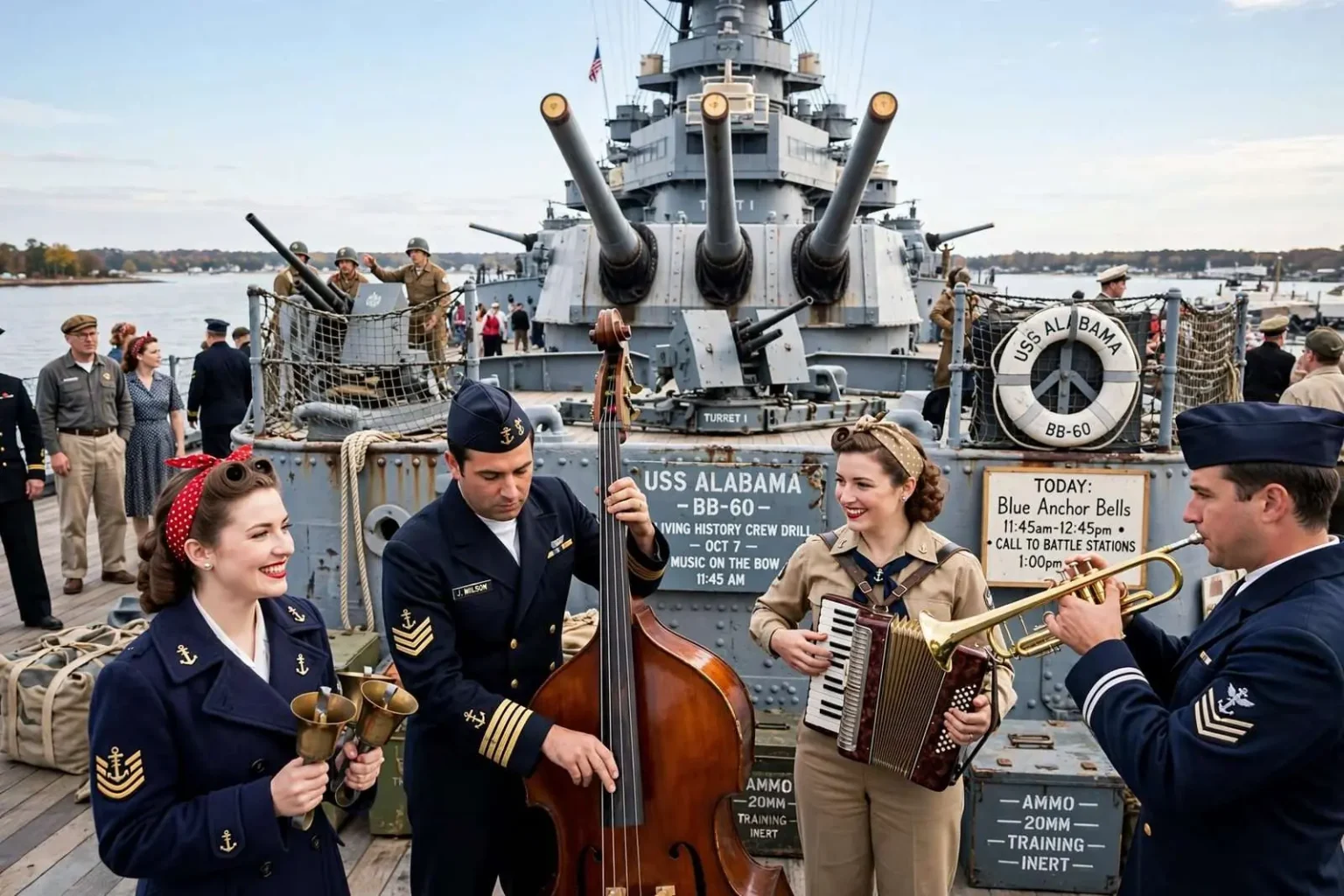
USS ALABAMA Battleship Memorial Park turns back the clock this Saturday, Oct. 7, as its “Living History Crew Drill” runs from 8 a.m. to 3 p.m. aboard the battleship and the submarine USS Drum, filling both vessels with the sights and sounds of the Navy at war.
World War II reenactors in period Navy uniforms will be stationed across the ships, holding demonstrations, leading weapons briefings and passing along stories handed down to them by original crewmen of the famed battleship. The drill is designed to let visitors experience the ships the way their wartime crews did — cramped, busy and alive with routine.
Music on the Bow is a centerpiece of the day. The Blue Anchor Bells perform 1940s and 1950s classics from the bow of the USS Alabama from 11:45 a.m. to 12:45 p.m., followed by a “Call to Battle Stations” performance on the bow at 1 p.m. that recreates the urgency of a ship preparing for combat.
Visitors who show up in 1940s or WWII-era attire get half off one adult admission ticket, a small nudge that has made era dress a signature of past drills, with servicemen’s uniforms, work shirts and victory-roll hairstyles moving through the passageways alongside modern-day tourists.
A battleship with a storied past
The USS Alabama, a South Dakota-class battleship known to her crews as the “Mighty A,” earned nine battle stars in the Pacific during World War II, protecting carrier groups, shelling enemy positions and surviving kamikaze and bomb strikes without losing a man to enemy fire. Decommissioned after the war, she was saved from the scrapyard in the 1960s by a statewide effort in which Alabama schoolchildren contributed pennies and dollars to bring the ship home.
Since arriving in Mobile Bay, the battleship has anchored the memorial park that bears her name, drawing visitors from across the country who climb her ladders, peer into her turrets and stand on decks where thousands of sailors once served. School groups make up a large share of the park’s audience, and the living history drills are built with them in mind.
Beside her lies the USS Drum, a World War II submarine that completed numerous war patrols in the Pacific and now rests in dry berth at the park, one of the oldest American submarines on public display. Together the two ships give the park a rare pairing — a surface combatant and a submersible from the same war, both walkable from bow to stern.
Guns, not planes, this time
Organizers note that planes will not fly during this drill due to mechanical issues, a change from events where vintage aircraft have joined the program overhead. The aircraft pavilion and the park’s static displays remain open, and visitors can still tour the military aircraft housed there even without a flyover.
Reenactors will still fire the ship’s 20-millimeter guns and stage demonstrations throughout the day, giving the drill its trademark percussion. The anti-aircraft mounts the reenactors crew are the same type the Alabama used to defend herself and her carriers against enemy aircraft in the Pacific, and the briefings that accompany the firings explain how the guns were aimed, loaded and worked by their young crews.
Living history events of this kind depend on reenactors who study more than uniforms. Many spend years researching the specific ships they portray, corresponding with veterans’ families and walking the ships to learn every compartment, so that a visitor’s question about where sailors slept, ate or stood watch gets an answer grounded in the ship itself.
The stories passed down from original crewmen form the emotional core of the program. As the World War II generation shrinks each year, reenactor crews treat firsthand accounts as material to preserve, repeating them to new audiences so the ship’s human history travels with its steel.
Planning your visit
The Living History Crew Drill is included with general park admission, meaning no separate ticket is required beyond the standard entry fee that covers the battleship, the submarine, the aircraft pavilion and the park grounds. The 8 a.m. start invites early arrivals to tour before the crowds thicken, and the 3 p.m. close leaves the afternoon for a slow walk through the Drum or the pavilion.
Visitors planning to take advantage of the era-attire discount should note it applies to one adult admission ticket, and comfortable shoes are the standard advice for anyone boarding the ships — the Alabama’s ladders, hatches and passageways were built for sailors, not sightseers. Strollers and visitors with limited mobility will find some areas of the ships difficult to reach, though the park grounds and pavilion are more accessible.
Mobile’s summer humidity gives way to some of the year’s best weather in early October, and the drill’s outdoor portions — the bow performances, the gun demonstrations, the lines to board — generally unfold under milder skies than the park’s summer events draw.
Why the park keeps the drills coming
Memorial parks like Mobile’s compete for attention against every other attraction on the Gulf Coast, and living history has proven to be the format that turns a one-time visitor into a repeat one. A child who fires a question at a reenactor in a period uniform, or hears a swing standard sung from the bow of a battleship, remembers the trip differently than one who only read the placards.
The drills also serve the park’s core mission of remembrance. The Alabama and the Drum are memorials to the tens of thousands of Alabamians who served in World War II, and every demonstration that explains what those service members did keeps the memorial an active place rather than a static one.
Organizers typically schedule living history events through the fall and spring seasons, and Saturday’s drill is part of that rhythm, giving families a full day’s program timed around the school year rather than the height of the beach season.
A Mobile landmark on the bay
Battleship Memorial Park sits on the Mobile Bay causeway just east of downtown, its white superstructure visible for miles as drivers cross the bay on Interstate 10 or U.S. 90. The park opened in the mid-1960s after the schoolchildren’s campaign brought the Alabama from her mothball fleet moorings in Washington State to Mobile, a tow of thousands of miles through the Panama Canal that made national news at the time.
In the decades since, the park has grown into one of south Alabama’s most-visited attractions, hosting reunions of the ship’s crew, veterans’ gatherings, patriotic ceremonies and a steady stream of tourists who pair a battleship tour with a trip to the beaches down the road. The aircraft pavilion shelters a collection of historic military planes, and memorials across the grounds honor Alabamians who served in conflicts from World War II to the present.
For visitors coming Saturday, the practical route is simple: cross the bay, follow the signs to the park, and arrive early enough to see the drill’s full arc, from the morning weapons briefings through the midday music and the Call to Battle Stations that brings the day’s program to its dramatic close.
Whether a visitor’s interest is the engineering of a 35,000-ton warship, the daily life of a submariner on war patrol, or simply the sound of 1940s harmonies drifting off a battleship’s bow, Saturday’s Living History Crew Drill packs all of it into a single day at one of the Gulf Coast’s most distinctive museums.
Inside the reenactor corps
The men and women who portray the Alabama’s wartime crews come from across the Gulf Coast, and many belong to units that drill together through the year, refining the procedures they demonstrate at events like Saturday’s. Uniform standards are strict — the ratings, insignia and gear must match what a sailor of the era would actually have worn aboard — and authenticity reviews are part of the routine before the public arrives.
Their demonstrations are choreographed but grounded in real practice. A weapons briefing walks visitors through the parts of a 20-millimeter anti-aircraft gun, explains the rate of fire and the teamwork required to keep it loaded, and often lets younger visitors handle safe components under supervision. Passage tours pause in galleys, berthing compartments and gun mounts, where a reenactor in character describes how the space was used during a deployment.
The Call to Battle Stations performance compresses that world into a few loud minutes. Klaxons, running feet and shouted orders recreate the moment a peacetime routine snapped into combat readiness, staged on the bow with the bay as a backdrop. For many visitors it is the moment the visit shifts from museum tour to time travel, and it lands hardest on those who have just walked the narrow ladders the crews used every day.
Between demonstrations, the reenactors answer questions in and out of character, and that conversation is where the handed-down stories surface — accounts of typhoon watches, shore bombardments and small acts of luck that never made the official reports but survived in the memories of the men who lived them.