Suspect Arrested After Police Chase, Crash Closes Bankhead Tunnel in Downtown Mobile
A police chase through Downtown Mobile ended in a crash that closed the Bankhead Tunnel. Suspect Steven Demetrius George faces drug and firearms charges.
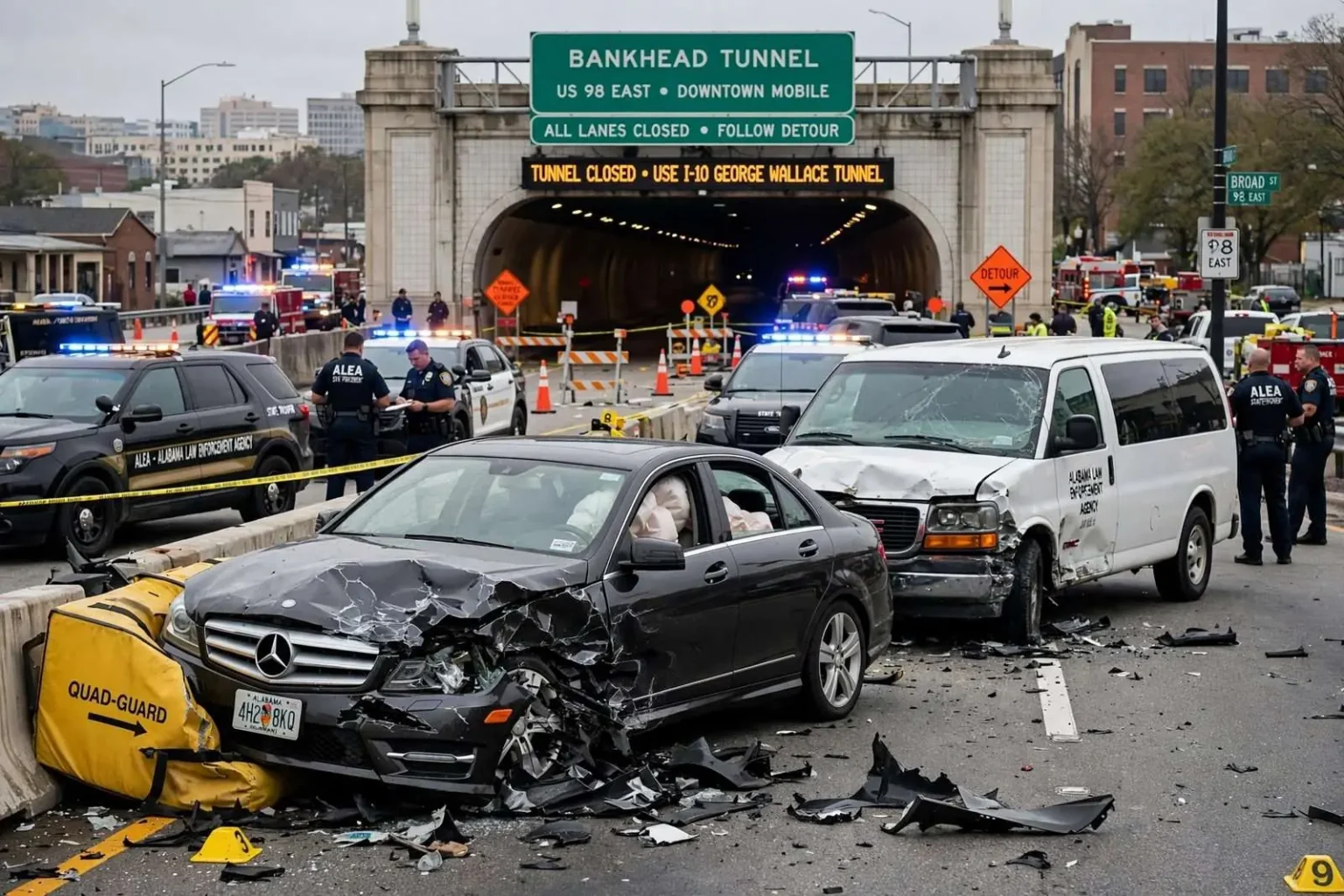
A police chase through Downtown Mobile on Saturday afternoon ended in a crash that shut down the Bankhead Tunnel and led to the arrest of a 23-year-old man on multiple charges, according to the Alabama Law Enforcement Agency. Steven Demetrius George was arrested in connection with the vehicle pursuit, which ALEA troopers say resulted in a traffic crash on US Highway 98 Eastbound near Broad Street, one of the busiest approaches into downtown on a weekend afternoon.
The chase began when George, driving a 2010 Mercedes C300, fled from law enforcement, setting off a pursuit that threaded through downtown streets before ending at the tunnel approach. Pursuits of that kind draw an immediate response from multiple agencies, and in this case they converged on the corridor that carries US 98 traffic under the Mobile River and toward the city’s eastern neighborhoods, where Saturday traffic was already building.
Crash and discovery of weapons, drugs
The pursuit ended after the Mercedes experienced mechanical failure following collisions with a curb, a Quad-Guard Crash Cushion System, and a 1997 GMC Savana, according to ALEA. Crash cushions like the Quad-Guard are installed at highway hazards precisely to absorb the impact of an out-of-control vehicle, and their job on Saturday was to bring the fleeing sedan to a stop before it could strike something less forgiving at the mouth of the tunnel.
Troopers reported discovering marijuana, drug paraphernalia, and firearms with altered serial numbers in George’s possession after the vehicle was stopped. The combination of discoveries turned what began as a flight from police into a multi-count case, with the altered serial numbers on the firearms adding a serious layer to the state charges that followed the arrest, since defaced weapons carry consequences of their own under Alabama law.
Both George and his passenger, 28-year-old Celia Athina Grijalva of Summerdale, had outstanding warrants for their arrests at the time of the incident, according to ALEA. Summerdale is a growing community in Baldwin County, and the passenger’s warrant meant that both occupants of the car were taken into custody once the crash brought the pursuit to its end, rather than only the driver facing consequences from the afternoon’s chain of events.
Arrests at the end of pursuits follow a familiar sequence: the scene is secured, evidence is photographed and collected, and the vehicle is inventoried before it is towed. Investigators then sort out which charges attach to the driver and which to the passenger, a process that can take hours when drugs, paraphernalia and weapons are all part of the recovery, and one that keeps officers tied up at the scene long after the flashing lights arrive.
The firearms recovered with altered serial numbers represented a particularly significant find for investigators. Serial numbers are the primary way authorities trace a weapon’s chain of ownership, and defacing them is a separate offense in its own right. Recovered weapons are typically checked against national databases to determine whether they have been reported lost or stolen, work that can add further charges as the case develops.
Tunnel closed, traffic diverted
The Bankhead Tunnel was closed for an extended period as crews cleared the scene. The crash initially left both lanes of the tunnel blocked, with traffic diverted to alternate routes through downtown Mobile — a significant disruption on a Saturday afternoon, when the tunnel and its approaches funnel drivers between downtown, the port district and the communities east of the Mobile River.
ALGO Mobile first reported the major crash on US 98 Eastbound near Broad Street, advising motorists to expect significant delays and seek other routes. The traffic-alert service’s early warning gave drivers approaching downtown time to reroute around the closure, and police on the scene directed vehicles away from the tunnel entrances while the investigation and cleanup proceeded behind the barricades.
Closures of the tunnel ripple quickly across the downtown street grid, as diverted traffic redistributes onto parallel routes already carrying weekend traffic. Motorists reported delays through the hours the tunnel was shut, and the closure underscored how little slack the system has when one of the few crossings under the Mobile River goes out of service without warning on a busy afternoon.
The Bankhead Tunnel itself is a piece of Mobile history — an underwater crossing opened in the early 1940s that carried generations of travelers beneath the river before the larger George Wallace Tunnel opened downstream decades later. Its older, narrower bores make any incident inside or at its approaches especially disruptive, since there is little room to maneuver around a wreck once the lanes are blocked and crews need space to work.
How pursuits are handled on Mobile’s streets
Vehicle pursuits in dense urban areas like downtown Mobile place a premium on quick decisions by pursuing officers, who must weigh the seriousness of the underlying offense against the risk a chase poses to pedestrians and other drivers at street level. The fast-moving sequence — from the moment a driver flees to the point the vehicle is disabled — typically lasts only minutes, but the aftermath, from crash reconstruction to evidence collection, can occupy a scene for hours afterward.
ALEA’s Highway Patrol Division handles crash investigation and enforcement on state and US highways, and troopers routinely take the lead when a pursuit ends in a wreck on a route like US 98. The agency’s post-crash work includes mapping the scene, interviewing witnesses, documenting the sequence of collisions and preparing the case file that prosecutors will use when the charges move toward an initial court appearance.
The mechanical failure that ended the chase is a common final chapter in pursuits: fleeing vehicles rarely make it far once tires, steering or engine components give out, and in this case the collisions with the curb and the crash cushion finished what the failing mechanics started. The struck GMC Savana added a third-party vehicle to the damage list, an all-too-typical cost of a chase through a populated corridor.
Law enforcement agencies across the region have long emphasized that fleeing from a traffic stop only compounds a driver’s legal exposure — adding charges, property damage and, in cases like this one, the discovery of contraband and weapons that would otherwise never have surfaced. The outcome near Broad Street offered a textbook illustration of that arithmetic, with a traffic stop’s worth of trouble multiplied into a multi-count case.
What happens next
George faces multiple charges stemming from the pursuit and the discoveries inside the car, and Grijalva faces arrest on her outstanding warrant, with both expected to move through the booking process before initial court appearances. The precise charges were not detailed in the initial report, and no further information was immediately available as ALEA troopers continued their investigation into the crash and the events that led up to it.
Investigators will also account for the damage left behind — the crash cushion at the approach, the curb strike, the struck van and the tunnel itself — as part of the case file. Such costs are routinely tallied in pursuit cases and can figure into restitution discussions when the case is resolved, adding to the financial consequences that follow a decision to flee.
For commuters and residents, the episode served as a reminder of how quickly a normal Saturday can snarl: a single fleeing driver, a disabled car and a tunnel closure combined to freeze one of downtown Mobile’s key gateways for an extended stretch of a weekend afternoon, with the investigation continuing after the barriers came down and traffic finally began moving through the tunnel again.
Saturday afternoons are typically kind to downtown traffic by Mobile standards, which is part of what made the closure so noticeable. Weekend visitors heading to the riverfront, residents running errands east of the river and port-area traffic all share the same few crossings, and a blockage at any of them shows up within minutes on the streets downtown.
Crash reconstruction in a case like this proceeds in careful stages. Troopers document skid marks and debris fields, measure the final resting positions of the vehicles involved, and pull together the sequence of impacts — the curb, the cushion, the van — into a single timeline of how the pursuit ended. That timeline becomes the backbone of the case file that follows the arrested pair into the courts.
Multi-agency pursuits also generate a paperwork trail of their own, with each participating department reviewing the actions of its officers under its own pursuit policy. Those reviews are standard practice after any chase, and they run in parallel with the criminal case rather than holding it up, so the court process can move forward while the administrative side is completed.
Crews clearing a tunnel scene face a narrow working environment: lighting is limited, shoulders are nonexistent and every piece of wreckage has to be hauled out by the same lanes drivers normally use. The extended closure on Saturday reflected that reality, with the tunnel reopening only after the wrecked vehicles were removed and the roadway was checked for debris.
The presence of an outstanding warrant can turn a routine encounter into an arrest on the spot, which is part of why traffic stops involving warranted occupants so often escalate. In this case, both occupants already had reasons not to stop, and the chase that followed ended with both in custody — the outcome officers warn about when they urge drivers to resolve warrants voluntarily instead of running.
Mobile drivers have seen similar closures before, and many knew instinctively what to do: swing north toward the other crossings or wait it out on the downtown side. The alerts from ALGO Mobile and the visibility of police units at the intersections made the rerouting smoother than it might otherwise have been on a Saturday with heavy weekend movement through the district.
As for the damaged property, repairs to a crash cushion and a struck vehicle fall to their owners and the agencies responsible for maintaining the highway hardware, with the costs typically pursued through the courts. The curb and the tunnel wall took their licks as well, and all of it ends up itemized somewhere in the file that grew out of one Saturday-afternoon decision not to pull over.
Drivers who frequent the corridor know the routine well: when word of a tunnel closure spreads, traffic shifts to the other crossing and to the surface streets of downtown, and the effect is felt from the Interstate ramps to the blocks near the waterfront. Saturday’s closure played out against that backdrop, with navigation apps steering drivers away from the blocked approach almost as soon as the first alerts went out.