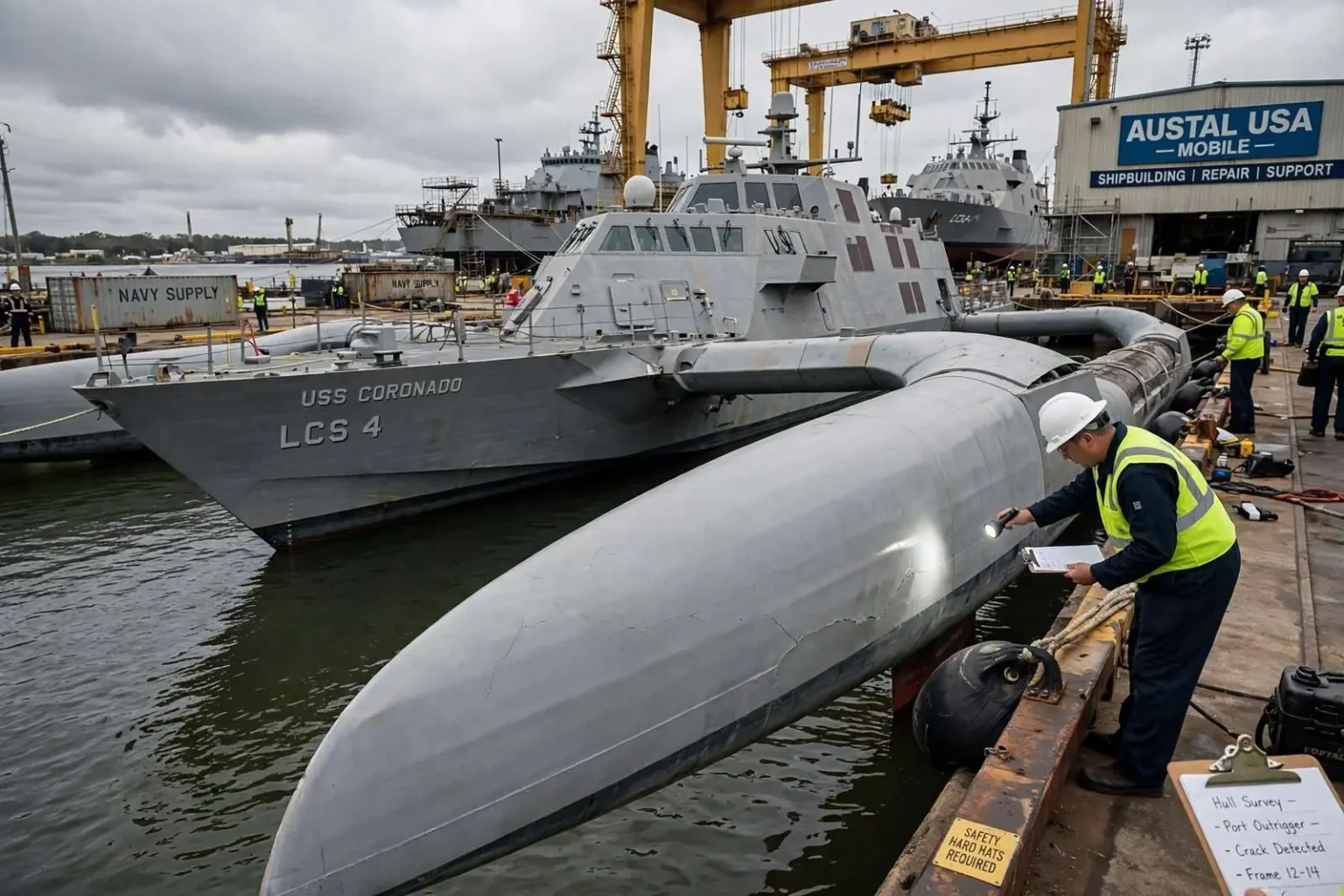
MOBILE, Ala. — Structural cracks have been discovered in the hulls of Navy littoral combat ships built by Austal USA in Mobile, including the USS Coronado, and some of the affected vessels are now headed for early retirement. The findings reach into one of the largest industrial operations on the Gulf Coast, where the Austal shipyard is among Mobile’s biggest employers, and they have opened a public conversation about the durability of a warship class the city built in quantity.
The problem first surfaced aboard the Coronado, an Independence-variant ship delivered to the Navy from Mobile in 2014. According to reporting by the Navy Times, hairline cracks began appearing on that hull around 2019 — only about five years after construction — and similar defects have since been identified across a large share of the class. For a class of warships designed for decades of service, cracks appearing that early prompted engineering reviews that eventually spread across the entire fleet.
About half of the fleet affected
The Navy Times reported that roughly half of the littoral combat ship fleet has shown hull cracking. The cracks stem from structural defects, and while the Navy has not treated them as an immediate safety concern, officials have noted that certain wave conditions combined with high speeds can cause the cracks to worsen over time. Operational guidance has accordingly kept a close watch on how and where affected ships are driven, since the Independence variant’s aluminum hull design was built around speed as a defining capability.
Under an agreement with the Navy, Austal is rebuilding ships still under construction or under warranty with modified hull designs designed to address the defect. Other affected vessels will either undergo repairs or be decommissioned early. The split treatment reflects the arithmetic of naval maintenance: fixing hulls under warranty falls to the builder, while ships whose repair costs exceed their remaining value become candidates for retirement long before their planned service lives end.
The Independence variant, recognizable by its wide, trimaran hull, was conceived as a fast, modular surface combatant capable of reconfiguring for different missions. Its aluminum construction kept weight down and speed up, but aluminum responds differently to stress than the steel used in most warships, and the hull cracking issue has centered attention on the structural design where the ship’s speed meets the sea’s punishment.
A troubled ship class
The cracking issue is not the first setback for the LCS program. In April 2022, the Navy announced plans to decommission nine Freedom-class littoral combat ships — vessels built by a different shipbuilder — representing roughly $4.5 billion in construction costs. Ships commissioned in the early 2000s from that variant struggled with excessive fuel consumption and light armor, and were retired well ahead of their planned service lives. Taken together, the two variants’ difficulties have made the LCS program a recurring case study in defense acquisition.
The program’s premise was ambitious: a relatively affordable surface combatant built in numbers, with swappable mission modules that could let one hull pursue mine countermeasures, surface warfare or anti-submarine work as needed. Critics in Congress and the Pentagon’s testing community questioned the concept’s survivability and the modules’ development timeline, while the Navy repeatedly restructured the program to manage costs. Through all of it, the ships continued to come out of the building ways in Mobile and Wisconsin.
For Mobile, the stakes are measured in a shipyard that has grown into one of the region’s anchor employers. Austal’s Mobile River facility has expanded steadily since its first Navy deliveries, drawing a skilled workforce of welders, outfitters and engineers and anchoring a supplier network across the Gulf Coast. News about the durability of its ships therefore resonates locally in a way defense program news rarely does elsewhere, because the work and the wages are concentrated on the Mobile River.
Mobile’s shipyard keeps building
Even as the crack repairs proceed, the Navy has continued ordering ships from Austal’s Mobile yard. In May 2022, the company secured a $230.5 million contract for another Expeditionary Fast Transport — a design Austal says is consistently delivered on schedule and on budget. Three more EPFs were already underway at the time, joining Independence-variant ships such as the future USS Canberra, USS Santa Barbara, USS Augusta and USS Kingsville then in production for the Navy.
The Expeditionary Fast Transport, a shallow-draft catamaran used to move troops and equipment quickly in coastal waters, has avoided the LCS program’s troubles and become one of Austal’s steadiest product lines. The vessels have seen steady operational use in theater, and their record for on-time, on-budget delivery has made them the yard’s counterargument to criticism generated by the combatant ships. Shipyard officials regularly point to the EPF record when describing the company’s execution.
The modified hull designs being applied to ships still under construction will determine how the Independence variant ages, and the Navy’s decisions about repairing versus retiring already-delivered ships will unfold across the fleet in the years ahead. Ships decommissioned early free up crewing and maintenance dollars for newer hulls, but they also shorten the fleet’s numbers, a concern as the Navy weighs its force structure against global commitments.
For the ships that remain in service, crews operate within the engineering limits the crack findings impose, monitoring hull conditions in the sea states and speeds that stress them most. The Navy’s public position that the cracks do not pose an immediate safety concern reflects that managed approach rather than a claim that the defects are inconsequential. Engineering change of this kind is not unusual across a warship class’s life, though rarely on this scale.
Mobile’s stake in the outcome is both industrial and civic. The yard’s future order book, from EPFs to the larger auxiliary programs the Navy has discussed, depends on the confidence the Navy places in the products the Mobile River ways have produced. How the Navy resolves the Independence variant’s hull cracking — through rebuilt hulls, disciplined operations and the test of time — will shape the story the city’s shipyard carries into its next round of contracts.
Hull cracking in fast aluminum ships is an engineering problem with a known vocabulary. High-speed operation in rough seas imposes repeated slamming loads on the hull, where the bottom structure meets waves at speed, and fatigue accumulates in welds and structural details that carry those loads. Naval architects design for this, but the Independence variant’s combination of a lightweight aluminum hull and sustained high speeds made its loading environment more punishing than most, and the hairline cracks reported in the fleet trace to precisely those stress points.
The Navy’s approach to the defect illustrates how it handles structural problems in ships that must keep operating while solutions are engineered. Fleets receive guidance on operating profiles, inspections concentrate on known trouble spots, and repairs are phased through maintenance availabilities rather than pulling whole classes out of service. The management of the Independence class has followed that pattern, with surveys documenting which ships show cracking and repair or retirement decisions following the surveys.
Early retirements carry budget logic as well as engineering logic. A hull that would require a costly structural rebuild to reach its full service life competes for money against new construction, and Navy leadership has repeatedly chosen new hulls over life extensions when the numbers favored them. That arithmetic produced the 2022 Freedom-class retirement plan, and it frames the choices ahead for Independence-variant ships whose cracking is most extensive.
The LCS program’s troubles unfolded against the backdrop of a shipbuilding industrial base concentrated in a handful of yards, of which Mobile’s is among the most prominent. Decisions about which ship classes to retire and which to keep buying ripple through those communities, affecting workforce stability, supplier contracts and the pipeline of skilled trades. Gulf Coast leaders watch the Navy’s budget deliberations with that in mind, arguing for the steady multi-year procurement that lets yards plan.
Warranty provisions in Navy shipbuilding contracts determine who pays for fixes like the hull modifications. Ships still in the yard or in early service fall to the builder to correct, which is why Austal is rebuilding in-construction and warranty hulls with modified designs. The arrangement spreads the financial burden but also preserves the customer relationship, since the Navy continues to accept deliveries while corrections proceed across the production line.
The future ships named in the production report — Canberra, Santa Barbara, Augusta and Kingsville — represent the continuation of the class even as older hulls head for early retirement. New hulls incorporate the modified structural design, and their service careers will provide the real test of whether the defect has been engineered out. That generational pattern, problems discovered in early hulls and corrected in later ones, has repeated across warship classes for as long as navies have built them.
Mobile’s shipbuilding lineage stretches back to the Civil War era and includes steel shipyards that built for both world wars, giving the city a workforce tradition that modern programs like Austal’s draw on. The yards along the Mobile River have turned out everything from ferries to destroyers over that history, and each generation of ships leaves behind welders and shipfitters who train the next. The Independence variant’s difficulties will be a chapter in that longer story rather than its ending, as the yard and the Navy work through the repairs while the production lines keep moving.