Mobile Advocate Renews Push for a Full-Scale Regional Transit System
A Mobile County commentary renews the case for a full-scale regional transit system, arguing that expanded bus service would pay for itself as gas prices and traffic push more residents toward public transportation.
A local commentary published in a Mobile County community column is renewing calls for a significantly expanded public transportation network across Mobile County, arguing that a properly funded system would ultimately pay for itself through wider use and reduced strain on the region’s roads. The piece adds a recurring voice to a debate that has surfaced in Mobile every few years for decades — and it arrives at a moment when the economic arguments for transit have grown harder to dismiss.
The argument comes at a moment when rising gasoline prices and worsening traffic congestion were pushing many South Alabama residents to reconsider their reliance on personal vehicles. Neither condition is novel, but their combination — expensive fuel on congested corridors — tends to be what moves transit from a niche concern to a mainstream topic in car-oriented cities, and the commentary leans into that opening.
The residents who have no choice
While plenty of area drivers remain attached to the convenience of their cars, the piece notes that a substantial number of Mobile County residents do not own a vehicle at all and depend entirely on whatever public transit options exist to get to jobs, medical appointments, school and grocery stores. For that population, transit is not an environmental statement or a budget experiment; it is the difference between employment and joblessness, between a managed chronic condition and an emergency room visit.
The geography of that dependency matters. Carless households concentrate in the older neighborhoods of Mobile — the downtown districts, the peninsula, parts of Toulminville and Prichard — where incomes are lower and where jobs, clinics and schools are spread across a metropolitan area built at automobile scale. A resident of those neighborhoods facing a job interview across town, a dialysis appointment on Spring Hill or a community college class in west Mobile is entirely at the mercy of the routes that exist and the hours they run.
The Wave and its limits
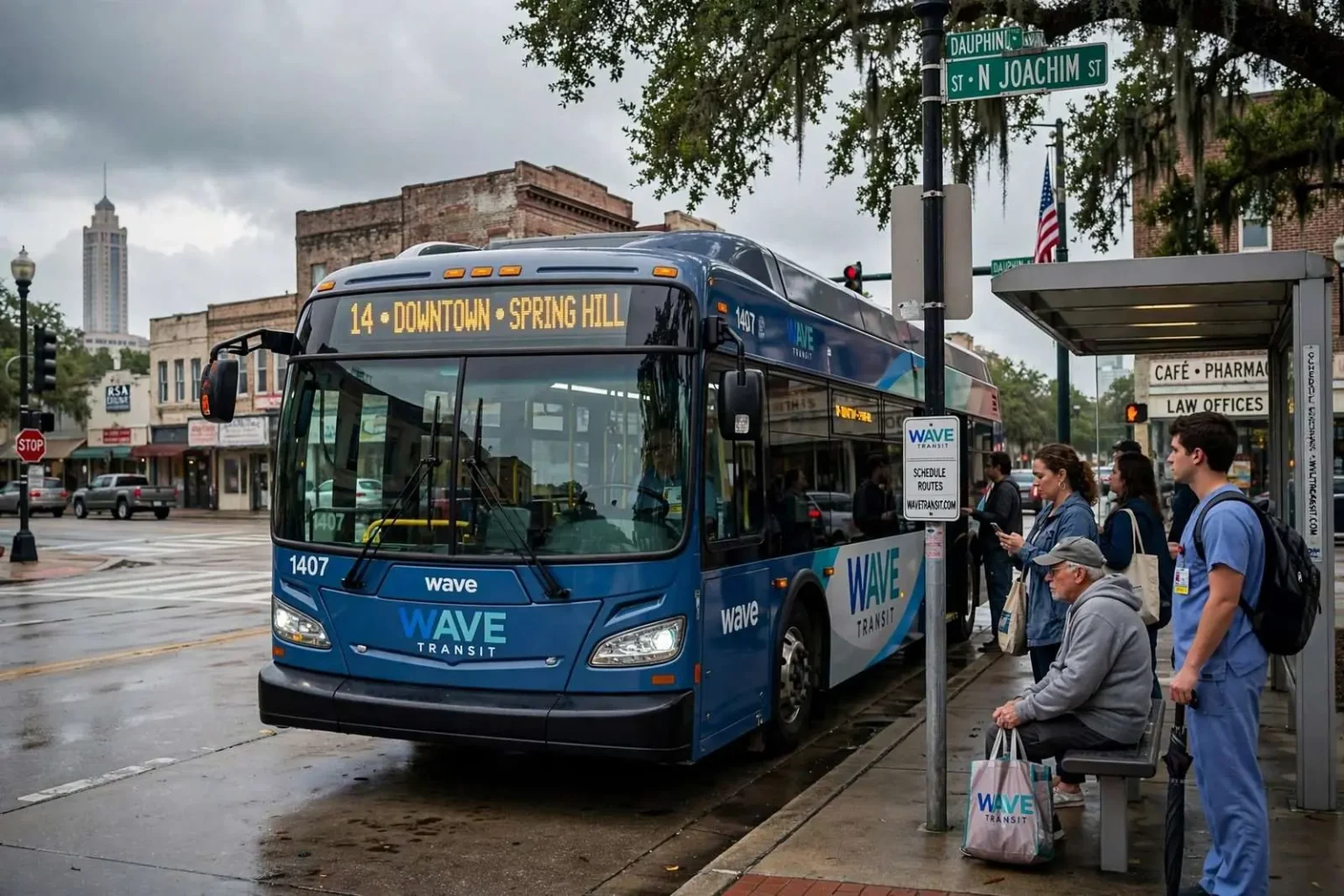
The Wave Transit System, Mobile’s existing municipal bus service, drew praise in the column as a meaningful improvement over what came before it. The Wave operates fixed routes across the city with connections to key destinations, and riders who remember the patchwork that preceded it credit the system with bringing basic reliability to an essential service. Its buses link neighborhoods to downtown, to hospitals and to commercial corridors, and its paratransit service serves residents whose disabilities rule out the fixed-route buses entirely.
But the piece argues that incremental upgrades are not enough, and that the region needs a full-fledged, more robust transit system with a significantly expanded schedule, broader coverage and more frequent service. The gap the commentary identifies is the classic one for mid-sized Southern systems: routes that exist but run infrequently, service that ends before evening shifts let out, coverage that stops at the city line while jobs and housing keep moving outward into unincorporated Mobile County and Baldwin County.
The concept echoes the long-discussed idea of a true Mobile Area Rapid Transit System, sometimes referred to by the shorthand MARTS, that would move beyond a limited bus loop toward something closer to comprehensive regional transit. The name has circulated in Mobile planning circles for a generation, surfacing in chamber of commerce white papers, city council debates and newspaper editorials whenever gas prices spike or a major employer complains about workforce transportation — and receding again when the moment passes.
An old argument in Mobile
Local transit advocacy is not a new topic in Mobile County, where transportation planners and civic leaders have periodically floated ideas for expanded bus routes, park-and-ride options and eventually rail or rapid-transit corridors linking Mobile with surrounding communities. The history is long enough to have a rhythm: a study is commissioned, a concept is drawn, a price tag is attached, and the funding question — always the funding question — stalls the effort until the next cycle.
The structural obstacle is familiar across the Deep South. Alabama routes most transit funding through local match requirements, Mobile County’s tax structure leaves little dedicated revenue for transit, and the city and county governments have historically split on how any permanent funding stream should be divided. Meanwhile, the region’s largest job centers — the hospitals along the I-10 corridor, the aerospace employers in west Mobile, the shipyards on the river, and the growing employment base across the bay — sit far apart from one another and from the neighborhoods where carless residents live.
Advocates argue that a stronger transit backbone could ease congestion on core corridors, support downtown redevelopment, and provide a lifeline for lower-income residents, senior citizens and people with disabilities who have limited transportation options. Each of those claims has a body of evidence behind it elsewhere: frequent transit reliably draws riders off parallel road corridors, walkable neighborhoods with transit access command development interest, and the populations most likely to be stranded by a thin system are precisely the ones least able to bear the alternatives — taxis, ride-hailing on every errand, or dependence on relatives and neighbors.
The case against — and the answer
Critics of large transit investments typically point to the up-front public cost and to Mobile’s comparatively low-density, car-oriented development pattern, which makes it harder to run buses efficiently compared with more compact cities. The criticism is grounded in real arithmetic: buses that crawl through low-density subdivisions carrying a handful of riders cost more per trip than the fares they collect, and no route structure can conjure the density that efficient transit prefers. The region’s sprawl — decades of growth pushing west along Airport Boulevard and Schillinger Road, south along the bay, east across the causeway — is the accumulated result of exactly the car-first pattern critics cite.
Proponents counter that ridership tends to grow once service becomes more reliable and frequent, and that a self-sustaining system becomes more realistic as more residents opt to ride rather than drive. The frequency argument is the strongest one transit research offers: riders will tolerate a slow bus but not an unpredictable one, and systems that cut headways — the wait between buses — from hourly to every 15 or 20 minutes routinely see ridership respond. Every new rider is fare revenue the system did not have and one car the roads do not carry.
What a real system would look like
Translating the commentary’s call into service changes is not mysterious; it is a matter of routes, frequencies and hours. Expanded schedule means buses that start early enough for hospital shifts and run late enough for restaurant work. Broader coverage means extending routes to west Mobile’s employment centers, to the communities along Highway 90 and 98, and — in the boldest versions — across Mobile Bay toward Baldwin County’s workforce, thousands of whom commute into Mobile daily. More frequent service means headways short enough that a rider can plan a life around the bus rather than around a timetable they must obey to the minute.
Park-and-ride lots at the corridor edges, the kind planners have floated for years, would bridge the gap between a car-oriented county and a transit system: a commuter drives five miles, parks free, and rides the frequent segment into downtown or the medical district. Express routes along the I-10 and I-65 corridors are the other standard tool, trading coverage for speed on the trips that carry the most riders. None of this requires rail or any single dramatic investment; most of the improvement Mobile’s advocates describe could be built bus by bus, route by route.
The stakes for the region
The commentary frames the choice as a matter of quality of life and economic pragmatism for the Mobile area, urging residents and officials alike to get behind a stronger public transit push rather than waiting for gas prices or congestion to force the issue. The economic case runs through the region’s employers, who consistently rank workforce transportation among their practical concerns: a worker without a car is a worker a business cannot reliably schedule, and a metro area that strands a share of its workforce pays for it in turnover, absenteeism and unfilled positions.
The pragmatism also runs through public budgets. Road capacity is the region’s default answer to congestion, but every added lane on I-10 or Airport Boulevard costs orders of magnitude more per rider carried than a bus on an existing street, and the roads still fill. Moving even a modest share of commuters, patients and students onto frequent transit stretches the capacity the region already has — which is what the commentary means by a system that pays for itself through wider use and reduced strain.
The events described in this report connect to broader patterns across the Gulf Coast region, where fast-growing metro areas are confronting the transportation debts of decades of automobile-first development. Local institutions, government agencies, and community organizations all play roles in addressing these issues — the transit authority that operates the Wave, the city and county governments that fund it, the employers and hospitals whose schedules define when service must run, and the advocates who keep the issue from slipping off the agenda between crises.
The outcomes of these efforts will shape the region’s future development and resilience. Mobile’s population and economy are growing, its corridors are congesting, and its residents without cars are still waiting — which is the situation the commentary describes, and the reason its argument, like the MARTS idea before it, keeps coming back.