Mobile County School Board Rejected Taser Proposal in 2009
The Mobile County School Board voted 3-2 against allowing school security personnel to carry Tasers in 2009 after a public debate over student safety and campus security.
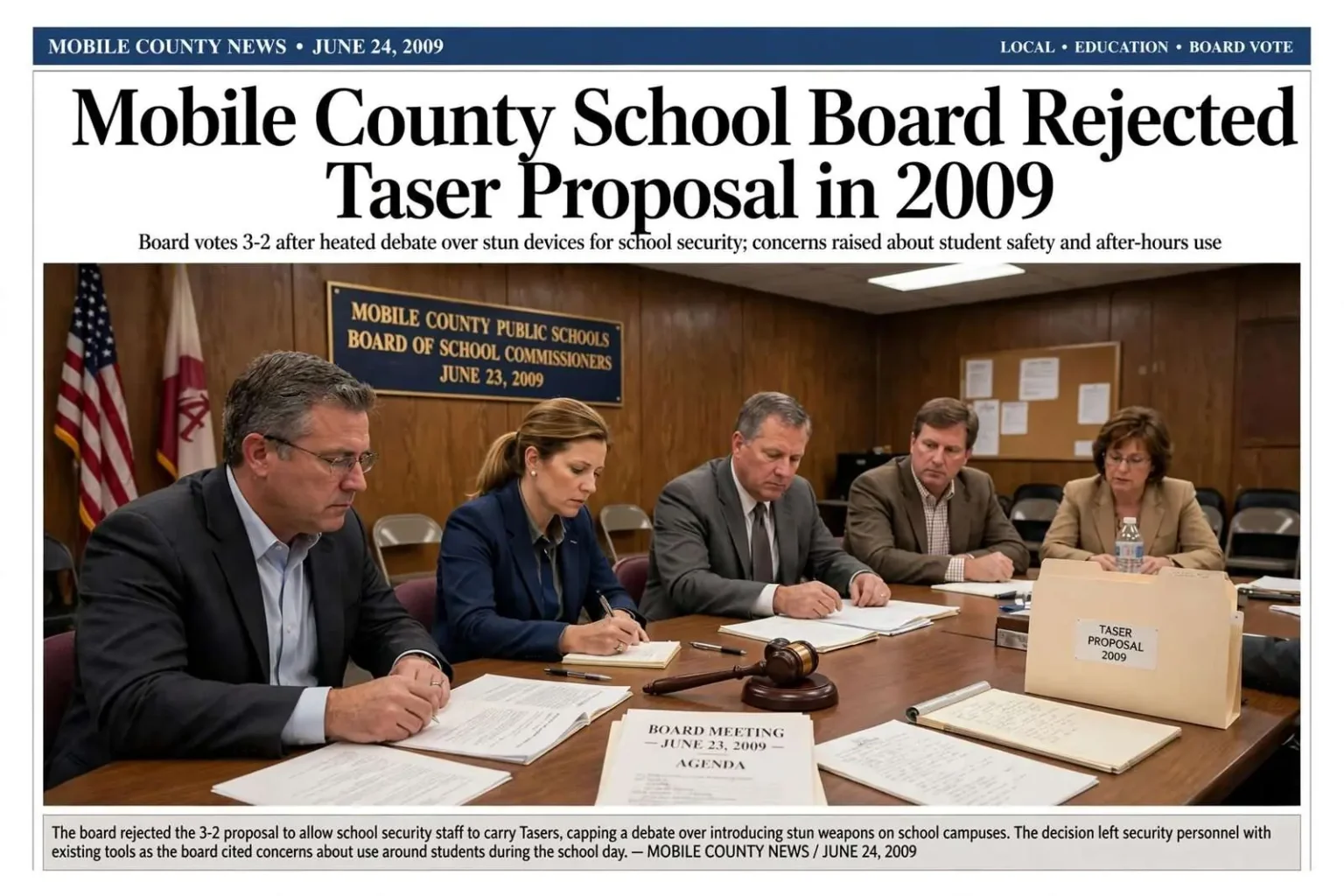
The Mobile County School Board voted 3-2 in June 2009 against allowing school security personnel to carry and use Tasers, rejecting a proposal that had divided the board and drawn public comment from both sides of the question. The vote capped a debate over whether the electric stun devices belonged on campuses where students spend their days.
Public speakers and board members debated whether the devices were appropriate on campuses while students were present. Some participants said the proposal went too far, arguing that introducing stun weapons into schools raised the risk of misuse against students and changed the character of school security. Supporters countered that security staff needed additional means of protection, particularly during after-hours building security work, when officers secure empty campuses and confront trespassers or burglars without backup nearby.
Several members said they could support tools for securing school facilities at night but not during the school day, a distinction that shaped the debate: the objection was not to the devices themselves but to their presence around students in session. The board rejected the proposal after that debate, leaving security staff with the tools they had carried before the proposal was made.
The security debate of that era
The 2009 vote came in the middle of a national reconsideration of school security tools. Districts across the country were weighing whether armed officers, stun weapons, surveillance systems and lockdown procedures belonged in schools, and the arguments echoed in board rooms everywhere. Supporters of expanded tools pointed to campus intrusions, after-hours vandalism and the occasional violent incident, arguing that unarmed security guards faced dangerous situations with no means of protection. Opponents raised the specter of devices being used on students, citing incidents elsewhere in which students had been stunned in school settings and the injuries and lawsuits that followed.
Mobile County Public Schools, the largest district in Alabama, employed its own security personnel alongside school resource officers provided through agreements with local law enforcement. The division of labor placed sworn officers in some schools and district security staff in buildings and on grounds across a system spanning tens of thousands of students, from inner-city Mobile to communities across the county. The question of what tools security staff should carry, therefore, was a question about a large workforce spread across an entire county’s campuses.
After-hours security was the crux of the practical argument. Empty school buildings are a recurring target for break-ins, copper theft and vandalism, and security staff checking buildings at night work alone across sprawling campuses. Supporters of the proposal argued that a Taser offered a less-lethal option in exactly those encounters, somewhere between a radio call for help and a firearm. Opponents, including some board members, saw the daytime and nighttime uses as inseparable in practice, since the same officers who secure buildings at night also work campuses during the day.
The same-night ACT vote
On the same night, the board also voted against a contract that would have allowed all juniors in the district to take the ACT college-preparatory test free on a weekday. The proposal represented a shift from the traditional model, in which students take the ACT on Saturday mornings at their own expense, toward a system in which every junior would sit for the exam during the school day at district cost, removing both the fee barrier and the transportation barrier for students whose families could not easily manage a weekend trip to a test site.
The ACT vote carried real consequences for students. Universal, school-day testing is associated with higher participation rates, and higher participation pulls into the college pipeline students who would never have registered on their own. For a district of Mobile County’s size and demographics, a contract covering all juniors represented a significant expense, and the board’s rejection left the district’s ACT participation to the traditional sign-up model for the time being. Alabama would later move toward statewide school-day testing in subsequent years, a shift that made the 2009 debate an early chapter in a policy conversation the state eventually settled differently.
That the two votes fell on the same night illustrated the budget pressures boards faced in the years after the 2008 recession. School systems across Alabama were absorbing proration, the state’s term for mid-year funding cuts, and every new expense was weighed against staffing, transportation and instructional spending. A proposal to equip security staff with new devices and a proposal to fund universal college-entry testing both landed on a board weighing each dollar twice.
What the votes meant and didn’t mean
The 3-2 margin on the Taser proposal showed a board divided but resolved: a majority was unwilling to put stun devices in the hands of school security personnel at that time. The vote did not end the district’s engagement with security questions, which continued to evolve with technology, staffing and national debates in the years that followed. Nor did it settle the underlying tension the debate exposed, between the duty to protect staff and students and the reluctance to introduce weapons into environments built around children.
For the security personnel at the center of the proposal, the vote meant continuing to work with the tools the district had already authorized. After-hours building security remained their responsibility regardless, and the risks that supporters cited, confronting trespassers alone on dark campuses, did not disappear with the proposal’s rejection. Districts that later adopted similar devices did so with training requirements, reporting protocols and usage policies that were part of the national conversation by the time Mobile County made its decision.
This account documents the 2009 votes and the public discussion that surrounded them. It does not reflect current Mobile County Public Schools security policy, test programs or board membership, all of which have changed in the years since. What the record preserves is a snapshot of a board weighing two questions that districts everywhere were wrestling with at the time: how to arm, or not arm, the people who guard schools, and whether the district should pay to put a college entrance exam in front of every junior in the county. On that June night in 2009, Mobile County’s answer to both was no.
The vote also became part of the local historical record consulted in later discussions of school security and testing policy. Board decisions like these, recorded in minutes and news coverage, are how communities trace how their schools arrived at current practice, and the 2009 debate over Tasers in Mobile County stands as a documented moment when a majority of the board chose caution over expansion.
How school boards weigh less-lethal weapons
Tasers occupy a specific place in the hierarchy of force, and that position was central to the 2009 debate. Marketed as less-lethal alternatives to firearms, stun devices incapacitate a person with an electrical charge that disrupts muscular control, and police departments nationwide had adopted them broadly by the late 2000s as a middle option between physical restraint and deadly force. But school boards considering them faced a different calculus than police chiefs: the environments were filled with children, the users were often unsworn employees rather than trained officers, and the incidents that would justify use were rare compared with the stakes of a mistake.
Districts that adopted the devices generally wrapped them in layers of policy: training hours, medical-consideration protocols, supervisory review of every use and reporting requirements. Boards that declined, as Mobile County’s did in 2009, often did so after weighing those safeguards and concluding that the after-hours benefit did not justify the daytime risk. The 3-2 vote suggests the Mobile County board saw merit on both sides, with a majority landing on the side of restraint.
The debate also reflected the particular character of school security work. District security personnel are not police: they enforce school rules, manage access to buildings, respond to disturbances and act as the eyes of the administration, but their authority and their training differ from sworn officers. Whether that workforce should carry any weapon, stun or otherwise, is a policy question each district answers for itself, and Mobile County’s answer in June 2009 was that the tools it had were sufficient.
The bigger picture on testing and access
The rejected ACT contract deserves its own place in the record, because the question it raised, who gets to take the college entrance exam and when, has shaped Alabama education policy ever since. In 2009, taking the ACT meant paying a registration fee, getting to a test site on a Saturday morning and navigating the process largely on one’s own. Students with college-educated parents navigated it easily; students without that support often never took the exam at all, and the district’s college-going data reflected the gap.
School-day universal testing solves that access problem by making the exam an ordinary school activity, like a graduation exam or a statewide assessment. The cost shifts from families to the district or the state, and participation jumps to nearly everyone. The Mobile County board’s vote against the contract kept the traditional model in place for its juniors that year, but the argument made that night, that the district should put the test in front of every student regardless of means, became state policy in the years that followed, when Alabama began administering a college entrance exam to all juniors during the school day at state expense.
Seen from that distance, the two June 2009 votes mark a moment when Mobile County declined to move early on two policies that other jurisdictions later adopted in modified forms. Boards vote in real time, with the information and budget in front of them, and neither vote was a final word on its subject. The district’s security staffing and its testing programs both continued to evolve.
What remains from that night is the documented record: a 3-2 vote against Tasers for school security personnel, a vote against a free school-day ACT for all juniors, and a public discussion that captured both the safety concerns and the access concerns of the moment. The account of those votes is preserved as history, a record of how Mobile County’s board answered two hard questions in June 2009, and a reminder that today’s settled practices were once contested proposals argued across a board table.