Dauphin Island Police Received State Grant for Taser and Equipment Purchases
Dauphin Island police received a $25,000 state grant in 2009 to buy Tasers, firearms, ammunition and other equipment after local budget cuts delayed the purchases.
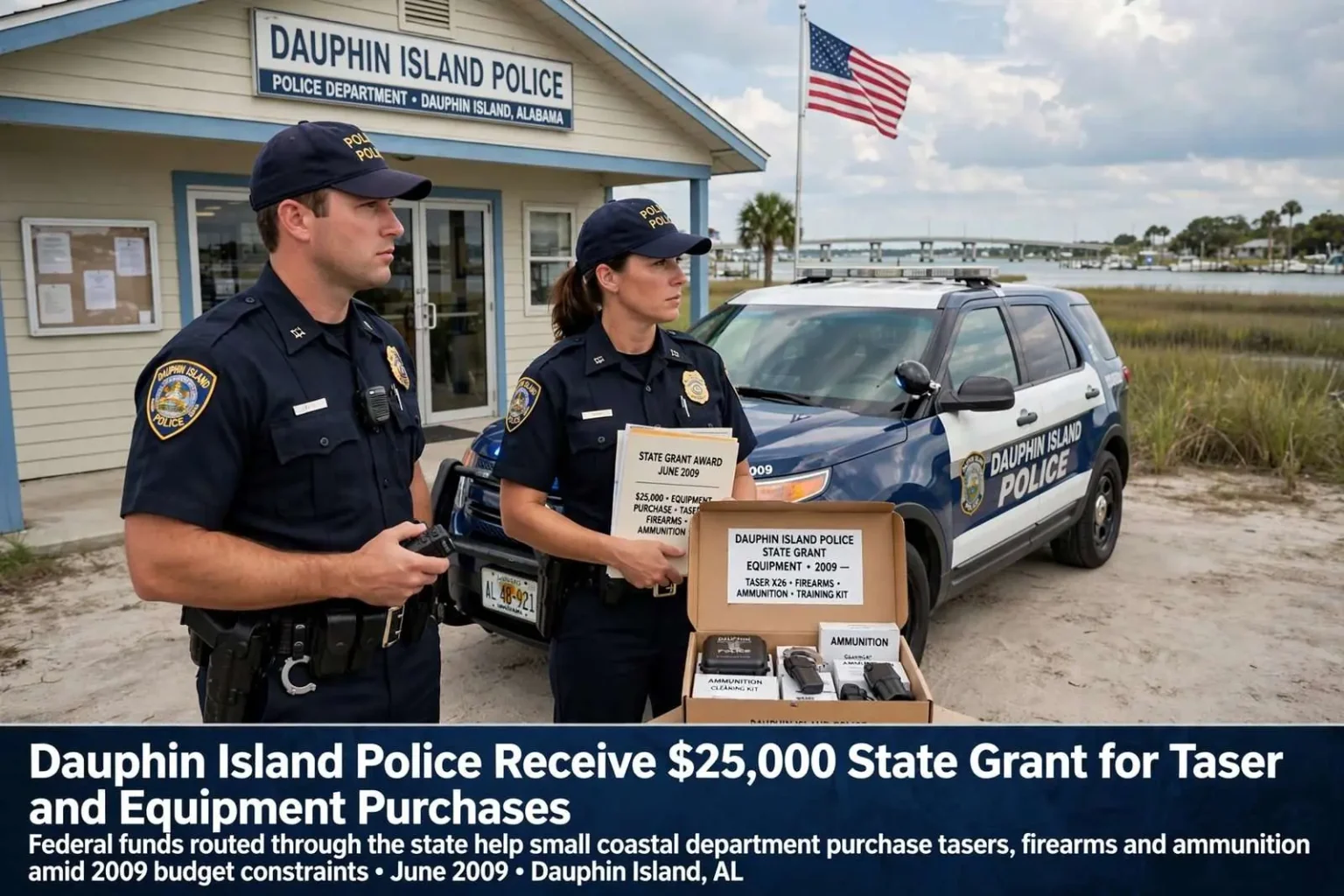
Dauphin Island police received a $25,000 state grant in 2009 to purchase Tasers and other equipment for officers after local budget constraints delayed earlier plans. The department said the funding would cover Tasers as well as new firearms, ammunition and related equipment. For a small barrier-island police department, the award represented the difference between deferring critical purchases for another budget cycle and putting the equipment in officers’ hands the same year.
The town’s budget had forced officials to postpone the purchases before the grant was announced. Small municipalities along the Alabama Gulf Coast face a familiar arithmetic: a limited tax base, a small full-time staff and public-safety costs that do not shrink when revenues dip. Dauphin Island, with its year-round population concentrated in a compact community and its policing responsibilities stretched by seasonal visitors, fishing traffic and storms, had found itself in exactly that position before the grant arrived.
Where the Money Came From
Federal funds routed through the state made the award possible. Gov. Bob Riley awarded the grant using funds made available to Alabama by the U.S. Department of Justice. The award was intended to help the island department obtain equipment it considered necessary for policing and officer safety. The routing — federal dollars flowing through state government to a local agency — is the standard mechanism by which Washington supports local law enforcement, allowing the state to set priorities among the requests it receives from police departments, sheriff’s offices and other agencies.
Riley said law-enforcement agencies needed reliable tools to protect and serve their communities. His administration distributed justice-assistance funding to departments across Alabama during his two terms as governor, with awards often targeted at equipment that small agencies could not otherwise absorb in their operating budgets. For Dauphin Island, the grant offered a way to move ahead with purchases that the town had not been able to fund through its regular budget.
Why Tasers Mattered to a Small Department
The Taser portion of the purchase reflects the way less-lethal options changed American policing in that era. Conducted-energy devices give officers an alternative between verbal commands and firearms in confrontations that fall short of deadly force, and departments that adopt them typically pair the hardware with certification training and usage policies. For a department with a small roster of officers responsible for an island community, the devices offered a way to de-escalate encounters without waiting for backup that might be miles away on the causeway.
The equipment purchases also carried a training component that small departments weigh carefully. Tasers require recurring certification, and firearms transitions involve qualification time and ammunition budgets — expenses that continue after the purchase itself. The grant’s coverage of ammunition and related equipment recognized those realities, funding not just the devices themselves but the sustainment costs that often stall such purchases in small departments.
Policing a Barrier Island
Local policing needs are a recurring local-government expense, especially for small municipalities balancing personnel, maintenance and public-safety demands. Dauphin Island’s circumstances sharpen those needs in particular ways. The town sits at the western end of Mobile Bay, connected to the mainland by a single causeway, and its police department operates far from the mutual-aid resources that mainland departments can summon quickly. Storm seasons add another dimension: island departments are responsible for evacuation support, damage assessment and security in the aftermath of tropical weather, all of which depend on functioning equipment.
The island’s seasonal economy shapes the department’s workload as well. Fishing tournaments, beach visitors and holiday weekends bring traffic and crowds that swell far beyond the town’s resident population, and the department patrols a community whose permanent population is small enough that every officer represents a significant share of its coverage. Equipment failures in that setting are harder to absorb than they would be in a larger city, which is why deferred purchases tend to linger until outside funding arrives.
What the Grant Did and Did Not Cover
The report did not specify how many devices or weapons would be purchased, nor did it provide a timeline for officers to begin carrying the equipment. It documented the grant as a targeted investment in the Dauphin Island Police Department’s resources — a single award addressed to a single department’s identified needs, rather than a broad program announcement. That specificity is typical of equipment grants to small agencies, where the request is built around a department’s own assessment of its gaps rather than a formula distribution.
The announcement in June 2009 came during a period when communities across Alabama were coping with the effects of the economic downturn on their local budgets. Sales tax and tourism-dependent revenues had softened across the state, and public-safety budgets — usually the largest discretionary slice of a small town’s spending — absorbed much of the pressure. Grants of the kind Riley awarded gave those towns a release valve, letting capital purchases proceed without cuts to staffing or services elsewhere in the budget.
A Historical Account of the Decision
This historical account reflects the state funding decision announced in June 2009 and the local budget conditions that preceded it. Viewed from that moment, the grant captures a recurring pattern in Alabama local government: a small department identifies an equipment need, the town’s budget cannot cover it, and state-administered federal funding closes the gap. The Dauphin Island award was modest by the standards of large urban departments, but for the island’s police force it funded the full range of what the department had deferred — Tasers, firearms, ammunition and related equipment — under a single state award.
The episode also illustrates the dependency of small-town policing on outside funding. A department the size of Dauphin Island’s cannot spread the cost of major equipment purchases across a large tax base, and when those needs arise, the alternatives are narrow: postpone, cut elsewhere, or seek grant support. In 2009 the town chose the third path, and the $25,000 award allowed the department to equip its officers with tools it had already determined it needed — a modest amount of money that nonetheless resolved a problem the town’s own budget could not.
The Grant System Behind the Award
The June 2009 announcement fits into the broader architecture of American criminal-justice funding, in which the U.S. Department of Justice distributes money to states and, through them, to thousands of local agencies each year. States receiving those funds typically run application cycles in which departments describe their needs and compete for allocations, with priority often given to agencies that can document a specific gap. Equipment purchases — radios, body armor, in-car cameras, less-lethal devices — are among the most common uses, because they are one-time costs that a small town cannot smooth into a payroll-driven budget.
For Alabama’s coastal counties, those federal streams have long been an important supplement to local funding. Departments in Mobile and Baldwin counties, along with the smaller municipalities scattered along the bay and the barrier islands, have drawn on justice-assistance grants for everything from communications upgrades to marine patrol equipment. The geography of coastal policing — long distances, isolated communities, hurricane exposure — has made equipment reliability a recurring theme in the region’s grant requests, and Dauphin Island’s 2009 award followed a well-worn path.
The Officer-Safety Dimension
The grant’s stated purpose — equipment necessary for policing and officer safety — points to the calculation every small department makes about its people. An island department’s officers patrol alone more often than their big-city counterparts, backups take longer and the population they encounter includes transient visitors the officers have never met. Equipment that improves an officer’s options in an uncertain encounter is therefore not a luxury purchase but a core safety investment, which is how the town and the governor’s office framed it.
Reliability was the word Riley used in making that case, and it captures why equipment grants target the basics. A department cannot deploy a device that fails in the field, and outdated firearms or insufficient ammunition supplies create risks that no policy can offset. The 2009 award addressed the department’s equipment inventory as a whole rather than a single item, recognizing that Tasers, firearms and ammunition function as a package in a department’s use-of-force readiness.
The Broader Lesson for Small Towns
Two decades later, the episode remains a useful case study in how Alabama’s smallest municipalities manage public safety. The town’s decision to seek the grant came only after its own budget had proven insufficient, and the state’s decision to fund it reflected a judgment that the department’s needs were legitimate and pressing. Neither party could have solved the problem alone at the level the town could afford, and the partnership between them — federal dollars, state administration, local need — produced the outcome that none could have achieved alone.
That pattern remains the reality for the Gulf Coast’s small police departments, where seasonal demands, storm exposure and limited budgets intersect. Equipment purchased with grant funds eventually wears out, training requirements recur and the cycle of need begins again. What the June 2009 grant document records is one turn of that cycle: a town that postponed what it could not afford, a governor’s office that shared the cost, and a department that put the equipment to work protecting a community of a few thousand people at the end of a causeway in Mobile Bay.