Mobile’s Stop the Madness Rally Connected Youth With Community Options in 2009
Mobile's Stop the Madness rally brought businesses, churches and community groups together in 2009 to connect teenagers with positive activities, jobs and alternatives to gangs and crime.
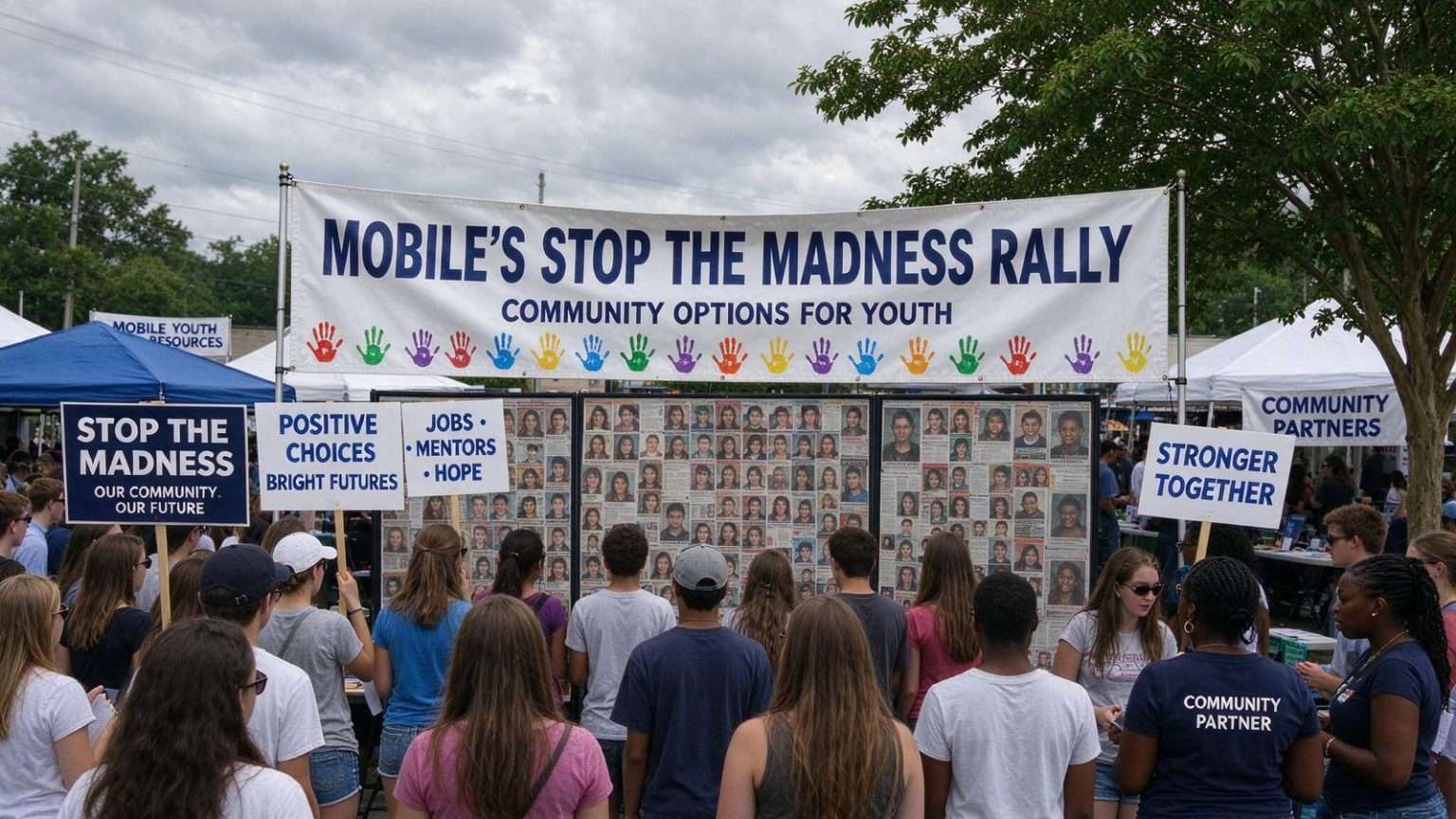
Mobile’s Stop the Madness rally brought local businesses, churches and community groups together in June 2009 with the goal of steering teenagers away from gangs and crime. The gathering, built around prevention rather than punishment, aimed to put young people face to face with the adults and institutions that could offer them something better — a job application, a mentor, a church group, a reason to stay in school. Organizers described the event as an attempt to offer young people positive options, including contact with local businesses, jobs and community involvement.
Program coordinator Denise Patterson spoke to the core concern behind the rally: young people can drift without positive opportunities to pursue. Her point reflected what community workers across Mobile had observed for years — that teenagers without structured summer activities, employment prospects or adult attention are the ones most vulnerable to recruitment by street groups. A June rally was timed deliberately, arriving at the point of summer when school-year routines disappear and idle weeks stretch ahead of young people with nothing to fill them.
Denise Harris Wells of Remington College said organizers wanted residents and institutions to take part in solutions for safer neighborhoods. That framing put responsibility on the whole community rather than on law enforcement alone. Businesses that hire young workers, churches that open their doors after school and civic groups that sponsor activities all become part of the safety infrastructure, in that view — not through programs with official titles, but through ordinary contact between adults and teenagers who might otherwise never interact.
What the Rally Looked Like on the Ground
The most sobering element of the event was a display that included a collage memorializing young people killed by violence in Mobile County during the preceding three years. The collage gave the rally’s abstract message a concrete face, or rather dozens of them, and it confronted attendees with the stakes behind every conversation about prevention. For parents and teens walking past, the images served as a reminder that the statistics discussed in policy meetings are names and families in neighborhoods across the county — Prichard, Chickasaw, Toulminville, down Germania and into downtown.
The event focused on prevention and community engagement rather than individual cases, a deliberate choice that kept the emphasis on what could be built rather than who could be blamed. Representatives from local businesses were on hand to talk with teenagers about employment, and church members and community group volunteers staffed booths and conversations throughout the gathering. The format reflected a widely held belief in community organizing circles: young people respond to being wanted, and a rally that treats them as future employees, students and leaders reaches them differently than one that treats them as suspects.
Mobile in 2009 was a city wrestling with the same questions as communities across the Gulf South. Economic pressures following the recession had cut into youth summer employment, and competition for a limited number of jobs left many teenagers without their first work experience. Neighborhood organizations, faith communities and city institutions had long-running anti-violence efforts, but organizers of events like Stop the Madness argued that the connections formed at a single gathering — a teenager shaking hands with a business owner, a family learning about a church’s after-school program — were the thread that could hold a young person through a difficult season.
The Role of Local Businesses
The rally’s emphasis on contact with local businesses recognized a practical truth: employment is one of the strongest protective factors for teenagers. A summer job fills idle hours, provides income that reduces temptation, builds a résumé and puts a young person under the supervision of adults who notice when something is wrong. Businesses that participate in youth hiring also gain employees trained in basics — punctuality, customer service, responsibility — that make them more employable later.
For Mobile’s business community, participation in events like Stop the Madness was also self-interest in the plainest sense. Neighborhoods where young people have prospects are neighborhoods where commerce is safer and stronger, and business owners who hire locally build a customer base that has a stake in their success. The rally gave merchants a low-friction way to get involved: show up, talk to teenagers, and leave the door open.
Churches and Community Groups as Anchors
Churches have historically been the most durable institutions in Mobile’s neighborhoods, and their presence at the rally reflected that standing. Congregations across the city run vacation Bible schools, youth groups, food ministries and mentoring programs, and summer is when many of those efforts need volunteers most. A teenager who connects with a church youth program in June may spend the rest of the summer with somewhere to go on weekday evenings and adults who know his or her name.
Community groups filled a similar role for families who were not connected to a congregation. Civic associations, fraternal organizations, youth sports leagues and neighborhood watch groups all maintain programming that depends on participation, and the rally functioned as a matchmaking session of sorts — putting families in the same room as the groups that could serve them. Organizers understood that a flyer or a phone number rarely moves a teenager; a conversation with a coach or a program leader often does.
The Broader Mobile Context
The rally took place against a backdrop of long-running concern about youth violence in Mobile County. The city and its neighbors had seen cycles of violence claim young lives in clusters, often tied to disputes that began over small matters and escalated through retaliation. Community memorials, vigils and anti-violence marches had become familiar events, and the collage displayed at Stop the Madness grew directly out of that recent history — young people from the preceding three years whose deaths had touched schools, churches and blocks across the county.
Prevention advocates in Mobile and elsewhere have long argued that enforcement alone cannot break those cycles. Investigations and arrests address individual cases, but the conditions that draw teenagers toward street life — absent opportunity, fractured adult relationships, unstructured time — persist unless institutions act. Events like Stop the Madness were part of that institutional response, modest in cost but significant in the connections they created.
The choice of June mattered as well. Summer months historically bring a rise in juvenile crime and violence in cities across the country, and Mobile was no exception. School-year structure — classes, sports, after-school programs — disappears, and teenagers who depended on it face long unstructured days. Communities that plan summer engagement before the break starts tend to fare better than those that react afterward, which is why rallies, job fairs and program sign-ups cluster in late spring and early summer.
What Organizers Hoped to Leave Behind
Patterson’s observation about drift cut to the heart of the event’s theory of change. A young person with a job interview scheduled, a team practice to attend and a mentor checking in does not drift; a young person with none of those does. The rally aimed to move as many Mobile teenagers as possible from the second category to the first before the summer hardened into a pattern, using the leverage of a single afternoon — businesses, churches and groups gathered in one place, accessible to any family that walked up.
Wells’ emphasis on shared responsibility extended the same logic to adults. Safer neighborhoods are not produced by police departments alone, and they are not produced by any single program. They emerge when residents know each other, when institutions stay engaged between crises and when young people can name adults who would be disappointed if they went the wrong way. The rally asked attendees to leave as those adults.
Prevention as a County-Wide Effort
Although the rally carried Mobile’s name, the problem it addressed crossed municipal lines throughout Mobile County. Prichard, Saraland, Chickasaw, Satsuma and the unincorporated communities along the county’s northern and western edges all had young people affected by the same forces, and violence in one neighborhood rarely stayed contained there. Community organizers had long coordinated across those lines — sharing mentors, transportation and gym space — because the geography of family life in the county ignores city limits. A teenager with an aunt in Toulminville, a grandmother in Prichard and a school in downtown Mobile belongs to all of those places at once.
That reality shaped how events like Stop the Madness were organized. Rather than targeting a single neighborhood, the rally invited participation from across the county, recognizing that families travel to opportunities and that a business owner in west Mobile can hire a teenager from the eastern shore of the community just as easily. The collage of young people lost to violence likewise represented the whole county, not one district, and that breadth was part of what gave the display its weight.
The Limits and the Promise of a Single Event
No one involved in organizing the rally claimed that one afternoon would transform a teenager’s trajectory. The realistic hope was smaller and more durable: that some number of young people would leave with a name to call, an application to fill out or a place to show up the following week. Community prevention work accumulates through exactly those small commitments, made repeatedly across seasons and years, and rallies function as the public doorway into that longer process.
The event also served the adults as much as the teenagers. Business owners who had wondered how to get involved left with contacts at youth-serving organizations. Church members met counterparts from across town working on the same problems. Families discovered programs they did not know existed blocks from their homes. A rally is, in that sense, a network-building exercise as much as a youth event, and the network is what persists after the folding chairs are put away.
The memorial collage ensured the stakes stayed visible throughout the afternoon. Every conversation about job applications and summer programs happened within sight of the faces of young people who had run out of chances — a deliberate piece of stagecraft that kept the event from drifting into mere festivity. Organizers of anti-violence events across the Gulf South have used similar memorials for the same reason: grief, honestly displayed, is a powerful argument for action.
A Record of the Moment
This account records the aims of the 2009 rally and does not state later program results, participation totals or the status of the organizations involved. What the record preserves is the shape of Mobile’s response at a particular moment: a community that chose to answer youth violence with engagement, that put businesses and churches in the same room as teenagers, and that honored its losses not with silence but with a collage that demanded the living do better.
The questions Stop the Madness posed — who will hire a teenager, who will mentor one, who will notice when a young person starts to drift — remain the operative questions in Mobile County long after that June afternoon. The institutions and residents that gathered in 2009 were part of a long local tradition of treating youth violence as a community problem with community answers, and the rally stands as one documented chapter of that continuing effort.