Forbes Ranked Mobile Among Top Cities for Recession Recovery in 2009
Forbes placed Mobile among its top U.S. cities for recession recovery in 2009, citing projections, housing, income, unemployment and the region's diverse industries.
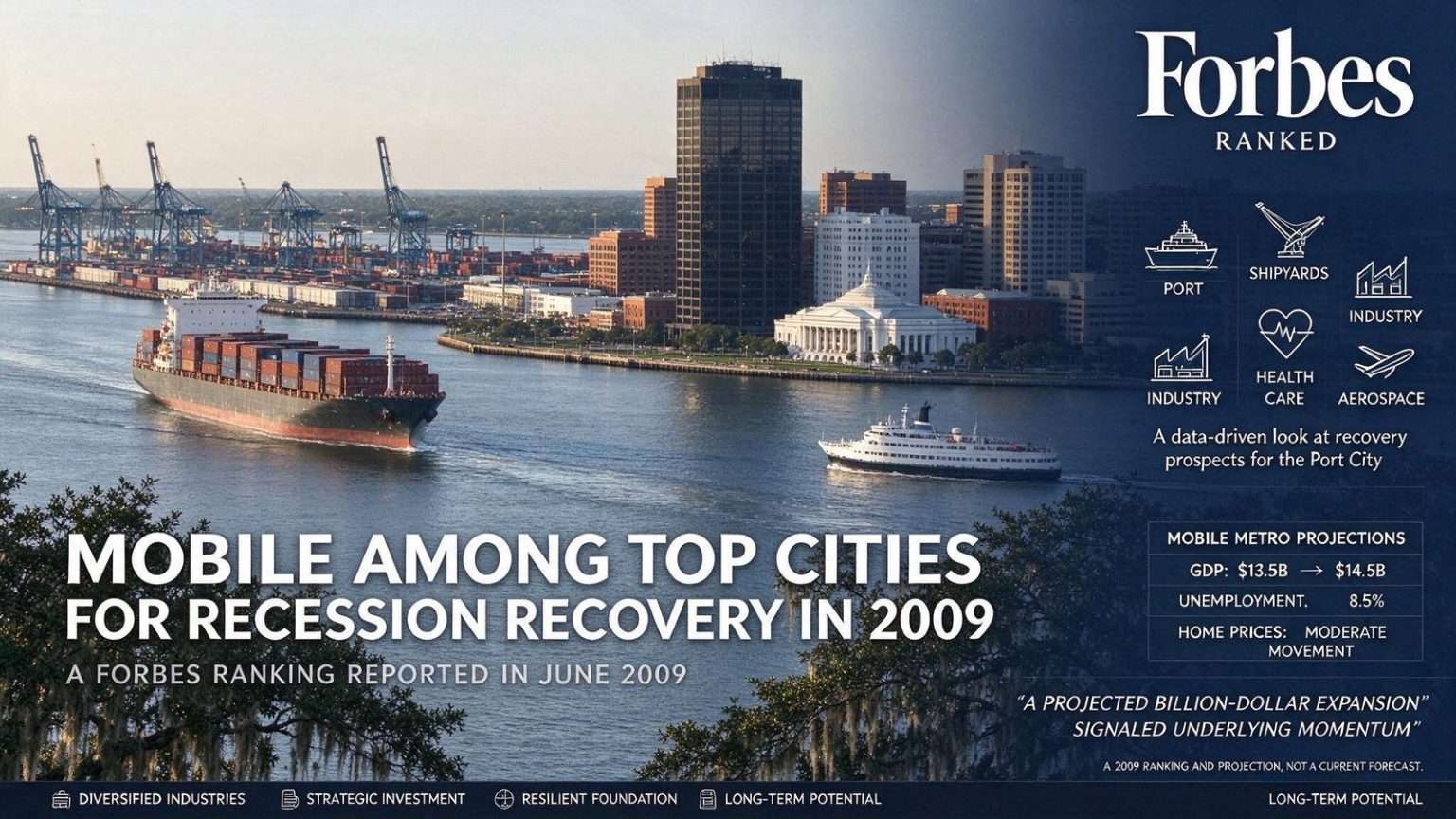
Forbes included Mobile among its top 10 U.S. cities for recession recovery in a ranking reported in June 2009, a distinction that placed the Port City alongside a select group of metropolitan areas the magazine projected would climb out of the national downturn faster than most of the country. The list arrived at a moment when communities across Alabama and the Gulf Coast were still absorbing the shock of layoffs, frozen credit markets and a housing slump that had stalled construction in nearly every corner of the region. For Mobile, the recognition served as an outside validation of an economic strategy that city leaders had spent years building around the port, the shipyards and a steadily diversifying industrial base.
The Forbes ranking weighed several forward-looking measures of metropolitan economic health, including projected metropolitan economic output, unemployment, home prices and income. Rather than simply measuring which cities had been hurt least by the recession, the analysis attempted to identify the places where recovery would take hold earliest and move fastest once the national economy began to turn. That distinction mattered for Mobile, which, like metro areas across the South, had watched national headlines raise questions about whether a regional economy so closely tied to shipping, manufacturing and trade could withstand a downturn of that depth.
At the time the ranking was published, Mobile’s unemployment rate was reported at 8.5 percent, a figure that reflected the strain the recession had placed on local workers even as analysts pointed to reasons for optimism about the months ahead. The jobless rate captured the reality on the ground in mid-2009: hiring had slowed, some residents had been out of work for months, and competition for open positions remained intense across the region. Still, the metro area’s gross domestic product was projected to grow from $13.5 billion to $14.5 billion by the end of the following year, an increase that, if realized, would signal a meaningful expansion of the region’s overall economic activity despite the tough environment.
A data-driven look at recovery prospects
Forbes’ methodology relied on projections and current indicators rather than a single snapshot of conditions, which is part of why the analysts behind the list argued it offered a preview of where the recovery’s geography would take shape. The approach reflected a broader shift in how economists evaluated regional economies during the recession, as traditional signals such as housing starts and retail sales gave way to measures of output, income and employment that could be tracked metro by metro. For a mid-sized metropolitan area such as Mobile, appearing on such a list meant analysts saw underlying fundamentals strong enough to power a rebound rather than merely absorb damage.
The timing of the recognition carried particular weight locally. By the summer of 2009, the national recession, which began in late 2007, had become the longest and deepest downturn since the Great Depression, and communities along the Gulf Coast were contending with both the national slump and regional pressures in shipping and heavy industry. Local officials had spent the previous two years courting aerospace work, expanding port facilities and recruiting new employers in an effort to make Mobile less dependent on any single sector. A national magazine concluding that those efforts had positioned the city for a faster-than-average recovery was, for City Hall, evidence that the strategy was being noticed beyond Alabama’s borders.
What the numbers meant for Mobile
The projected growth in metropolitan gross domestic product stood at the center of Mobile’s showing on the list. A metro area’s GDP measures the total value of goods and services produced within its borders, and for Mobile that figure was projected to rise from $13.5 billion to $14.5 billion by the end of the following year. Economists watch that measure closely during downturns because output tends to recover before hiring does: companies typically restore production and shipping volumes first, then begin adding workers once they are confident the demand will hold. A projected billion-dollar expansion suggested to Forbes analysts that Mobile’s underlying economy retained momentum even with unemployment sitting at 8.5 percent.
The unemployment figure itself put Mobile in line with statewide conditions at the time. Alabama’s jobless rate had climbed steadily through 2008 and into 2009 as manufacturing, construction and retail all shed positions, and communities along the Gulf Coast felt the pullback in everything from dockside hiring to residential building. Against that backdrop, the Forbes projection was less a declaration that Mobile had escaped the recession than a judgment about trajectory, an assessment that the region’s mix of employers and its pipeline of industrial projects would allow it to regain lost ground sooner than most American metros.
Home prices and income, the other two pillars of the ranking, told a similar story. Unlike Sun Belt metros that experienced dramatic housing bubbles and equally dramatic collapses, Mobile had seen more moderate price movement, which limited the damage when the national housing market seized up. Steady income levels across the metro gave households a firmer footing to keep spending through the downturn, supporting the local restaurants, shops and service businesses that anchor neighborhood economies. For the magazine’s analysts, those conditions combined with the output projections to paint a picture of a region that had been bruised by the recession but not broken by it.
Rankings of this kind also carried practical significance beyond civic pride. Economic development organizations across Alabama routinely cite national media recognitions when courting prospective employers, and a Forbes designation offered an independently produced talking point for recruiters pitching Mobile to companies weighing expansion decisions during the downturn. In a period when businesses were cautious about committing capital anywhere, third-party validation that a city was positioned to recover quickly could influence where new facilities and jobs ultimately landed.
Reading the ranking in context
Analysts cautioned then, as they do now, that such lists are snapshots built on projections rather than guarantees. Metropolitan forecasts made in the middle of a recession carry wide margins of error, and a ranking that looks prescient one year can look outdated the next as federal policy, global demand and local developments shift. But for Mobile residents and business owners living through the downturn, the June 2009 recognition offered something that had been in short supply: an outside, data-based reason to believe the hardest stretch was passing and that the city’s long-term economic foundations remained intact.
Industry diversity factored into outlook
The report cited Mobile’s mix of aerospace, maritime, health care and hospitality industries as a factor supporting its recovery outlook. That blend of employers mattered because no single sector dominated the metro economy, so weakness in one industry could be cushioned by stability or growth in the others. Diversification has long been a stated goal of Mobile’s economic development efforts, precisely because port cities that lean too heavily on one trade or one employer can be devastated when that industry cycles downward. In 2009, the magazine’s analysts concluded that Mobile had assembled a mix resilient enough to carry it through the recovery.
The maritime component of that mix was anchored by the Port of Alabama at Mobile and the shipbuilding and repair operations clustered along the Mobile River, work that continued through the downturn as naval contracts and commercial shipping demand provided a base of activity. Aerospace employers in and around the city added another layer, part of a deliberate, years-long push to bring higher-wage technical work to the Gulf Coast. Health care, which employed thousands across the metro’s hospital systems and clinics, tended to hold steady regardless of economic conditions, giving the region a reliable employment floor when discretionary industries pulled back.
Hospitality completed the picture. Mobile’s Carnival tourism, convention traffic and its role as a gateway for travelers headed to the Gulf beaches kept visitor dollars flowing into downtown restaurants, hotels and attractions even during the slump. Tourism jobs often pay less than industrial work, but the sector’s steady demand helped absorb some of the workers displaced from harder-hit industries, and the city’s historic downtown had been the focus of revitalization efforts that officials hoped would accelerate once the recovery took hold.
Mayor Sam Jones welcomed the recognition but said the city still needed to manage spending cautiously during the downturn. His caution reflected the reality facing municipal governments across Alabama in 2009: sales tax and property tax revenues had softened with the economy even as demand for services held steady or grew. Cities that had expanded their budgets during the boom years were being forced to trim, and Jones signaled that Mobile would treat the Forbes distinction as encouragement rather than as a license to relax its fiscal discipline.
City Hall balancing optimism and caution
The mayor’s dual message, pride in the ranking paired with a pledge of careful budgeting, summed up the posture of many Gulf Coast local governments that summer. Recognition from a national business magazine helped morale and marketing alike, but payroll deadlines, paving contracts and public safety budgets do not pause for good press. Jones’ approach was to let the projection reinforce the city’s recruitment pitch while keeping day-to-day spending aligned with the revenues actually arriving at City Hall, a stance that mirrored the belt-tightening underway in households across the metro.
A year after being named fastest-growing midsized city
Mobile had also received a Forbes designation the previous year as the fastest-growing midsized U.S. city, according to the report. Taken together, the two recognitions formed a narrative that local officials were eager to tell: the city was not merely bouncing back from a national crisis, but had been building economic momentum in the years before the recession arrived. For a metro that had spent decades working to diversify beyond its traditional port and paper-making roots, back-to-back nods from a national business publication suggested the investment was paying measurable dividends.
That earlier recognition had highlighted Mobile’s population and economic growth relative to other midsized metros nationwide, a category in which the city competed against communities across the Southeast that were themselves growing quickly. Holding its own in that field reflected the region’s combination of relatively affordable housing, available land for industrial development, a deepwater port and a business climate that state leaders had spent years marketing aggressively to manufacturers and aerospace firms. The recession then tested whether that growth story had real foundations or was simply riding a national boom, and the 2009 recovery ranking was Forbes’ answer that the fundamentals held.
For residents, the practical meaning of the recognitions lay in what they signaled about future opportunity. A city projected to expand its economic output was a city where employers were more likely to hire, where construction projects were more likely to proceed and where the tax base supporting schools, roads and public safety was more likely to recover. During a period when national news was dominated by foreclosures and layoffs, the rankings gave Mobile a counter-narrative: a mid-sized Gulf Coast city that analysts expected to emerge from the recession ahead of much of the country.
Together, the recognitions reflected local optimism about the region’s ability to withstand the national recession. City officials, business leaders and residents alike pointed to them as evidence that Mobile’s strategy of diversification, port investment and industrial recruitment had positioned the community to weather the storm and come out stronger on the other side. Whether every projection made in the depths of the downturn came to pass exactly as forecast, the June 2009 ranking captured a genuine turning point in how the region was perceived nationally.
This is a historical account of a 2009 ranking and economic projection. It does not represent current Forbes rankings, present-day unemployment data or a current forecast for Mobile’s economy. Figures such as the 8.5 percent unemployment rate and the projected growth in metropolitan gross domestic product reflect conditions and estimates as they were reported at the time of the June 2009 article.