Airbus Launches New High School Pipeline and Fast-Track Hiring Program in Mobile
Airbus and Gov. Kay Ivey announced two new workforce programs, FlightPath9 for high school seniors and the Fast Track training program, aimed at building a homegrown pipeline of aerospace workers in Mobile.
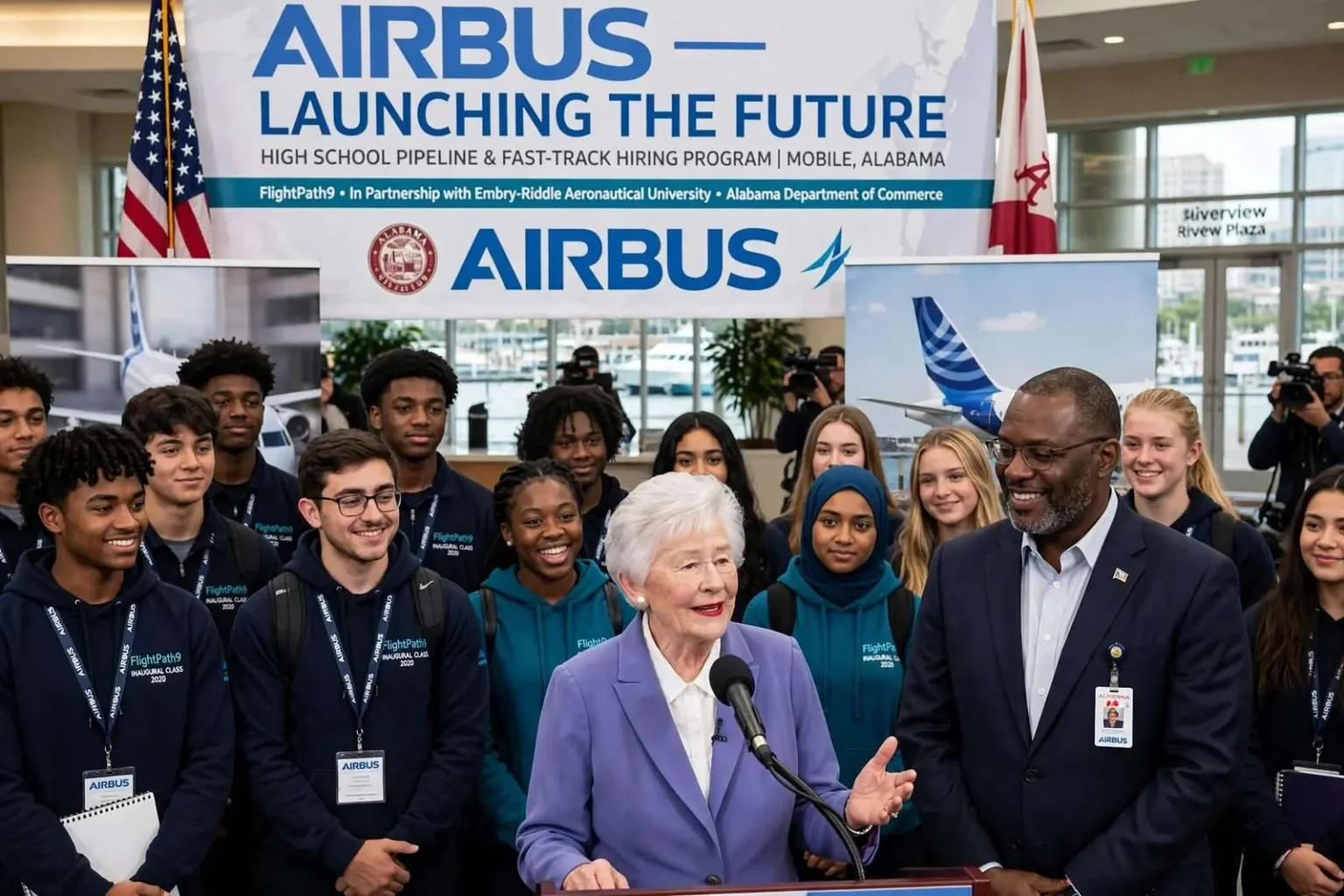
Airbus and Alabama Gov. Kay Ivey unveiled two new workforce initiatives this month designed to steer more local residents into aerospace careers, as the Mobile-based aircraft manufacturer looks to grow its homegrown talent pipeline. The first effort, called FlightPath9, targets incoming high school seniors who have an interest in aviation and an aptitude for hands-on technical work.
Candidates must be willing to commit to a nine-month program, remain drug free, meet basic literacy and math requirements, turn 18 by June 2020 and demonstrate solid workplace skills, according to Daryl Taylor, vice president and general manager of Airbus’ Mobile A320 manufacturing facility, who spoke at an announcement event held downtown at the Riverview Plaza. Gov. Ivey said the program puts participating students “on a path to a career,” calling the launch a “spectacular day” for the students involved and for the region’s aerospace industry as a whole.
The requirements reflect the reality of modern aircraft assembly work. A final assembly line runs on precision, schedule discipline and safety, and manufacturers of Airbus’s scale invest heavily in screening for the habits — reliability, attention to procedure, drug-free conduct — that determine whether a new hire succeeds on the floor. By moving the screening process into a high-school pipeline, the company effectively identifies promising workers years before they would otherwise appear in its applicant pool.
The Inaugural Class
The inaugural FlightPath9 class includes 25 students drawn from 10 Mobile County schools and one Baldwin County school. McGill-Toolen Catholic High School sent the largest contingent with six students, followed by B.C. Rain High School with five. St. Michael Catholic High School in Fairhope was the only Baldwin County school represented in the first cohort. The mix spans Mobile County’s public, Catholic and private schools, and Airbus officials said the first year focuses primarily on Mobile County public and Catholic schools, with possible expansion to additional schools and counties in future years.
Airbus officials said the strong showing from B.C. Rain reflects the school’s existing aerospace academy, which has already introduced many of its students to aviation coursework. The academy has made the south Mobile County school a natural feedstock for the region’s aviation employers, and its students arrive at programs like FlightPath9 with foundational knowledge their peers elsewhere must acquire from scratch. Among that group is incoming senior Ty’Nora Edwards, who called her selection a “once-in-a-lifetime opportunity.” Edwards said she turned down an invitation from Stanford University to take part in a summer law program in order to instead pursue a Naval aviation course, though she still hopes to eventually attend law school and work as an attorney for the Navy.
Ben Vereen, an incoming senior at McGill-Toolen, said he is looking forward to the twice-weekly evening classes that will run alongside his regular school schedule and after-school job. He said the program offers a clear route into the aerospace industry and a chance to build a relationship with Airbus before graduation. For students like Vereen, the appeal is the combination: a credential-bearing program that fits around normal coursework, and a direct connection to the region’s largest manufacturer that no classroom alone could provide.
How the Class Was Chosen
To identify candidates, Airbus first reached out to school counselors, who shared information with interested students. The company then held an information session for students and parents, followed by drug screening and round-robin interviews to determine which applicants were the best fit for the inaugural class. The process borrowed deliberately from the company’s own hiring pipeline — interviews conducted in rounds, screens for dependability, and a parent information session designed to make sure families understood the commitment before students signed on for a nine-month schedule that will overlap their entire senior year.
Officials said the company will evaluate its staffing needs each year to determine how many students can join future FlightPath9 classes, with the first year focused primarily on Mobile County public and Catholic schools. Airbus said the program could expand to additional schools and counties in future years. The year-by-year approach ties class size to hiring forecasts rather than building the program faster than jobs can absorb it — a lesson drawn from workforce programs elsewhere that trained more workers than the local industry could hire.
More Than 200 Hours of Instruction
As part of FlightPath9, Airbus is partnering with Embry-Riddle Aeronautical University, which already operates two campuses in Mobile, to provide participating seniors with more than 200 hours of instruction and the opportunity to earn as many as 13 industry certifications. Classes will be taught by Mobile-based faculty and will run two evenings a week from 3:45 p.m. to 7:45 p.m., with dinner provided. The evening schedule keeps the program compatible with a full high school course load and part-time jobs, while the dinner removes a practical barrier for working students. Embry-Riddle’s Mobile campuses give the program an established aviation education partner with accreditation and industry recognition behind the certifications students will earn.
The certifications themselves matter more than their number. Industry-recognized credentials in aircraft assembly give graduates portable qualifications across the Gulf Coast aerospace cluster — a sector that now includes not only Airbus’s final assembly line but a growing ring of suppliers on the Alabama Gulf Coast and beyond. A student who completes FlightPath9 leaves high school with documented skills that employers across the region can verify, rather than a diploma alone.
The Fast Track Program
Students who complete FlightPath9 will be eligible to join Airbus as full-time employees through the company’s second new initiative, the Fast Track program. Fast Track is open to anyone with an interest in aerospace, regardless of prior experience, and pays $16 an hour during a 12-to-15-week training period. Participants learn core aircraft-assembly skills such as torqueing, riveting, gauging, blueprint reading, tool use and ergonomics before moving on to hands-on training on Airbus’ A220 and A320 aircraft lines in Mobile.
The paid training period is what distinguishes Fast Track from most workforce programs. Rather than asking applicants to absorb the cost of learning, Airbus pays while it trains — $16 an hour for as long as 15 weeks — which opens the program to career-changers and workers from other industries who cannot afford unpaid retraining. The skill list runs from the mechanical basics of torqueing and riveting to blueprint reading and ergonomics, the vocabulary of an assembly floor, before candidates ever touch an actual A220 or A320 structure in Mobile.
Fast Track openings are currently available for electrician, structural assembler and corrosion team positions, with postings listed on Airbus’ career site. The three specialties map onto the daily work of keeping an assembly line moving: electricians run wiring and systems installation, structural assemblers join the airframe sections, and corrosion teams protect finished structures against the salt-air environment of a Gulf Coast site. Together, company officials said, FlightPath9 and Fast Track are meant to build a steady homegrown pipeline of skilled workers for the growing Mobile aerospace campus, giving local students and job seekers a direct route into the industry without requiring a four-year degree.
The initiatives arrive as competition for skilled aerospace labor has intensified along the Gulf Coast. Airbus’s Mobile plant has grown steadily since its 2015 opening, adding the A220 line alongside the A320 work and expanding its output year after year, and every expansion increases demand for the same pool of mechanically skilled workers that shipbuilders, other manufacturers and the regional aerospace suppliers are also chasing. Building a pipeline through the high schools of Mobile and Baldwin counties — students who live within commuting distance of the plant and can progress from FlightPath9 into Fast Track and onto the line — insulates the company from that competition in a way out-of-market recruiting cannot.
For the region, the programs carry an economic promise that extends beyond Airbus itself. A high school senior who earns 13 industry certifications before graduation has options across the Gulf Coast economy, whether at the final assembly line, at a supplier, at the shipyard across Mobile Bay or in aviation maintenance. The two programs formalize a path that previously depended on chance connections — a counselor who knew about a posting, a relative who worked in the industry — and make it available to any student or job seeker in the region willing to commit to the training.
State government’s role, represented by Gov. Ivey at the announcement, reflects the same priority. Alabama has staked much of its economic development strategy on aerospace and advanced manufacturing, and the workforce that strategy requires cannot be imported in full. Programs that connect schools to employers have become the standard instrument of that policy across the state, and the Airbus announcement placed Mobile — home to the state’s flagship aerospace manufacturing operation — at the front of that effort. For the 25 students of the inaugural FlightPath9 class, the sequence that begins with twice-weekly evening classes could end, two years from now, with a full-time job on an aircraft line in their hometown.