
Mobile Police Respond to Overnight Shooting Report at Azalea Pointe Apartments
Mobile police investigated an early-morning shooting at Azalea Pointe Apartments on Azalea Road; the victim's injuries were not serious.
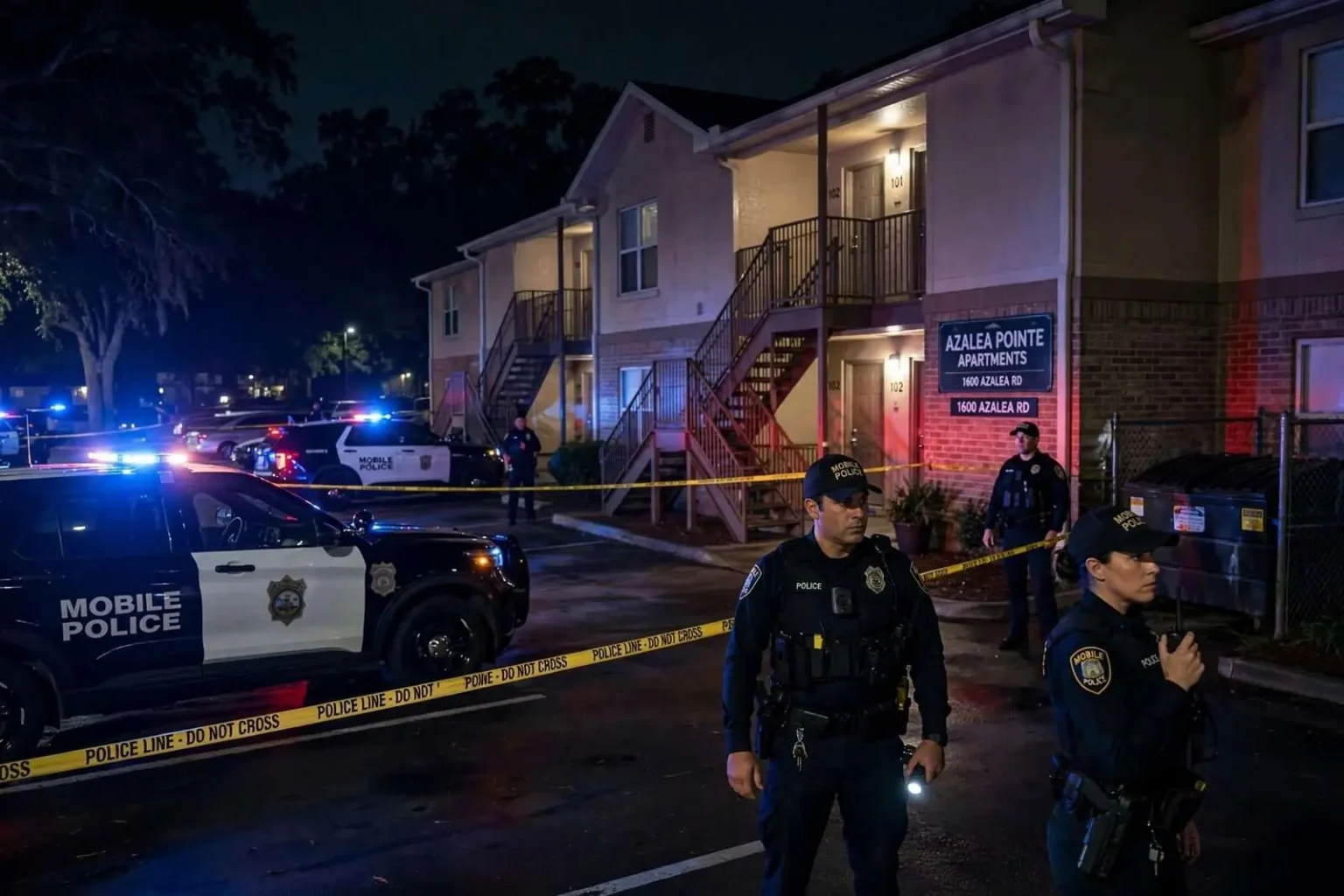
MOBILE, Ala. — Mobile police responded to a report of a shooting at the Azalea Pointe Apartments on Azalea Road in the early hours of Friday morning. Officers were dispatched around 4:20 a.m., according to the Mobile County crime map, which logged the incident as an assault. When officers arrived, they found a man who had been wounded. The victim was alert enough to point out to officers where he had been shot, and he was treated at the scene. His injuries did not appear to be serious. No arrests were immediately announced, and police have not released a description of any suspect. Investigators continue to look into what led to the gunfire.
The dispatch came at one of the quietest hours of the city’s day, when apartment complexes sleep and the only traffic on major corridors belongs to early workers and late stragglers. According to the Mobile County crime map, the public log of calls for service across the county, officers were sent to the Azalea Pointe Apartments around 4:20 a.m., and the incident was categorized as an assault — the classification the system applies while the nature of an injury call is being sorted out. What officers found on arrival was a man who had been shot.
The victim’s condition made the encounter different from many overnight shooting responses. He was alert enough to point out to officers where on his body he had been shot — an exchange that matters both medically and investigatively. Medically, it gave responding crews immediate direction for assessment and treatment, which was administered at the scene. Investigatively, an alert victim is an investigative resource, and officers could begin asking the questions that will determine whether the shooting has witnesses, suspects, or a discernible trail, before the scene dissolved into a closed door and a crime log entry.
His injuries, per the initial account, did not appear to be serious. Non-fatal shootings of this kind are the most common form of gun violence in American cities, far outnumbering homicides, and they occupy a particular place in police work: serious enough to demand full investigative treatment, survivable enough that the victim may be discharged from care the same day and back in the community before detectives have finished their first round of interviews.
The Scene at Azalea Pointe
The Azalea Pointe Apartments sit on Azalea Road in west Mobile, one of the city’s densest corridors for multifamily housing. Azalea Road runs between Airport Boulevard and Government Street, lined with apartment communities, office parks and retail strips where thousands of residents live within a few square miles. Complexes along the corridor experience the full range of urban calls for service — alarms, disturbances, domestic incidents and, periodically, gunfire — and overnight disturbances draw officers from across the western districts.
An overnight shooting at an apartment complex triggers a standard sequence. Patrol officers secure the scene and render aid first. A perimeter establishes whether a suspect may still be nearby, and a K-9 track or drone search follows when circumstances support one. Detectives arrive to process the scene — shell casings, blood evidence, bullet strikes, vehicles of interest — and canvas the complex for witnesses, a task that is hardest between 4 and 5 a.m., when the number of people awake to have seen anything is at its smallest.
The crime map entry, logged as an assault, will be updated as the investigation firms up the facts. The public log is the county’s transparency mechanism — a running record of where and when calls for service occur — and it is frequently the first public trace of an overnight incident, hours before any press release or official confirmation. Residents across Mobile use the map to track activity near their homes and workplaces, though the entries reflect reports rather than adjudicated facts.
What Investigators Are Working With
Police released no description of any suspect and announced no arrests, which is the normal condition of a shooting investigation in its first hours and days. The questions detectives will pursue are the ones every gunfire scene poses: where the shots were fired from, how many shooters and weapons were involved, whether the victim was targeted or struck randomly, and what brought the victim and the shooter into the same place before 4:20 a.m. The answers determine whether the case moves toward a targeted-violence investigation, a dispute that escalated, or something else entirely.
Witness cooperation is the hinge in cases like this one. Overnight shootings in apartment complexes often have dozens of potential witnesses within earshot and few who come forward on their own. Mobile police routinely appeal to residents of a complex after such an incident, and investigators can work with tip lines that allow anonymity for anyone reluctant to be identified. The difference between a closed case and a cold one, detectives often say, is usually a phone call made in the first week.
The victim’s own account will be central, but investigators treat initial statements carefully — victims who are wounded, frightened or involved in the circumstances leading to the shooting may give incomplete or shifting accounts, and detectives reconcile those accounts against the physical evidence. Hospital treatment records, once the victim’s care is complete, also feed the file, documenting the wound and its severity for whatever charges the evidence eventually supports.
Gun Violence Response in Mobile
Mobile police investigate shootings of this kind against the backdrop of a broader city effort around gun violence. The department deploys its investigators, crime analysts and community policing resources to address both the individual cases and the patterns behind them — repeat locations, retaliatory cycles, and the small number of incidents that account for a disproportionate share of the city’s gunfire. Non-fatal shootings receive that attention because the research is unambiguous: they are both predictors and products of further violence, and intervening after the first shot is how departments interrupt the cycle.
Citywide, Mobile’s response includes traditional enforcement and community-based violence prevention, with police working alongside neighborhood associations, faith leaders and intervention programs. West Mobile’s apartment corridors, where thousands of residents live in close proximity, are regular sites for that outreach, and complexes themselves participate through lighting, cameras, and cooperation with the investigations that follow incidents like Friday morning’s.
For the residents of Azalea Pointe, the shooting’s practical residue was the ordinary aftermath of an overnight incident: patrol cars in the parking lot before dawn, detectives knocking on doors as the complex woke up, and questions that outlasted the police presence. The victim, treated at the scene and expected by all early indications to recover, represents the kind of outcome investigators see often — a wound that does not kill, an incident logged as an assault, and a case whose solving depends on what the community knows and chooses to share.
Anyone with information about the shooting is encouraged to contact Mobile police directly or to leave an anonymous tip through the department’s tip lines. Investigators continue to look into what led to the gunfire, and updates will come through the department as the case develops — the next chapter of an incident that began, as far too many do, with a 4:20 a.m. dispatch and a man pointing to where the bullets went in.
Overnight Calls and the Morning After
The hours between midnight and dawn produce a distinctive slice of the city’s crime log. Calls that come in overnight tend to involve fewer witnesses, darker conditions and slower information — victims alone, suspects gone, scenes that cannot be fully processed until daylight. Police departments staff overnight shifts with that reality in mind, and a 4:20 a.m. shooting call sets in motion resources that may work the scene for hours after most of the city wakes.
The crime map entry will sit as an assault in the meantime. Reclassification is routine: an incident logged on the strength of a caller’s report becomes a shooting once officers confirm wounds, and the public record follows the case as it firms up. For residents watching the log, the entry is a prompt to be cautious and observant — not a conclusion about what happened in the parking lot or stairwell where the call originated.
Apartment complexes, for their part, carry legal and practical responsibilities in the aftermath. Management cooperates with investigators, preserves surveillance footage before it cycles over, and communicates with residents about what occurred. In complexes across Mobile, camera systems have become the difference in many shooting investigations, providing the timeline and the images that witness memories cannot. Whether Azalea Pointe’s systems captured the incident will be one of the early questions detectives answer.
The investigation continues, and the facts available remain those of the early morning: a report of shots fired, a 4:20 a.m. dispatch, a wounded and alert man treated at the scene, injuries that did not appear serious, no arrests, and no suspect description. The rest — who fired, why, and whether anyone will be charged — belongs to the days ahead, in the interviews and evidence work that follow every overnight gunshot in the city.


