Sears Call Center Sought About 200 Workers in Mobile in 2009
A Sears call center on Demetropolis Road planned to hire about 200 customer service and sales workers in Mobile in early 2009.
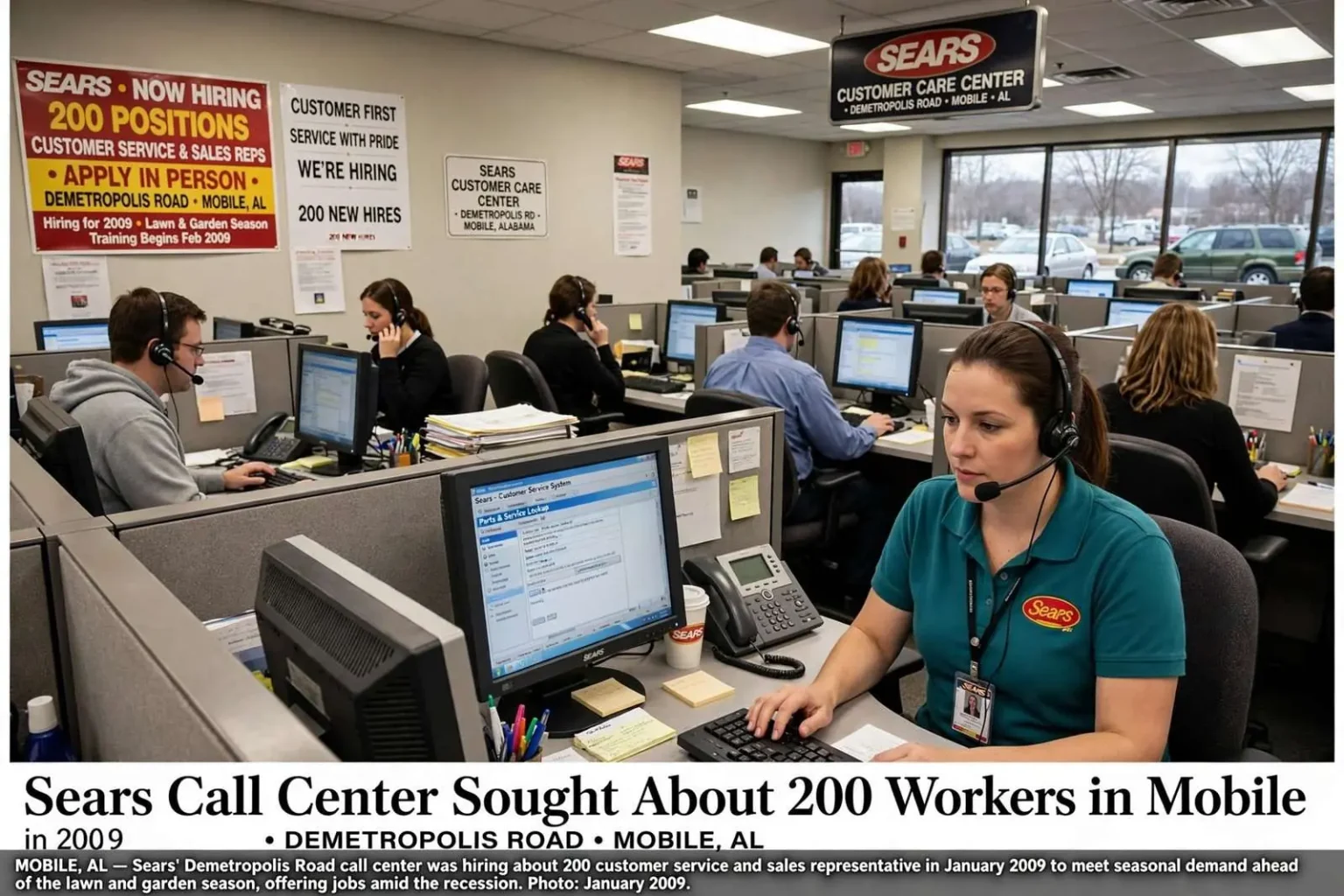
MOBILE, Ala. — A Sears call center in Mobile planned to hire about 200 customer service and sales representatives in early 2009, creating one of the larger local hiring opportunities reported during a difficult economic period.
The national company operated a call center on Demetropolis Road, one of roughly 20 such locations in the United States. Workers there handled calls from customers across the country.
In the depths of the recession, with Mobile’s shipbuilding, chemical and retail sectors all shedding jobs or freezing openings, a 200-person hiring push by a national employer stood out. Call centers had become a steady presence in the Mobile-area economy over the preceding decades, drawn by the region’s labor pool, lower operating costs and time zone, and they offered something the struggling industries could not: large numbers of entry-level positions with benefits and no specialized credentials required.
Customer Service and Sales Roles
Sears said the available positions included helping customers obtain parts and service for appliances, lawn equipment and garden equipment. Other roles involved customer-service work, including handling complaints and supporting stores.
Sheila Baudy of Sears said the company was increasing staffing ahead of the lawn and garden season, which began in April.
The seasonal rhythm mattered. Calls about riding mowers, tillers and trimmers surge every spring as the weather warms and equipment comes out of garages across the country, and the Demetropolis Road center — one of a network of Sears customer-care sites handling everything from appliance repairs to credit accounts — scaled up each year to meet it. For job seekers, that meant the positions were announced in a hiring window when hundreds of seats needed filling at once.
An employee described the work as a changing environment with daily interaction with customers from around the country.
Applicants interested in the Sears work were directed to apply in person at the Demetropolis Road location. The center sits in western Mobile near Airport Boulevard’s commercial corridor, an area that had grown into one of the city’s retail and office hubs, putting the jobs within reach of workers across the city and in neighboring Prichard and Tillman’s Corner.
Other Local Public-Sector Openings
The report also noted job openings through the Mobile County Personnel Board. The board recruited for city and county departments, including the Mobile County Racing Commission, the Mobile County Emergency Management Association and the Mobile County Health Department.
Personnel Board Director Donald Dees said openings covered a range of agencies, offering opportunities beyond the call-center positions.
The Personnel Board occupies a distinctive role in local government. Established to professionalize hiring for Mobile County’s public employers, it administers competitive examinations, publishes eligibility lists and processes applications for classified positions across city and county government. For job seekers, that meant a single application channel — the board’s offices and job postings — connected them to openings in law enforcement support, public health, emergency management and administrative roles throughout Mobile County, one of Alabama’s largest local-government workforces.
Public-sector hiring carried extra weight in 2009. Government jobs, which had seemed stagnant to a generation chasing private-sector wages, suddenly looked stable against a backdrop of national layoffs, and postings for county agencies drew crowded applicant pools. Openings at agencies like the Emergency Management Association also reflected the region’s particular needs — a Gulf Coast county that maintains year-round readiness for hurricanes, and that had spent the middle of the decade building capacity after Ivan and Katrina.
The Recession Context in Mobile
To understand why 200 openings counted as major news, it helps to recall the moment. The national unemployment rate was climbing toward double digits, Alabama had lost manufacturing and construction jobs for months running, and local news outlets in Mobile were reporting more closures than openings. In that environment, a company adding hundreds of positions — even seasonal customer-service seats — was a genuine bright spot, and employment news of any kind moved the needle for households cutting expenses.
Call-center work has long served as both a footing and a floor in the local economy. The positions require no degree, pay modest but steady wages, and teach transferable skills in customer relations and computer systems. Employees who start on the phones often move into quality assurance, training and supervisory roles, and for many Mobile workers over the years, a call center was the first rung on a career ladder. The trade-offs — repetitive work, rigid schedules and quotas measured in calls per hour — were part of the same story.
The 2009 announcement offered a measure of welcome employment news for Mobile amid a recession that had brought layoffs and uncertainty to many local industries. It also showed how customer-service operations and public agencies remained important sources of jobs in the region.
What the Hiring Meant for Applicants
For the people who took the Sears jobs, the work was a paycheck in a market with few of them. For the broader economy, the announcement signaled something subtler: that even in a severe downturn, demand for customer support does not disappear. Appliances still break, warranties still get honored, and lawn equipment still needs service every spring — recession or no.
In-person application requirements like the one at the Demetropolis Road center were typical of the era, giving employers a first screening tool and giving applicants a preview of the workplace. Lines at large-scale hiring events became a defining image of the recession, in Mobile as elsewhere, and the Sears hiring drive was one of the occasions on which local job seekers turned out in numbers.
Inside a Call Center’s Operation
The mechanics of a Sears-scale call center explain why 200 hires could be absorbed quickly. Agents sit in rows of cubicles with headsets and dual monitors, logged into customer accounts and product databases, working from scripted and unscripted talk paths depending on the call. Training cohorts run for several weeks before new hires take live calls, covering products, systems and the etiquette of handling frustrated customers, which is why centers hire in batches rather than one at a time — it is far cheaper to train a large class together than to onboard callers individually.
The Mobile site’s role in a national network also shaped its work. With roughly 20 locations handling different slices of the company’s customer contacts, individual centers are often assigned specialized call types — in Mobile’s case, an emphasis on parts and service scheduling for appliances and outdoor equipment. That specialization makes the workforce more valuable to the company and gives the site a measure of stability that general-purpose centers lack.
Scheduling around the lawn and garden season illustrates the business logic. A customer whose riding mower fails in April wants it fixed before the grass grows back; every week of delay compounds frustration and warranty costs. Staffing up ahead of that surge is not generosity but arithmetic, and the April start date for the season meant the January and February hiring window was, in effect, the center’s high tide of opportunity.
The Personnel Board’s Place in Mobile County
The Mobile County Personnel Board dates to a mid-century reform movement that sought to remove patronage from local government hiring. Its merit-system framework still governs many county and municipal positions today, meaning applicants compete on scored examinations and veterans’ preference rather than connections. Jobs posted through the board — from records clerks to heavy-equipment operators to public-health technicians — list salaries, require formal applications and feed ranked eligibility lists to the hiring agencies.
The agencies named in the 2009 report spanned the county’s public responsibilities. The Racing Commission regulates dog racing at Mobile Greyhound Park, a legacy industry employing hundreds. The Emergency Management Association coordinates disaster response across the county’s municipalities. The Health Department operates clinics, restaurant inspections and communicable-disease programs from its facilities in the city. Each hiring cycle through the board thus touched a distinct slice of county life, and in a recession year the board’s postings were among the most closely watched lists in local job hunting.
Together, the two hiring streams painted a picture of Mobile’s labor market in 2009 that was narrower than usual but not closed. The private openings at Sears went to workers who could pass a customer-service screen and work flexible hours; the public openings through the Personnel Board went to those who could navigate examinations and civil-service paperwork. Neither channel required a college degree, and both offered benefits — a combination that had become rare enough in the recession to draw applicants from across the region, including workers displaced from construction, shipyard supply chains and retail.
For the community, the story of that hiring season was ultimately about resilience. Mobile’s economy has always been a patchwork — port, shipbuilding, chemical plants, healthcare, tourism, aerospace and a thick layer of customer-service and back-office operations — and downturns hit the pieces unevenly. In early 2009, the customer-service and public sectors were the pieces still adding jobs, and the Sears expansion and Personnel Board postings were where that quiet countercycle showed up in the classified pages.