Congressman Jo Bonner Picks Up New Appropriations Posts in 111th Congress
Mobile's Rep. Jo Bonner, R-Ala., joins Commerce-Justice-Science and Labor-HHS subcommittees as Artur Davis steps back ahead of a possible governor run.
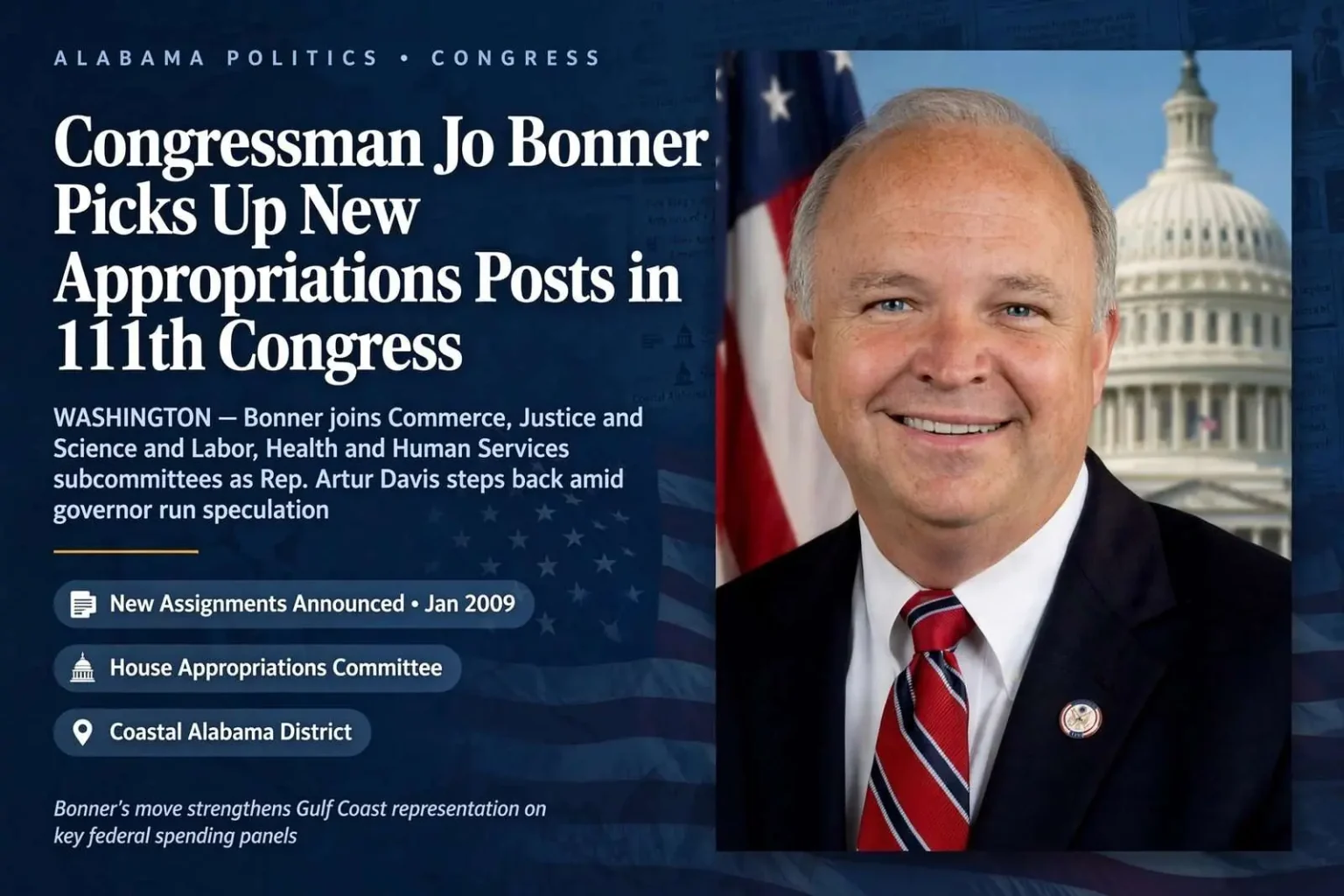
WASHINGTON — Less than a year after joining the powerful House Appropriations Committee, U.S. Rep. Jo Bonner, R-Mobile, is moving up the ladder. At the same time, Rep. Artur Davis, D-Birmingham, is stepping back from some responsibilities as he weighs a run for governor. Under new appropriations subcommittee assignments for the 111th Congress announced Monday, Bonner will join the Commerce, Justice and Science subcommittee along with the Labor, Health and Human Services panel.
The assignments were detailed in a release from Rep. Jerry Lewis of California, the top Republican on the full committee. In exchange, Bonner is giving up his seats on the Financial Services and Legislative Branch appropriations subcommittees. The swap may read like procedural housekeeping, but on the Appropriations Committee, subcommittee seats are the currency of influence: they determine which corners of the federal budget a member can actually shape.
The shift places the Coastal Alabama congressman on panels that steer funding for justice, science, labor and health programs, a portfolio with direct reach into Gulf Coast priorities. Commerce, Justice and Science funding touches the Justice Department grants that flow to local law enforcement, the National Science Foundation, oceanic and atmospheric research, and economic development programs. The Labor and Health panel funds job training, public health and health research initiatives that reach every county in the district.
How the Appropriations Committee Works
The House Appropriations Committee is the panel through which every one of the twelve annual spending bills must pass before reaching the House floor. Its subcommittees draft the individual bills, holding hearings with cabinet secretaries and agency heads before writing the actual funding lines. A seat on the committee is among the most coveted assignments in the House because it gives members a concrete way to deliver for their districts.
Within the committee, the twelve subcommittee chairs are known as “cardinals,” and seniority largely determines who holds those gavels and which members sit on which subcommittees. New members typically start on less prominent panels and trade up as openings appear. Bonner’s move from Financial Services and Legislative Branch, both relatively narrow in jurisdiction, to two of the largest subcommittees signals a rising position within the Republican conference on the panel.
For a first-term-to-second-term member, the assignments are a meaningful win. The Commerce, Justice and Science bill funds agencies such as the Justice Department, the Commerce Department and NASA, while the Labor, Health and Human Services bill is among the largest of the twelve, covering education, workplace programs and the nation’s health agencies. Both panels touch money that reaches schools, police departments, ports and research institutions in south Alabama.
Following Mobile’s Appropriations Tradition
Bonner, first elected to represent Alabama’s 1st Congressional District in 2003, follows in the footsteps of predecessors Sonny Callahan and Jack Edwards, both of whom built influence on the Appropriations Committee. The tradition matters in a district whose economy is anchored by the Port of Mobile, the shipbuilding and aerospace industries, and the tourism economies of the barrier islands.
Edwards, a Mobile Republican who served two decades in the House, used his seniority on the committee to steer projects home during the 1970s and 1980s. Callahan carried the torch through the 1990s and early 2000s, chairing the Transportation and Related Agencies Appropriations Subcommittee at the height of his influence and directing federal dollars toward the district’s transportation and port needs. Bonner succeeded Callahan in 2003 and waited out the years in the minority before Republicans lost and regained control of the chamber around him.
Joining the Appropriations Committee at the start of the 111th Congress, as Bonner did, restored the district’s seat at the spending table. Moving onto Commerce, Justice and Science and Labor, Health and Human Services within his first year on the panel puts him closer to the agencies whose programs matter most along the Gulf Coast, from fisheries and weather research to justice grants and health funding.
Davis Steps Back as Statewide Speculation Builds
While Bonner climbs, the story on the other side of the Alabama congressional delegation runs in the opposite direction. Rep. Artur Davis, D-Birmingham, is stepping back from some responsibilities as he weighs a run for governor, recalibrating his own workload amid the speculation. Davis represents the state’s 7th Congressional District, a majority-Black district stretching from Birmingham through the Black Belt to parts of Montgomery.
Davis, a second-term-to-third-term Democrat and a Harvard-trained lawyer, had been one of the most visible members of the delegation, frequently appearing on national media and taking high-profile positions within his party. A gubernatorial bid in 2010 would require him to leave the safe district behind and campaign statewide, a different contest entirely from holding a congressional seat that Democrats have held for decades.
The contrast between the two congressmen illustrates the choices members face. Bonner is consolidating influence inside the institution, trading up to subcommittees with broader jurisdiction and building the seniority that delivers federal projects home. Davis is contemplating leaving the institution altogether for a statewide office, a path that requires freeing himself from committee obligations as the campaign approaches.
What the Subcommittees Fund
The Commerce, Justice and Science subcommittee writes the annual bill covering the departments of Commerce and Justice, NASA, the National Science Foundation and related agencies. For coastal Alabama, the bill’s reach is wide: Justice Department grants support local sheriffs’ offices and prosecutors, Commerce funding touches the National Weather Service and economic development administration programs, and science funding supports the research infrastructure of Gulf universities and marine laboratories.
The Labor, Health and Human Services subcommittee oversees what is typically the largest non-defense spending bill in the annual cycle. Its jurisdiction includes education funding that flows to school systems, workforce development programs administered through the states, and the health agencies whose grants reach hospitals, clinics and public health departments across southwest Alabama.
Membership on both panels gives Bonner a hand in areas that connect directly to district priorities: the federal share of port and coastal programs, law enforcement support for rapidly growing suburbs, and the education and health programs that serve both urban Mobile and the rural counties north of the bay. Giving up Financial Services and Legislative Branch seats narrows his reach over banking regulation and Capitol operations, a trade most appropriations members accept when larger panels are on offer.
The Bigger Picture on Capitol Hill
The reshuffling illustrates how seniority and party dynamics on Capitol Hill continually redraw which members hold the levers of federal spending for their home regions. Subcommittee rosters are set at the start of each Congress and adjusted as members depart, retire or run for other offices, and every change ripples into the districts the affected members represent.
For the 111th Congress, the arrangements also reflect a chamber adjusting to a new administration and a new balance of power. Members of the minority party retain their seats and their voices on appropriations, and ranking members like Lewis play a central role in negotiating the final spending bills even when the majority controls the gavels.
For Coastal Alabama, the practical meaning of Monday’s announcement is straightforward: the district’s representative now sits on two of the subcommittees with the broadest reach into programs the region actually uses. Whether that translates into visible results will unfold across the annual appropriations cycle, but on Capitol Hill, seat assignments are where the work begins.
Alabama’s Delegation and the Power of the Purse
Alabama’s congressional delegation has long punched above its weight on spending matters precisely because of members like Edwards, Callahan and now Bonner on Appropriations. With only seven House seats, the state cannot rely on numbers; it relies on seniority, and seniority is built by holding the same seat for decades and accumulating committee positions year after year.
That strategy has served the state’s port cities especially well. Mobile’s fortunes as a port, shipbuilding center and logistics hub have often depended on federal investment, from channel dredging and harbor maintenance to the Navy and Coast Guard contracts that flow through annual defense and energy-water bills. A seat on Appropriations is the vantage point from which those decisions can be watched, questioned and influenced.
Bonner’s placement on Commerce, Justice and Science also connects him to the agencies that matter in day-to-day coastal life. Weather forecasting, fisheries management, coastal mapping and law enforcement grants all trace back to that bill. For a district that stretches from Mobile Bay through Baldwin County’s growing beach communities, those line items are not abstractions.
The 2010 Horizon
The subcommittee announcements land at the start of a political cycle that will reshape both stories. Bonner’s positioning strengthens a member expected to be a fixture in the delegation for years, while Davis’s deliberations point toward a statewide campaign that would end or transform his congressional career either way.
Gubernatorial races in Alabama draw crowded fields and demand months of statewide travel, and members of Congress who run must effectively campaign as outsiders to their own institution. Davis’s decision to shed committee duties is the classic first move of a member clearing the calendar for a campaign, and it will be watched closely by Democrats weighing their own prospects in a state where statewide office has been elusive for the party.
Whatever Davis decides, the institutional machinery keeps moving. The twelve appropriations bills must be drafted, debated and passed every year, and the members who hold the seats when the bills are written are the ones who leave fingerprints on them. For south Alabama, Monday’s news means its representative will be in the room where more of that work happens.