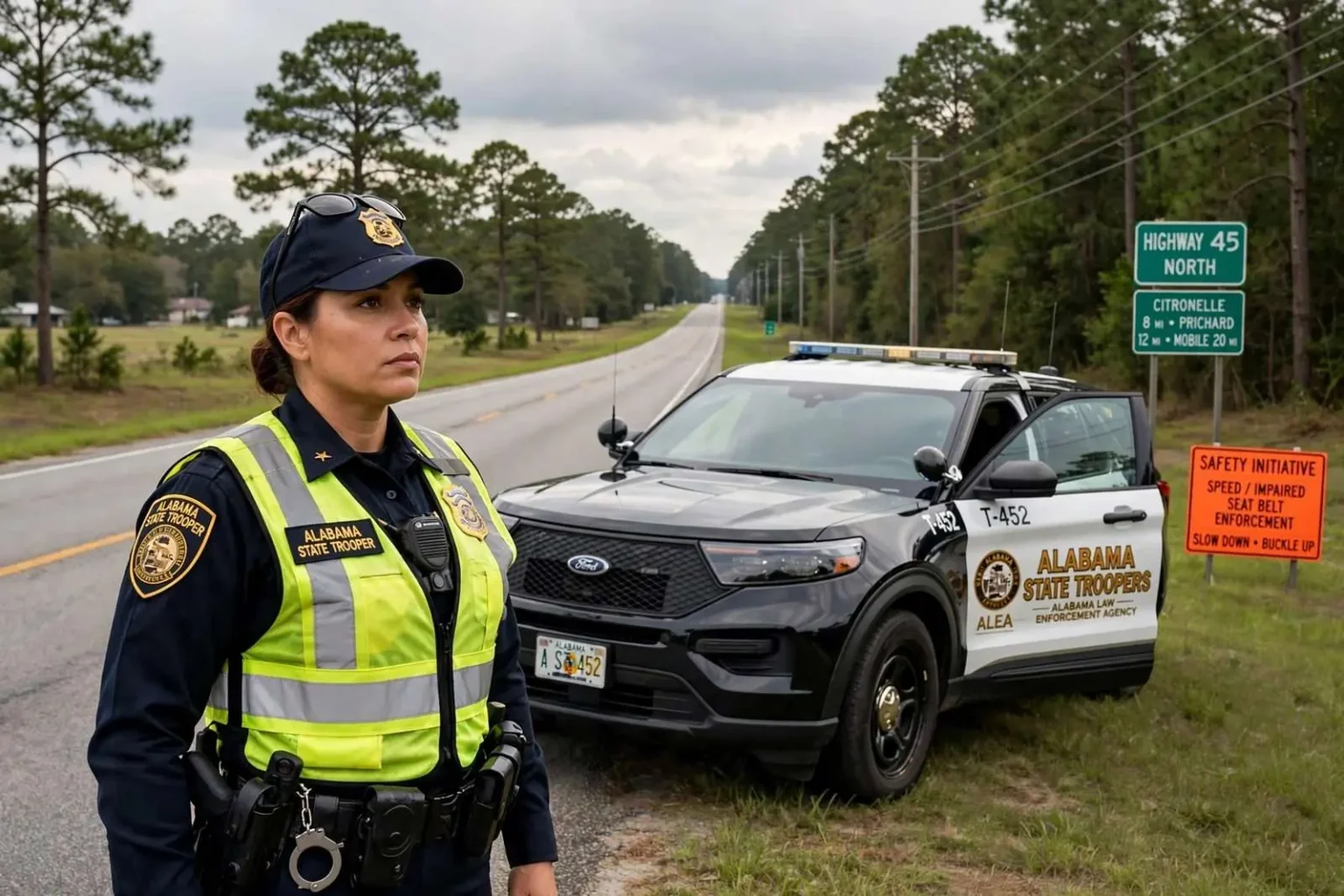
Alabama Law Enforcement Agency troopers have launched a new initiative along Highway 45 in Mobile County, aiming to reduce the number of crashes and fatalities on the busy stretch of road. The enforcement surge concentrates troopers on the corridor that runs north from Mobile through Prichard, Citronelle, and the rural stretches toward the state line, putting extra patrols on a highway that has carried a disproportionate share of the region’s serious crashes.
The effort comes in response to a series of fatal accidents along the highway, including at least two deadly crashes in a single month. That kind of clustering is what typically prompts a targeted enforcement campaign, and officials with the agency say the goal is to change driver behavior before the pattern extends further into the year. Over the past five years, more than 75 people have been killed along the 60 miles of Highway 45 that runs through Alabama, a toll that spans the road’s full length from the Mobile area through west Alabama and that has made the corridor a recurring subject of safety reviews.
Targeting Speeding and Impaired Driving: Senior Trooper Anna Peoples said the initiative focuses on removing impaired drivers, reducing crashes, deterring speeding, and promoting proper seat belt usage. Those four priorities mirror the factors that appear again and again in fatal-crash investigations: a driver who had been drinking, a speed too high for the conditions, and an unbuckled occupant who might otherwise have survived the impact. Troopers working the initiative are instructed to look for all three, along with the distracted driving that has become a growing contributor on every Alabama highway.
Since the effort began on a Friday, troopers had written approximately 200 citations and warnings, most of them for speeding. The volume underscores how prevalent violations are on the corridor during routine driving hours, and troopers say the mix of citations and warnings reflects the campaign’s dual purpose: punish dangerous behavior where it appears, and put enough visible patrol presence on the road that drivers think twice before pressing the accelerator.
“Our top speed, our high-speed citation, is 125 miles an hour,” Peoples said. That figure, recorded during the initiative’s early days, stunned even veteran troopers, and it illustrates the extreme end of the speeding problem the campaign is confronting. A vehicle traveling at that speed on a two-lane rural highway has no realistic margin for error, and the consequences of a mechanical failure, a blown tire, or an oncoming driver’s mistake are almost always catastrophic.
A Dangerous Stretch of Road: Peoples said Highway 45 is one of the top areas for complaints about traffic violations. Residents who live along the corridor call regularly about speeders in front of their homes, trucks using residential stretches as a shortcut, and drivers who treat the road’s long straightaways as an invitation. Those complaints, combined with the fatality record, have made the highway a persistent priority for the agency’s Mobile-area post.
The road lacks barriers to prevent head-on collisions, making distracted driving particularly dangerous. Unlike the interstate system, where divided lanes and median barriers separate opposing traffic, Highway 45 through much of its length is a two-lane road with only a painted center line between an oncoming car and a moment’s inattention. “You look down, you mess with your phone, and then you cross the center line, and then you have a head-on collision,” Peoples said. The geometry of a head-on crash at combined highway speeds explains why the corridor’s fatal crashes so often involve frontal impacts.
“We want people to be aware of distracted driving, their speed, and as always, buckle up,” Peoples said. The message, troopers emphasize, is not about writing tickets for their own sake. Enforcement is the tool, but the objective is a corridor where drivers slow down, put the phone away, and buckle in, so that the crashes that do occur are survivable.
Understanding the Highway 45 Corridor
Highway 45 serves a distinct role in the region’s transportation network. It is the principal route connecting Mobile and its northern suburbs to the rural communities of north Mobile County and onward into Washington County, carrying commuter traffic, school buses, farm equipment, and commercial trucks on the same pavement. Its communities, from Prichard and Chickasaw at the southern end through Mount Vernon and Citronelle to the north, sit directly on the highway, meaning local traffic enters and exits constantly through driveways and side streets rather than controlled interchanges.
That mix is what makes the road unforgiving. A driver negotiating around a slow-moving truck in a no-passing zone, a teenager pulling out from a side road, and a commuter running late all share the same narrow strip of asphalt, and the crashes that result are often severe because speeds are high and margins are thin. Rural two-lane highways across Alabama consistently produce fatality rates well above the interstate average, and Highway 45’s numbers have kept it on the state’s watch lists.
The highway’s crash history has also been shaped by impaired driving, which surfaces repeatedly in the investigations of its fatal wrecks. Weekend nights pose particular risk, and troopers staffing the initiative say DUI enforcement patrols will remain a visible part of the campaign, particularly during the evening hours when impairment crashes cluster.
What Enforcement Can and Cannot Fix
Targeted campaigns like this one have a track record: sustained, visible enforcement measurably reduces speeding and belt violations while it lasts, and the challenge is sustaining the effect after the emphasis patrols rotate away. That is why the agency pairs the enforcement push with public messaging, asking residents to report dangerous driving and reminding drivers that the corridor is being watched.
Longer-term fixes, median barriers, passing lanes, wider shoulders, and better lighting at intersections, depend on funding and engineering studies, and safety advocates in the corridor’s communities have pressed for those investments for years. In the meantime, troopers say the calculus for drivers is simple: the enforcement is real, the fatality count is real, and the behaviors that prevent both, slowing down, staying off the phone, sober driving, and buckling up, cost nothing.
For the residents of the communities along Highway 45, the initiative is a response they have sought. The complaints that Peoples described have come from people who watch speeders pass their homes and children’s bus stops every day, and the sight of a trooper’s car parked along the shoulder is, for those residents, the most visible sign yet that the state takes the corridor’s toll seriously.
The seat belt message deserves its own emphasis, troopers say, because it is the single factor most likely to determine whether a crash becomes a fatality. Alabama’s seat belt use rate has climbed over the years, but rural corridors like Highway 45 historically lag the state average, and unbuckled occupants are overrepresented among the dead in rural crashes. A belt does not prevent a collision, but it very often decides who walks away from one, which is why troopers treat every belt stop as a potential life saved rather than a minor citation.
The initiative’s early results, roughly 200 citations and warnings in its first days, will be tracked as the campaign continues, and the agency has indicated the emphasis patrols will recur rather than disappear after a single week. Drivers who use the corridor daily should expect to see troopers at different times and locations, including the school-zone stretches in the corridor’s towns and the rural straightaways where the highest speeds have been recorded.
The combination of enforcement and engineering is what safety researchers recommend for corridors like this one. Enforcement changes behavior quickly but temporarily, while physical improvements, turn lanes at dangerous intersections, center-line rumble strips that wake a drifting driver, and passing zones that reduce illegal passes, reshape the road itself so that ordinary human error is less likely to become a fatal event. Communities along Highway 45 have asked for those improvements in the same breath as they asked for patrols, and safety officials view the two as complements rather than alternatives.
Peoples’ account of the 125-mile-an-hour citation has already circulated widely, and troopers hope the story does some enforcement work on its own. The driver who wrote it out described a vehicle passing other traffic at speeds that left no possibility of a safe stop for anything on the road ahead, and the fact that it happened on a two-lane highway with oncoming traffic is precisely the scenario the campaign exists to interrupt.
For now, the corridor’s drivers are on notice. The Alabama Law Enforcement Agency has committed its attention to Highway 45, the communities along it have been asking for exactly that, and the numbers, 75 deaths in five years, two fatal crashes in a single month, 200 citations in the campaign’s opening days, explain why. The invitation that comes with it is simple: slow down, stay off the phone, drive sober, and buckle up, so the next fatality count along the 60 miles of Highway 45 stops growing.