Fairhope Brewing Reveals Bottle Labels Ahead of 2015 Retail Launch
Fairhope Brewing Company unveiled label designs for its three flagship beers as it prepares a bottling expansion set to hit store shelves by summer 2015.
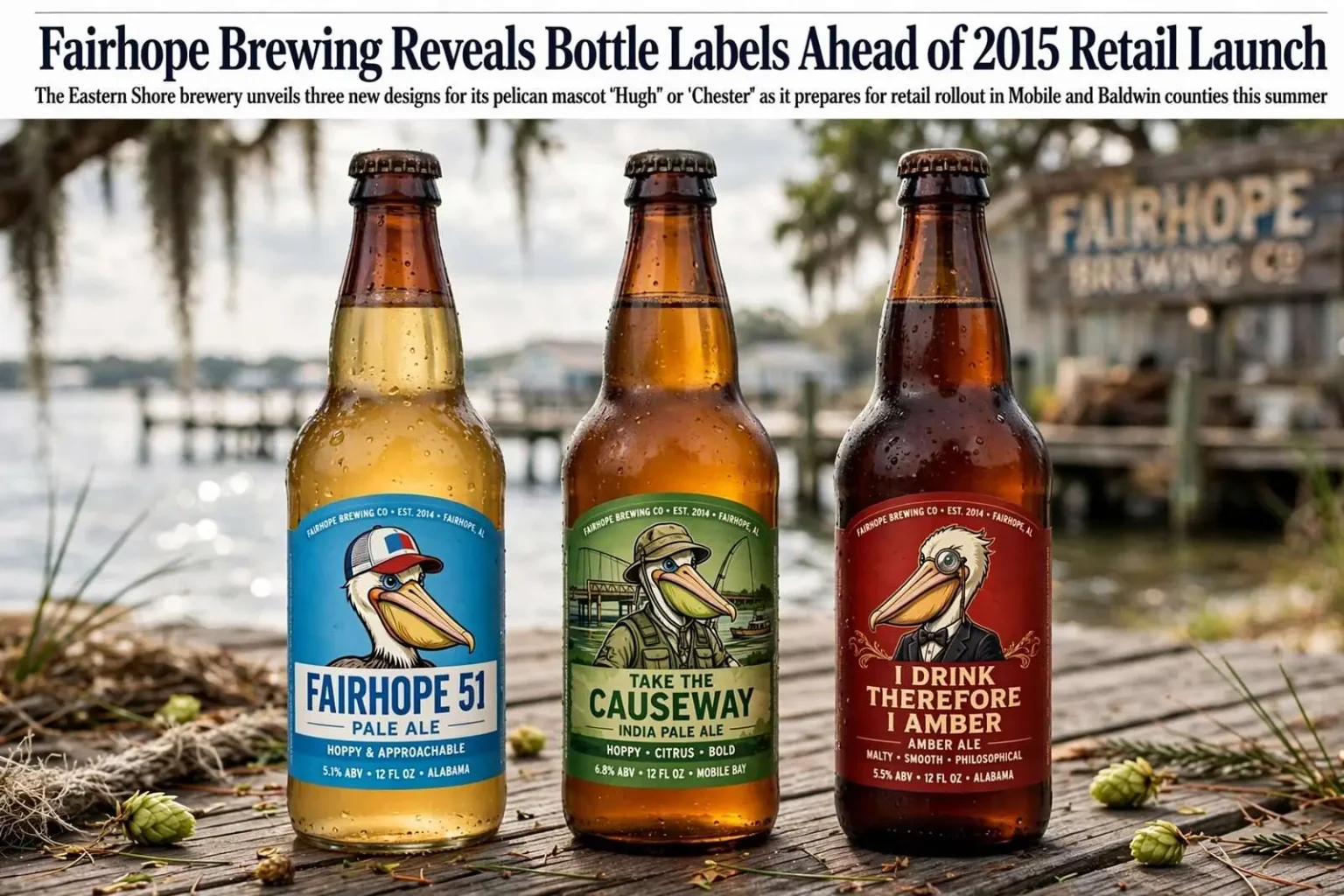
The pelican mascot known to regulars as “Hugh” or “Chester” has perched on tap handles across Alabama for years, but Fairhope Brewing Company is giving the bird a much bigger stage — and Alabama beer drinkers will soon find him staring back from cooler shelves across the region.
The Eastern Shore brewery revealed label designs this week for its three flagship beers, which are set to hit retail shelves in Mobile and Baldwin counties and beyond by around summer 2015. The move into bottles represents the most significant milestone yet for a brewery that has grown its reputation one tap handle at a time since opening its doors off U.S. 98 in Fairhope.
“There’s something about his look. He knows something you don’t,” said Brian Kane, co-owner of Fairhope Brewing Company, describing the pelican’s appeal. The bird has become the brewery’s public face, recognizable at bars and restaurants across the state, and the label designs now give him a life beyond the tap room.
The character appears in three different costumes depending on the beer: a red, white and blue trucker cap for the blue-packaged Fairhope 51 Pale Ale, a fishing hat and vest for the green-themed Take the Causeway IPA, and a monocle, suit vest and bow tie for the scarlet-colored I Drink Therefore I Amber. Each costume plays to the personality of the beer it fronts — the everyman pale ale, the outdoorsman IPA named for the causeway that crosses Mobile Bay, and the philosophical amber with its tongue-in-cheek nod to Descartes.
Design Built for the Cooler
The color coding is meant to help drinkers identify each beer at a glance, even in a cooler where labels might not face outward. That practical thinking reflects the realities of retail: a six-pack stack in a packed cooler door offers at best an inch of beer name, and packaging that leads with a bold, color-keyed character sells the brand where words fail.
The artwork, designed by Eastern Shore resident and former Red Square Agency partner Matt Whitfield, is the most visible piece of a near-million-dollar expansion already underway at the brewery’s home off U.S. 98 on Nichols Avenue. Red Square, the Mobile-based advertising agency with national clients, brought agency-grade brand thinking to a local brewery’s shelf debut — the kind of design investment that smaller craft breweries often defer and frequently regret.
Labels do heavy lifting in the craft beer market, where shelves grow more crowded every year and packaging is often the only pitch a brewery gets before a customer chooses. A mascot with personality, applied consistently across a lineup and tied to colors shoppers can spot from across the aisle, gives Fairhope Brewing a fighting chance against brands with national budgets.
The Expansion Behind the Labels
New equipment being installed in a larger adjacent building is expected to boost output by roughly 600 percent, according to the owners, supporting both a bigger keg supply and, for the first time, a dedicated bottling line. Until now, the brewery’s reach has been limited by its own production ceiling — every new account that signed on for its tap handles stretched the same tanks further.
The bottling line changes the business model in a fundamental way. Kane said bottling offers a more efficient way to get beer to customers than kegs alone, since empty kegs sitting outside circulation cost the brewery money, while bottled beer, once it leaves the building, is simply sold. The distinction matters more than it sounds: a keg tied up at a slow bar generates no revenue until it returns empty, while a bottle on a store shelf has already been paid for.
Keg logistics are the hidden tax of the draft business. A brewery’s keg fleet is finite, and every keg sitting half-full in a cooler across town is capital that cannot work. Bottles free the brewery from that cycle, extend shelf life dramatically, and open distribution channels — grocery stores, convenience stores, package stores — that draft alone cannot reach.
Co-owner Jim Foley said the new bottling line paired with the expanded brewing system will be capable of producing upwards of 500 cases of beer per day once fully operational. At that rate, the brewery’s output steps into a different class entirely — enough volume to supply retailers across Mobile and Baldwin counties with room left for the broader Alabama distribution the owners have in mind.
The labels have drawn praise from the brewery’s own staff. Assistant brewer Tim Heath, one of the newest additions to the team, said he appreciates the restraint of the designs, which let the pelican character and the color system carry the brand without cluttering the cans of text and decoration that weigh down so many craft labels.
A Homegrown Brewery Comes of Age
Fairhope Brewing’s growth mirrors the arc of Alabama’s craft beer scene, which has expanded rapidly as state law has gradually made room for brewers to operate like their counterparts elsewhere in the country. For years, Alabama breweries labored under restrictions that kept them from hosting tastings and selling beer on site, rules that chipped away at the tap room culture — the tasting flights, growler fills and community events — that powered the craft boom in other states. As those restrictions loosened, breweries across the state, including Fairhope’s, found their tap rooms becoming destinations in their own right.
The Eastern Shore setting has been part of the brewery’s identity from the start. Fairhope, the picturesque community on the bluffs above Mobile Bay, draws visitors from across the region to its shops, restaurants and pier, and the brewery’s Nichols Avenue home sits close enough to capture that foot traffic. Local names run through the beer lineup — the Fairhope 51 pale ale and the Causeway IPA among them — rooting the brand in the geography its customers know.
The three flagship beers each tell that local story in their own way. Fairhope 51 is the brewery’s namesake pale ale, an approachable beer built for the broadest audience. Take the Causeway IPA nods to the drive across Mobile Bay that connects the Eastern Shore to Mobile itself, and the bolder hop profile of an IPA rewards the craft drinkers who seek the style out. I Drink Therefore I Amber — the philosophical one in the monocle — covers the malty middle ground between the two, rounding out a lineup designed to have an answer for every taste.
What Bottles Mean for Drinkers
For customers, the retail launch means the brewery’s beer will be available beyond the hours and walls of the tap room. A six-pack can go home for dinner, into a cooler for a day on the bay, or to a friend’s crawfish boil — occasions where draft-only distribution simply cannot follow. Bottled beer also keeps longer than keg beer once packaged, letting drinkers keep a backup on hand without worrying about a keg’s short shelf life.
For the restaurants and bars that already pour Fairhope Brewing’s taps, the bottles add a marketing push rather than a threat. Shoppers who meet the brand on a store shelf become tap room visitors, and tap room regulars who see the pelican in a grocery cooler are reminded to order it on draft. The formats feed each other, and the color-coded packaging ties them together visually.
The summer 2015 target puts the launch on the calendar for the season when Alabama beer sales peak — the long stretch of boating weather, beach trips and backyard gatherings that runs from Memorial Day through Labor Day. If the brewery hits that window with its pelican on the shelves, it will be introducing its flagship lineup to the widest possible audience at exactly the moment those drinkers are buying.
Between now and then, the work continues on Nichols Avenue: tanks and bottling equipment going into the adjacent building, recipes finalized for the longer shelf life bottles demand, and a pelican that has spent years knowing something you don’t finally getting ready to share it with everyone in the store.
Behind the Scenes of the Buildout
A 600 percent production increase is not achieved by ordering a bigger kettle. The expansion on Nichols Avenue touches every stage of the process — more fermenting and conditioning capacity, a larger cold room for finished beer, upgraded piping and pumps, and the bottling line itself, a machine that rinses, fills, caps, labels and packs bottles far faster than any hand-bottling operation could manage. Each piece must be installed, tested and dialed in before the first commercial run, which is why brewers budget months between construction and launch.
Hiring scales with the hardware. A brewery producing at the new facility’s potential needs more hands in the cellar, on the packaging line and behind the bar, and Fairhope Brewing’s team — already growing with recent additions like assistant brewer Tim Heath — will continue to expand as the capacity comes online. Local breweries of this size are meaningful small-town employers, and their payrolls ripple through the communities that support them.
The Broader Alabama Craft Market
The timing of Fairhope’s retail debut places it in a generation of Alabama breweries making the same leap. The state’s craft industry has matured from a handful of pioneers into a market with breweries in every major city, tap rooms that draw weekend crowds, and increasingly sophisticated branding. Retail shelves that once carried only national labels now feature Alabama-made beer alongside the imports, and consumers have shown they will choose local when the quality and the story hold up.
For the Eastern Shore, a bottled Fairhope lineup adds one more locally made product to a regional identity already built on them — the farms, seafood, roasted coffee and artisan foods that Baldwin County markets to visitors and residents alike. A pelican in a trucker cap on a six-pack shelf fits that picture, and it gives Alabamians one more answer to a question the craft beer era has made common: ever tried the local stuff?