Foley Fire Death Ruled Homicide as Investigators Pursue Leads
Authorities ruled a fatal house fire in Foley's Monteith Oaks neighborhood a homicide, the city's first in five years, as investigators worked to confirm the victim's identity.
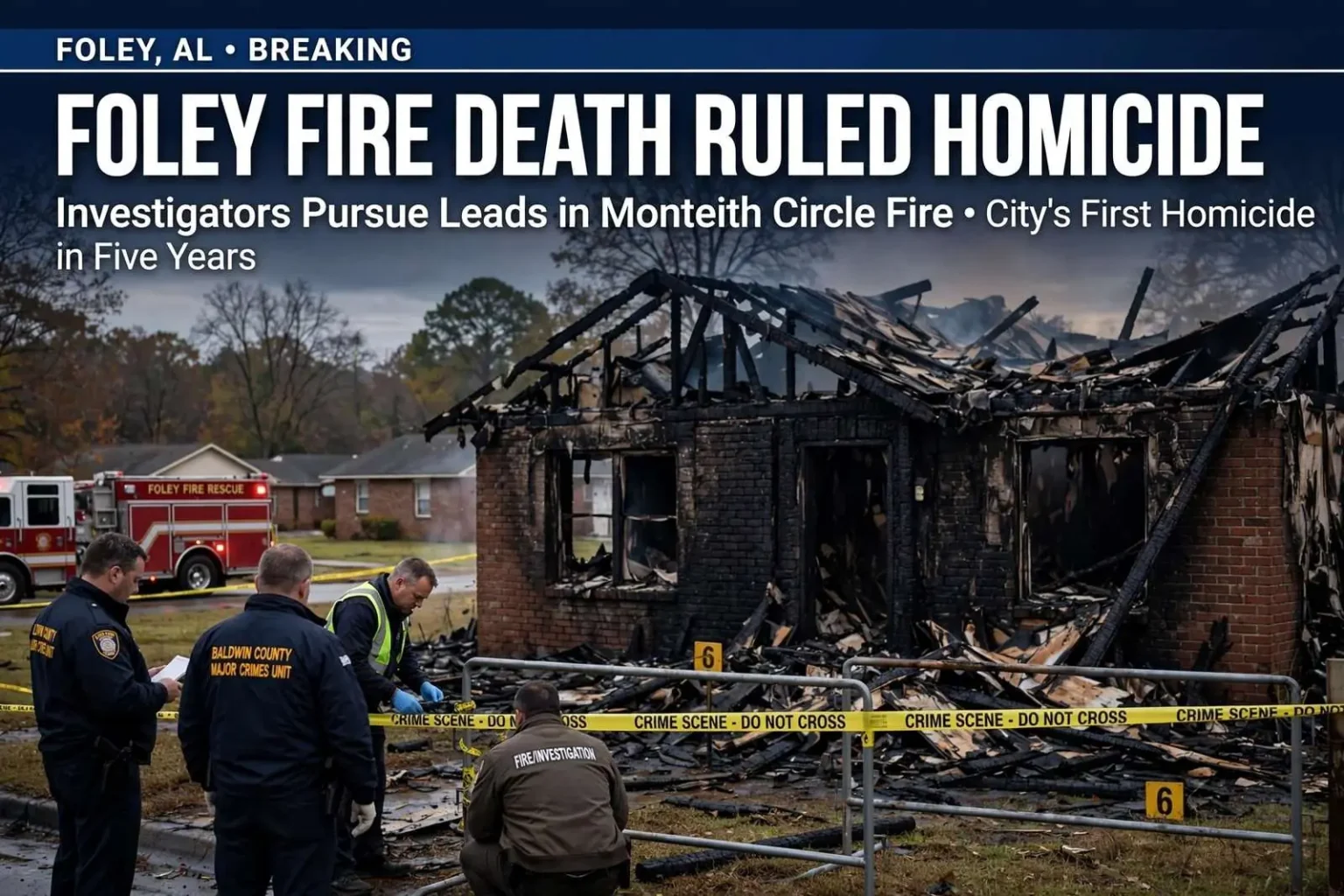
Investigators in Foley spent days sifting through the charred remains of a Monteith Circle home after a fire that gutted the residence was ruled the city’s first homicide in five years, a determination that came within about 16 hours of the blaze being reported. Foley firefighters responded to the one-story brick home in the Monteith Oaks subdivision around 9:30 p.m. on a Sunday night after a passerby jogging in the area reported the fire. Crews arrived within minutes, but the fire chief said the blaze was already fully involved by the time firefighters reached the scene, a detail that later helped raise investigators’ suspicions. Fires that reach full involvement that quickly in an occupied home often indicate an accelerated burn, and that possibility shaped everything that followed.
A body was found inside the home’s bathroom, badly burned in the fire. Authorities believed the victim was a 70-year-old man who had lived alone at the residence for years, according to Baldwin County property records, though officials said dental records would be needed to formally confirm his identity given the extent of the burns. Identifying fire victims through dental records is a routine but slower process, requiring comparison between remains and dental files maintained by the victim’s dentists. Officials withheld formal confirmation of the identity until that comparison could be completed.
A Rapid Ruling in a Quiet Subdivision
The Foley police chief handed the investigation over to Baldwin County’s Major Crimes Unit, a multi-agency task force that draws on investigators from law enforcement agencies throughout the area. The unit exists precisely for cases like this one: a single city police department rarely has the depth of staffing to run a prolonged homicide investigation on its own, and pooling investigators from across the county gives major cases the manpower they require. Members of the unit come from municipal departments, the Baldwin County Sheriff’s Office and other agencies, and they work under a coordinated command structure when activated.
A member of that unit said tips had come in following the fire but that there was little new information to share as the investigation continued. Investigators appealed to residents of Monteith Oaks and the surrounding neighborhoods to think back to anything unusual they might have seen near the home in the hours before the blaze. In suburban subdivisions, where houses sit close together and evening activity is usually routine, investigators place heavy weight on small observations — an unfamiliar vehicle, a raised voice, a light on at an odd hour.
Fire officials said the speed and intensity of the flames stood out as unusual compared with typical residential fires, one of several factors that led investigators to suspect the blaze was not accidental. Experienced fire investigators read a burn pattern the way other detectives read a room: where the fire started, how fast it spread, and whether the damage matches what a normal household fire would do. When those elements do not line up, the scene is treated as a potential crime scene from the first hours, and evidence gathered inside the burned structure is preserved for prosecution.
Results from the victim’s autopsy further corroborated evidence gathered at the scene, prompting officials to classify the death as a homicide. The ruling transformed what began as a fire response into a murder investigation, and it made the case the first homicide in Foley in five years. That span without a homicide is notable for a city of Foley’s size, and it meant the case drew immediate attention in a community unaccustomed to violent death. The classification also opened the door to more serious charges once a suspect is identified, since a death caused during the commission of a fire can carry the state’s most severe penalties.
Neighbors described the resident as someone who largely kept to himself but would occasionally stop by to talk. People who lived along Monteith Circle said the man had been in the home for years and was a familiar, if quiet, presence on the street. In a subdivision like Monteith Oaks — modest one-story homes, many occupied by retirees and working families — an elderly resident living alone is not unusual, and neighbors often keep a casual but real watchfulness over one another’s comings and goings.
One neighbor, also a Foley councilman, said his first assumption was that the fire might be connected to an earlier incident in which police were called to the home over concerns the resident might harm himself, though officials said that episode was unrelated to the fire. The councilman’s remarks reflected how quickly speculation moves through a neighborhood after a sudden death, and investigators moved to separate past incidents from the current case. Officials emphasized that the earlier police call played no role in the fire investigation and that its circumstances did not bear on the homicide ruling.
How the Investigation Proceeds
Baldwin County’s Major Crimes Unit continued processing evidence from the scene in the days following the fire, with investigators asking anyone with information about the case to come forward as the homicide investigation moved into its next phase. Processing a fire scene is slow, methodical work: investigators must determine whether the structure is stable enough to enter, then excavate the burned interior layer by layer, documenting where debris and fire damage point to the origin of the blaze. Anything removed from the scene — samples, appliances, potential accelerant evidence — goes to the state forensics lab for testing.
The autopsy findings are paired with the physical evidence to build the case’s foundation. Investigators have not said what the autopsy showed or how the victim died, and they are likely to keep those details confidential while the case is active. Withholding the cause and manner of death is standard practice in homicide investigations, both to protect the integrity of the case and to keep possible suspects from being able to shape their accounts around information only investigators and the killer would know.
Foley, one of the fastest-growing cities in Baldwin County, has built out its police and fire services in recent years as south Baldwin’s population has surged. The city sits along the Highway 98 corridor between Magnolia Springs and Summerdale, a few miles north of the beaches at Gulf Shores and Orange Beach. Longtime residents often describe it as a town where serious crime is rare, which is part of why the five-year gap between homicides became a talking point once the fire was ruled a killing. For the Major Crimes Unit, the case is now a matter of matching the physical evidence from the home to the tips and interviews gathered since the night of the blaze.
In the weeks after the ruling, the most valuable currency for investigators remained the same as it is in any Baldwin County homicide case: tips from the public. The Major Crimes Unit’s multi-agency structure means information can be routed through any of the participating departments, and investigators stressed that even details that seem minor — a vehicle seen twice, a person on foot near Monteith Circle that Sunday evening — can matter once they are laid alongside the physical evidence. Authorities have not announced a suspect or an arrest in the case, and the investigation remains active.
Fires inside single-occupant homes present particular challenges for investigators. With the only resident dead and no surviving occupants to interview, the account of what happened inside the house must be assembled from the scene itself, from neighbors, and from anyone who passed through the area that night. The passerby who reported the fire while jogging became an early point of interest for investigators, as the timing of that report helped fix when the blaze was visible from the street and, by extension, how quickly it developed.
The case also illustrates the division of labor in Baldwin County major-case work. Foley firefighters handled suppression and initial scene preservation, Foley police secured the property and initiated the handoff, and the Major Crimes Unit assumed the homicide investigation — a sequence designed to keep early mistakes from contaminating later prosecutions. Fire investigators from the state level can also be called in for scenes involving suspected arson, adding another layer of expertise to the analysis of burn patterns and accelerant evidence.
For residents of Monteith Oaks, the return of homicide to Foley — after five years without one, and in a quiet residential pocket rather than a commercial corridor — has kept attention fixed on the case. Investigators have promised updates as they are able to release them, and the department has made clear that the case will remain open until someone is held accountable for the death of the man who lived alone on Monteith Circle.
As the case enters its later stages, investigators in Foley and the Major Crimes Unit are expected to re-interview the people closest to the victim — neighbors, acquaintances and anyone who had regular contact with the man on Monteith Circle. In cases involving elderly residents living alone, financial records, phone activity and recent visitors often become focal points, since investigators must account for who knew the victim’s routines and who might have benefited from or been threatened by them. Authorities have not said whether any such lines of inquiry are active in this case, but they are standard in deaths ruled homicide inside a victim’s home.
The Baldwin County District Attorney’s office will ultimately decide what charges to present once investigators identify a suspect. A death caused in connection with a fire can be presented to a grand jury as capital or felony murder depending on the evidence, which raises the stakes of getting the scene analysis right the first time. That is one reason the unit has taken a deliberately measured pace, releasing little information while the forensic work continues. Officials have not given a timetable for an arrest, and they caution that cases built on fire evidence frequently take months before charges are filed.
What investigators have established publicly is narrow but firm: the fire was reported about 9:30 p.m. on a Sunday by a jogger, the home was fully involved when crews arrived, a badly burned body was found in the bathroom, the victim is believed to be the 70-year-old man who lived there alone, and both the scene evidence and the autopsy pointed the same direction — that his death was a homicide. Between those fixed points, the Major Crimes Unit is working to place the right person inside or near the Monteith Circle home that night, and investigators say the public’s help remains the fastest route to that answer.