
Bankhead Tunnel Temporarily Closed After Weed Killer Spill in Downtown Mobile
Mobile Fire-Rescue cleaned up a weed killer spill that briefly closed the Bankhead Tunnel in downtown Mobile. The crossing reopened by early evening.
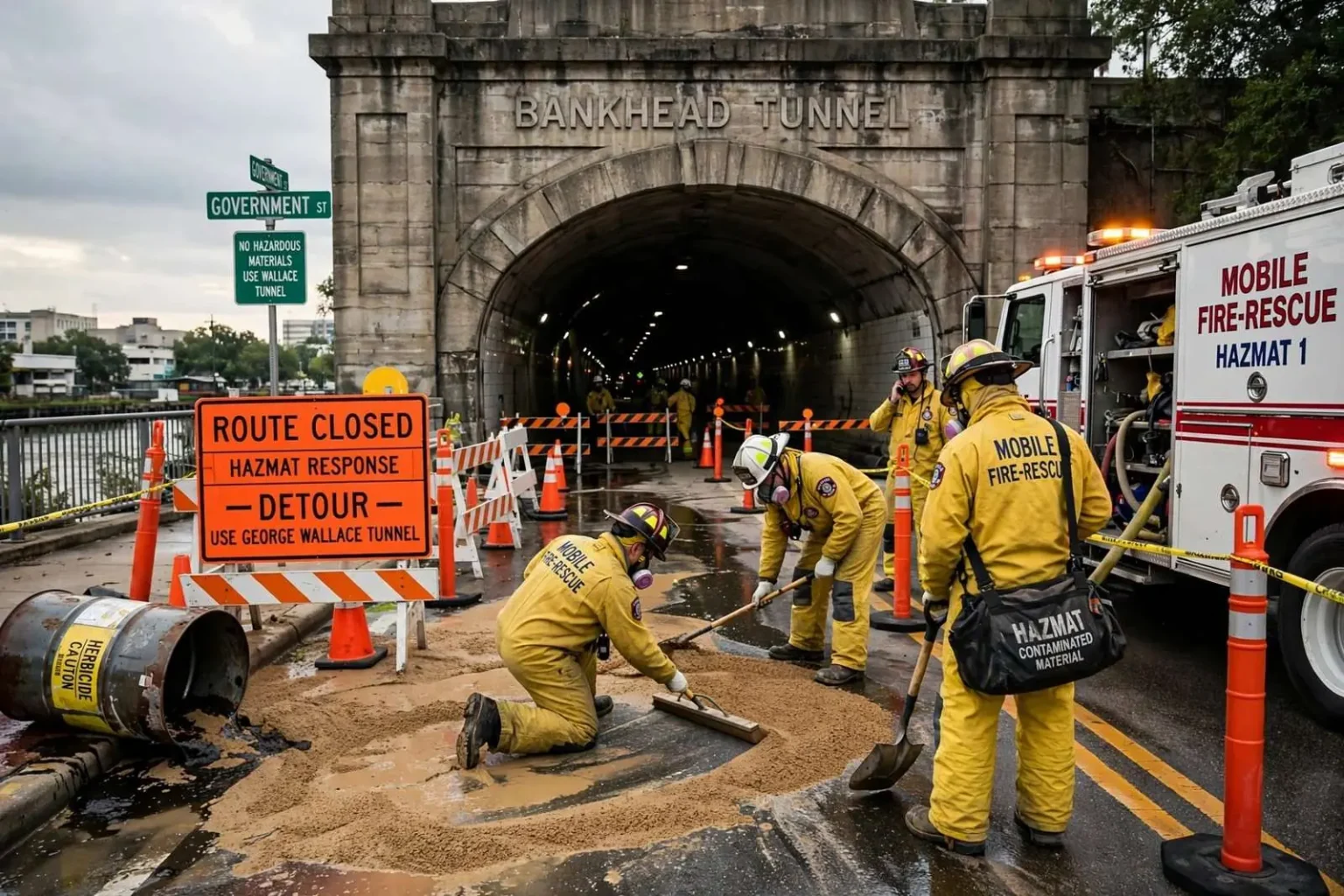
The Bankhead Tunnel in downtown Mobile was temporarily shut down Thursday afternoon after a barrel of weed killer fell from a truck and spilled across the roadway, according to Mobile Fire-Rescue. The incident closed one of the city’s two river crossings at a peak travel hour, snarling traffic through downtown until hazmat crews could contain and clear the spill.
Hazmat crews were called to the scene to contain and clean up the spill. Responders used Oil-Dri, a clay-based absorbent material, to soak up the herbicide from the tunnel’s lanes. The absorbent — a granular clay product commonly carried by fire departments for liquid spills — works by soaking up the chemical so it can be swept from the surface and disposed of as contaminated material, a standard procedure when a chemical container ruptures on a roadway.
Officials said the crossing would remain closed until the roadway was fully cleared, and they could not immediately estimate how long the cleanup would take. The uncertainty was the operational problem: with no reopening time announced, downtown traffic had to reroute for the remainder of the afternoon, and drivers approaching the tunnel from Government Street found themselves diverted before they reached the entrance.
A One-Way Crossing Under the River
The Bankhead Tunnel carries Government Street beneath the Mobile River, connecting downtown Mobile with Blakeley Island and routes toward the Eastern Shore. Because it handles only two lanes of westbound traffic, any incident inside the bore quickly backs up approaches on Government Street and pushes drivers toward the parallel George Wallace Tunnel as the primary alternate crossing. The two tunnels — one carrying Government Street traffic west, the other carrying Interstate 10 beneath the river in both directions — form a paired system, and closing either one puts pressure on the other within minutes.
The Bankhead’s design dates to 1941, when the bore opened as the city’s first crossing under the Mobile River. Built by a public works-era construction program and named for Sen. John Hollis Bankhead, the tunnel runs beneath the river just south of the modern convention district, its portal descending from Government Street near the waterfront. Its single-direction, two-lane configuration reflects the traffic volumes of its era, and its low clearance and age have long made it the more delicate of the city’s two crossings — trucks carrying hazardous materials are routed to the Wallace Tunnel, while the Bankhead handles everyday automobile traffic between downtown and the island’s industrial and port facilities.
That industrial connection is what made a chemical spill here more than a routine fender-bender closure. Blakeley Island hosts port terminals and industrial operations, and the steady truck traffic crossing the river daily carries a wide range of cargo. A drum breaking loose on the approach or inside the tunnel is the kind of incident responders plan for but hope not to see, because containment inside an enclosed bore — with limited ventilation, narrow lanes and no shoulder — is more demanding than the same spill in an open parking lot.
Containing the Spill
Hazmat response to a chemical spill inside a tunnel follows a containment-first logic. Crews close the affected lanes, identify the material from placards, shipping papers or container labels, and prevent it from spreading toward drains or low points before applying absorbent. Clay-based products like Oil-Dri are the workhorse of that effort for liquids that are not acutely volatile: spread generously, they take up the chemical, and the saturated material is collected for proper disposal rather than washed into the drainage system, where it could reach the river the tunnel passes beneath.
The cleanup’s pace depends on the material and the spread. A single drum’s contents confined to one or two lanes can be contained, absorbed and swept within hours; a spill that reaches drains or requires the tunnel’s ventilation systems to clear fumes takes longer. Officials’ inability to give a reopening estimate Thursday afternoon suggested crews were still assessing the spread — the honest answer during a hazmat response, since a premature reopening before the roadway is verified clean is not an option responders will take.
By early evening, the situation had resolved: ALGO traffic reported just after 5 p.m. that the Bankhead Tunnel had reopened to vehicles. The full closure had lasted a matter of hours — long enough to knot up downtown’s afternoon commute, short enough to spare the evening rush, and a demonstration of the containment playbook working as designed.
Traffic Ripple Across Downtown
The closure’s ripple effects moved through downtown Mobile’s street grid in predictable patterns. Government Street approaches, already among the city’s busier east-west corridors, filled with diverted vehicles seeking the George Wallace Tunnel’s entrances, and signals near the waterfront absorbed the overflow. Drivers heading to the Eastern Shore — Spanish Fort, Daphne, Fairhope and the U.S. 98 and I-10 corridors beyond — had the choice of the Wallace Tunnel’s busier lanes or the long detour north over the Cochrane-Africatown USA Bridge, each option trading time differently depending on when they hit the road.
The episode was a live rehearsal of what transportation planners describe whenever a river crossing closes: in a city whose road network funnels toward a limited number of river and bay crossings, redundancy is thin, and every closure of one crossing immediately tests the others. Mobile’s geography — the Mobile River dividing downtown from the port and industrial districts, and Mobile Bay beyond — means the metro’s east-west mobility depends on a handful of structures, and any single-incident closure shows how quickly the system’s margins disappear.
For the crews on scene, the reopening just after 5 p.m. marked the end of a contained, textbook response: secure the scene, identify the chemical, absorb it, remove contaminated material, verify the roadway, reopen. Mobile Fire-Rescue’s hazmat capability, maintained for exactly these calls — and for the port and industrial facilities that generate more serious chemical responses — handled the incident within an afternoon shift.
Why the Bankhead Matters
The tunnel’s role in Mobile’s daily traffic deserves a closer look, because closures like Thursday’s reveal how much rides on a two-lane bore. The Bankhead connects the Government Street corridor — one of the city’s historic east-west arteries, running from the waterfront through the heart of downtown — with the islands and industrial reaches east of the river. Commuters, port workers, service vehicles and visitors all use it as the direct link between downtown and destinations toward the Eastern Shore without merging onto Interstate 10.
Its counterpart, the George Wallace Tunnel, opened in 1971 as part of the I-10 crossing and carries the interstate’s far heavier load. The two bores sit close enough together that their approaches interconnect, and traffic engineers treat them as complementary: the Bankhead siphons downtown-bound and local traffic away from the interstate, and when it closes, that traffic rejoins the interstate’s queues at the Wallace — which is exactly the cascade Thursday afternoon produced.
Incidents involving spilled cargo also land in an ongoing regional conversation about hazardous materials movement through urban cores. The Port of Mobile’s growth, and the industrial facilities on Blakeley Island and along the river, mean trucks carrying chemicals, fuels and other regulated materials cross the river daily, routed to the interstate crossing rather than the Bankhead but still passing close to downtown. When a container fails — as one did Thursday — the response depends on the fire service’s hazmat training and equipment, and the closure demonstrates why responders rehearse tunnel scenarios rather than treating them as ordinary traffic accidents.
For Thursday’s drivers, the episode ended with an ordinary evening: the Bankhead Tunnel open again, the spilled weed killer bagged up as hazardous waste, and downtown’s arteries flowing on schedule. But the closure left its small lesson about the city’s infrastructure — that a single loose barrel can interrupt a crossing seven decades old, and that the system’s recovery depends on crews who can absorb, clear and reopen a river tunnel before the evening news.
The Bankhead’s history adds context to its modern role. Opened in 1941 after years of planning and Depression-era construction funding, it was an engineering landmark of its day, carrying the Government Street route beneath the river that had previously required ferry crossings. Generations of Mobilians have driven its curved, tiled interior — a passage distinctive enough to appear in regional film and photography — and its portals frame the boundary between downtown’s street grid and the working waterfront beyond.
Its age imposes limits that Thursday’s incident highlighted. The bore’s height and width restrictions keep heavy and hazardous freight on the interstate crossing by regulation, and its two-lane capacity means it operates close to saturation at commute peaks even in ordinary weeks. Add any obstruction — a stalled vehicle, a spill, a fender-bender — and the crossing has no internal capacity to absorb it: with no shoulder and no room to pass, a stopped vehicle in the Bankhead closes the tunnel, full stop.
That structural fragility is why responders move quickly on any tunnel incident and why traffic reporters like ALGO’s service make reopening announcements the moment they’re confirmed — a few minutes of notice saves thousands of drivers from joining a queue that will take an hour to drain. Thursday’s sequence, from the drum falling loose to the 5 p.m. reopening announcement, fit inside a single afternoon, but the memory of downtown’s blocked approaches will linger with commuters longer than the spill itself.
Motorists who use the Government Street crossing regularly know the drill by now: when the Bankhead is down, the Wallace Tunnel is the move — with patience, a full tank of fuel and the knowledge that Mobile’s crossings, like its weather, occasionally demand a detour. The city’s tunnels have carried its traffic beneath the river for more than eighty years, and Thursday’s brief closure was the latest proof that keeping them open is a daily operation, not a given.


