Wind-Test Failures Threaten to Further Delay Mobile County’s $40 Million 911 Radio Overhaul
Mobile County's $40 million 911 radio system faces further delays after officials discovered microwave dishes on the network's towers can't withstand hurricane-force winds, compounding an ongoing land-access dispute in Theodore.
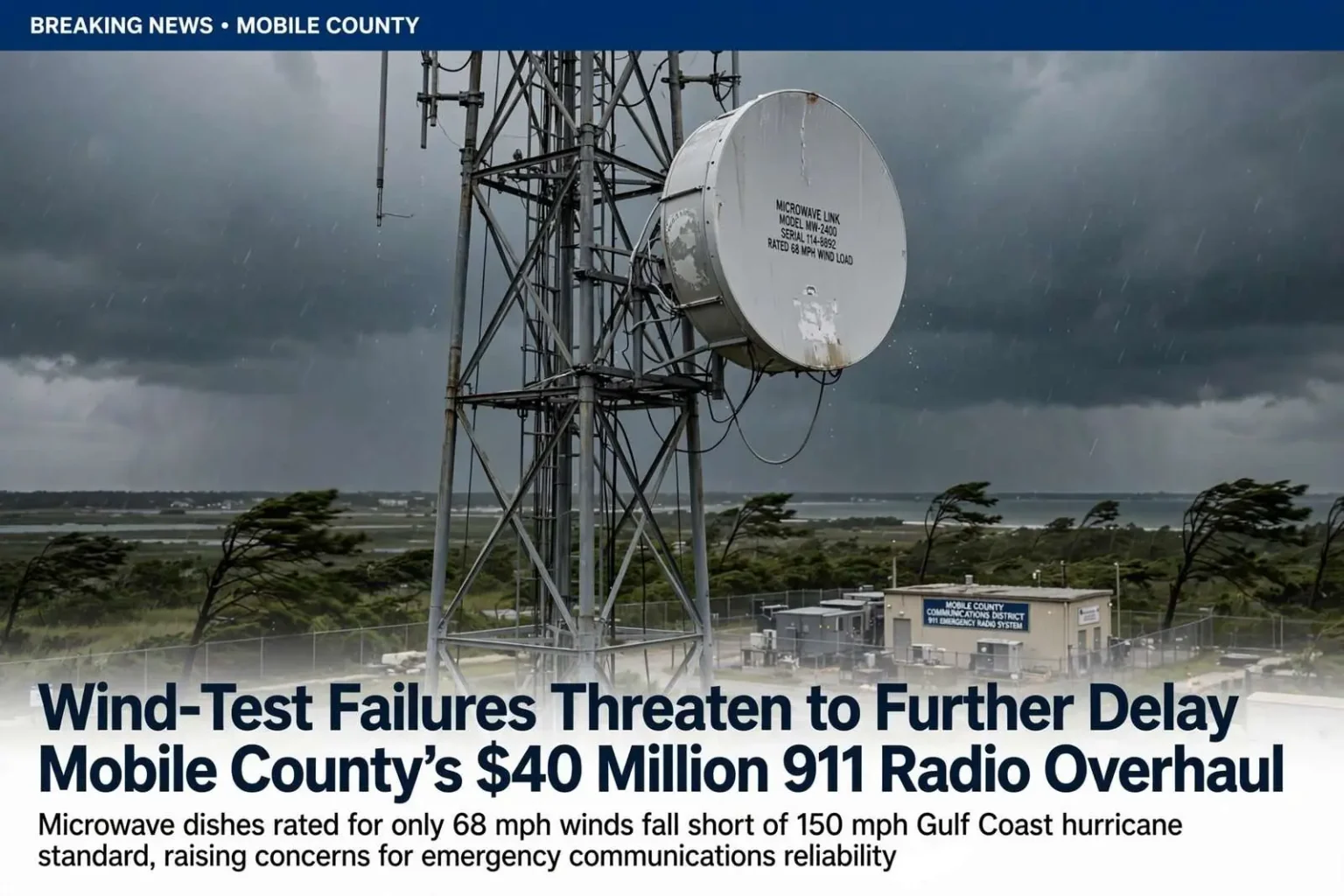
A $40 million overhaul of Mobile County’s 911 emergency radio system may fall even further behind schedule after officials discovered key equipment cannot withstand the kind of high winds that regularly accompany Gulf Coast hurricanes. The Mobile County Communications District, which oversees the county’s emergency dispatch network, learned this year that some of the microwave dishes installed as part of the new radio system failed wind-resistance testing conducted over the summer.
Jeya Selvaratnam of Tusa Consulting told district officials the dishes, as currently designed, can only withstand winds up to 68 mph, well short of what a public safety system serving a hurricane-prone region should require. Federal standards mandate that any communications tower built in Mobile County be able to withstand winds of 150 mph, and the towers themselves were constructed to meet that threshold. But the microwave dishes mounted on those towers were not built to the same standard, creating what officials describe as a significant vulnerability.
The gap between the two numbers is where the system’s survival would be decided. Microwave dishes are the backbone links of a modern public safety radio network — the point-to-point connections that carry dispatch traffic between tower sites and into dispatch centers — and they are typically the most wind-exposed hardware on a tower, mounted at the top on brackets with the largest surface area in the wind. A dish engineered for 68 mph fails precisely at the boundary between a severe Gulf thunderstorm and a minimal hurricane, which means the network’s most hurricane-relevant test would come at the moment the county is least able to respond to a failure.
A Category 1 hurricane carries minimum sustained winds of 74 mph, meaning even a relatively minor storm could knock out the system’s usefulness at the exact moment first responders would need it most. Mobile County’s history makes that scenario more than theoretical: Hurricane Frederic in 1979 destroyed communications and utilities across the region, and Hurricane Katrina in 2005 knocked out dispatch and radio infrastructure along the entire central Gulf Coast, forcing agencies to improvise for days. The county’s storm plan assumes that police, fire and EMS units can talk to each other and to dispatch through the worst hours of a landfall — and every mobile radio, console and tower in the system routes through the dishes now known to be underbuilt.
A project already long delayed
The revelation frustrated members of the district’s board, many of whom pointed out that a storm-resilient network was one of the central selling points when the project was approved back in 2013. Only a handful of current board members were serving at that time — a turnover that has itself complicated the project’s oversight, since the officials who approved the $40 million contract and its promises are mostly gone, while the officials now managing its consequences inherited the delays without the original assurances.
The storm-resilience argument was not incidental to the project’s approval. The case for replacing the county’s aging dispatch network rested on reliability in catastrophe: older analog systems were fragmented by agency, prone to dead zones and vulnerable to exactly the failures Katrina exposed. Building a countywide, interoperable digital network on hardened towers was pitched as the answer — a system that would keep working when the power grid, cell towers and telephone lines did not. Discovering that a critical component was rated below a Category 1 storm therefore struck board members as more than a technical footnote; it cut at the reason the district had spent $40 million.
District director Charlie McNichol said his staff is now working to determine how the design flaw made it through review in the first place, though he cautioned that assigning blame would take a back seat to fixing the problem. McNichol said he has already met with the regional sales team from Harris, the contractor on the project, to find a solution. According to McNichol, Harris has agreed to correct the issue at no additional cost to the district, and if the fix works as intended, it should not affect the project’s broader timeline. In the meantime, installation of mobile radio units for first responders is continuing without interruption.
That arrangement — the contractor absorbing the cost of the correction — reflects how large public safety procurements allocate risk: equipment that fails the applicable wind standards is a vendor defect, and Harris’s willingness to fix the dishes avoided a county paying twice for the same hardware.
Even so, the wind-resistance issue adds to a project that has already faced repeated delays. The system was originally supposed to be fully operational by this past September, but Selvaratnam said last week that a March 2017 completion date is now the earliest realistic target. The project was previously pushed back once in 2015 during contract renegotiations with Harris, and again this past summer amid what officials described as a data-sharing dispute between the district and Mobile County’s public works department.
The delays have compounded on each other in a way that has made the schedule the project’s most visible failure. A system promised for one September and now targeted for the following March has missed a full hurricane season in which it was supposed to be the county’s backbone — meaning first responders spent another summer and fall working on the old network the $40 million project was meant to retire. Each slip also pushes installation work deeper into the next storm season, when tower crews compete with post-storm repairs for the same Gulf Coast contractors.
The 2015 renegotiation and the 2016 data-sharing dispute each carried their own lesson about why radio projects stall. Contract renegotiations on a decade-scale procurement reopen price and scope questions that were locked years earlier, when radio technology, tower standards and federal grant requirements were all different. The data-sharing fight — between the district that owns the network and the public works department that builds and maintains county infrastructure — reflects a recurring friction in local government: two elected or appointed bodies with overlapping missions and separate budgets, each guarding its own authority over the same physical system.
The land-access fight in Theodore
Separately, the project has become entangled in a dispute over county land access. The district’s radio system relies in part on land controlled by the GUS Board, which maintains roughly 2,000 acres between Laurendine Road and Bay Road in Theodore. The property generates revenue through hunting and agricultural leases and also functions as an environmental mitigation bank for the county. The communications district uses a portion of the land to reach one of its radio towers, and in 2014 agreed to provide the GUS Board with 13 mobile radios in exchange for continued access.
That arrangement has since become a point of contention. At roughly $5,250 per radio, the deal would cost the district more than $68,000, and attorneys for the district have raised legal questions about whether money collected through residents’ 911 phone fees can be used to supply radios to county employees who are not first responders. The question turns on the purpose for which the fees were collected: Alabama’s 911 districts are funded by a dedicated fee charged on telephone service, and the statutes that authorize those fees generally confine their use to emergency communications purposes. Thirteen radios delivered to a county board whose staff are not emergency responders sit uncomfortably close to the line — close enough that district attorneys flagged it before any radios changed hands.
The GUS Board itself has no direct employees, since most of its work is carried out by the county’s engineering department under the supervision of environmental services director Bill Melton, who said the board would ultimately decide who ends up using the equipment. That structure adds a layer of ambiguity to the dispute: the party demanding the radios does not itself employ the people who would use them, and the county department that would operate them answers to county leadership rather than to the board holding the agreement.
District attorney Jeff Hartley has argued the original agreement, brokered under a former county attorney, falls outside the board’s statutory authority. County Attorney Jay Ross has countered that the GUS Board, including some of its current members, already approved the deal and cannot simply back out now that terms have become inconvenient. The two positions frame a familiar standoff between a board’s current legal view and its own past actions: one side says the promise was void from the start because the board had no power to make it; the other says estoppel — the principle that a party is bound by commitments others have relied upon — keeps the board to its word.
According to Hartley, the GUS Board sent a formal demand letter over the radios last month, though no party has moved to restrict access to the property while a resolution is sought. The demand letter converts what had been an informal disagreement into a papered dispute — the step that precedes litigation — while the continued open access preserves the radio project’s construction schedule. For the communications district, that distinction is the practical one: as long as crews can reach the tower, the wind-test fix, the tower work and the final system integration can proceed on the March 2017 timetable; if access were ever cut, the entire network’s completion would be hostage to a land dispute over radios.
The radios themselves are the least expensive item in a $40 million program, which makes the fight’s persistence notable. Thirteen mobile units at $5,250 apiece is a rounding error against the project’s budget — but the principle the radios carry is not. The communications district exists to spend 911 fee money on emergency communications and nothing else; the GUS Board exists to manage county land and its revenues; and each side regards the other’s ask as an improper use of its charge. Deals like the 2014 access-for-radios trade are common in local government precisely because they convert a friction into a courtesy — but when a courtesy is later audited against a statute, the courtesy becomes a liability.
What the dispute shares with the wind-test failure is a lesson about how the system’s weakest links were never in the radios. A $40 million network can be delayed by a dish rated for the wrong wind speed, a letter from a land board, a data-sharing disagreement between departments — none of them radio problems in the engineering sense, all of them decisive to whether the network exists on the day a hurricane does. Mobile County’s emergency communications will ultimately be judged in exactly those terms: not by the specification sheets, but by whether, in the next Gulf storm, dispatch keeps talking to the units on the road.