Mobile, Baldwin County 911 Centers Now Flag Homes of COVID-19 Patients for Responders
Mobile and Baldwin County 911 officials say they are flagging the addresses of confirmed COVID-19 patients in dispatch systems so police, firefighters and medics can take precautions, a practice its director defends despite privacy concerns.
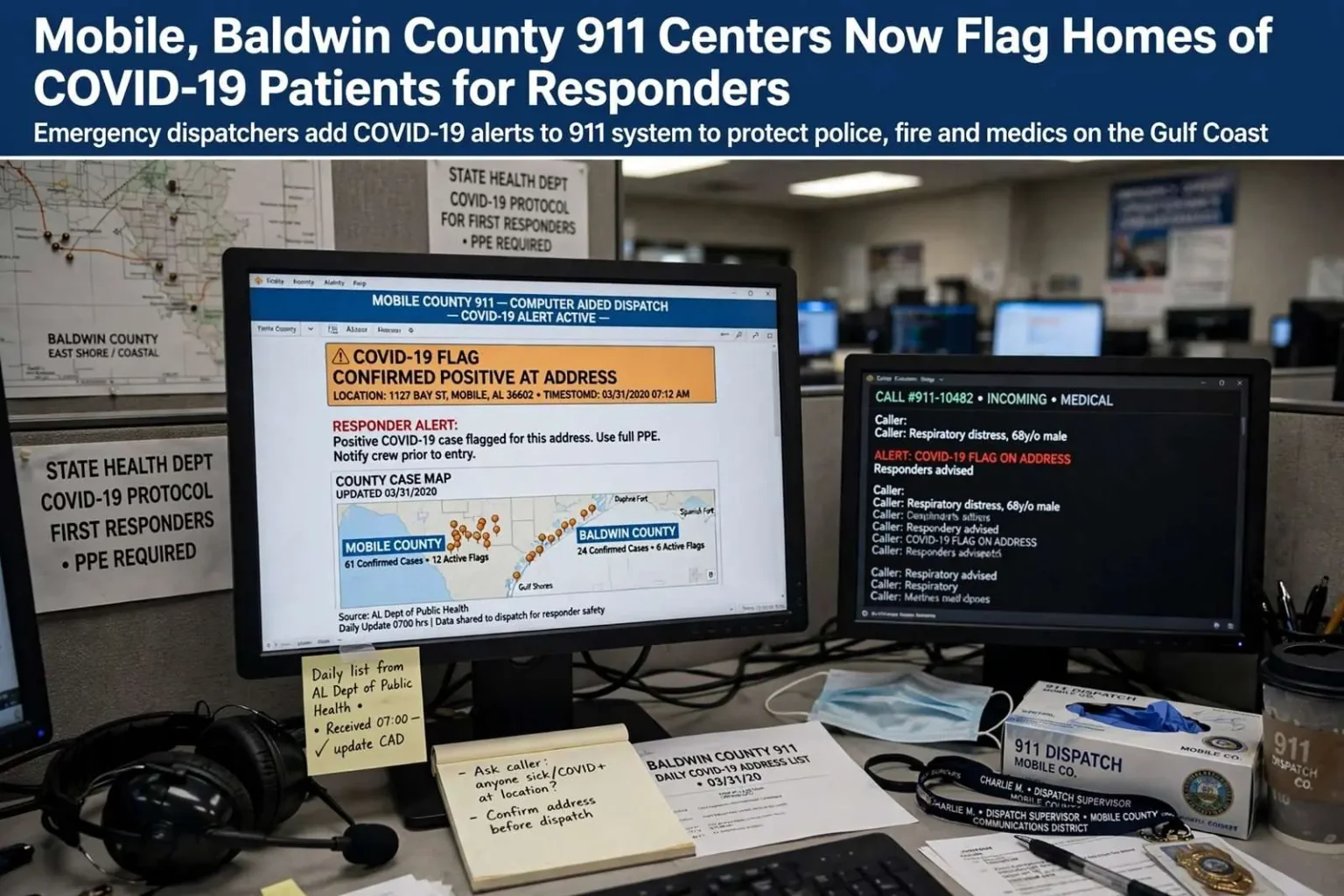
Emergency dispatchers in Mobile and Baldwin counties have begun quietly flagging the home addresses of confirmed COVID-19 patients in their computer systems, a practice local 911 officials say is meant to protect police officers, firefighters and paramedics from unknowingly walking into a house with an active infection. The practice emerged as the pandemic’s first weeks forced every public safety agency on the Gulf Coast to rethink how routine calls were handled.
Charlie McNichol, director of the Mobile County Communications District, which oversees the county’s 911 system, said he personally receives a daily list of addresses tied to confirmed COVID-19 cases from the Alabama Department of Public Health. Those addresses are then entered into the district’s computer-aided dispatch system, so that if a 911 call comes in from one of those locations, responding officers, firefighters or medics are automatically alerted that someone there has tested positive.
“We flag those in our [Computer Assisted Dispatch] system so if a call comes into one of the addresses for any first responders — fire, police or medical — we let them know that location is suspected of having a positive case,” McNichol said. “I think we owe that to our first responders. It doesn’t give us anyone’s name or any other personal information about the individual, it just lets us notify them that someone at that address has tested positive for COVID-19 so that they can have their guards up.”
Baldwin County 911 Director Joby Smith has confirmed his office is receiving similar information from state health officials, though he has said the data initially arrived more slowly than he would have liked. Baldwin’s dispatch center serves the county’s fast-growing beach and eastern shore communities, where call volumes spread across a much larger geographic area than in Mobile.
As case counts climbed this week, Mobile County had 61 confirmed COVID-19 cases and Baldwin County had 24, according to state figures. The numbers were still small by later pandemic standards, but they were growing quickly enough that dispatch officials wanted a working system in place before the volume made manual notification impossible. State case totals were updated daily, and each update fed directly into the dispatch flags, meaning the accuracy of the protection depended on how quickly the health department could push new confirmations to the counties.
Why the county systems differ
The two dispatch centers serve very different geographies. Mobile County’s system handles a dense urban core, suburban corridors and a large rural western half, all served from a single call-processing center. Baldwin’s covers one of the fastest-growing counties in Alabama, stretching from Spanish Fort and Daphne down to the beach communities, with long response distances that make any delay in caller screening or responder warning more consequential. Smith’s complaint about slow data delivery reflected that geography — in a county where a medic may drive 20 minutes to a call, the sooner a flag appears, the better.
Privacy questions and how officials answered them
The arrangement has drawn scrutiny from some residents and privacy advocates who question whether sharing addresses tied to a specific medical diagnosis runs afoul of the Health Insurance Portability and Accountability Act, the federal law that protects patient health information. HIPAA generally restricts how health care providers and insurers can share patient data, and the concern was that a daily pipeline from the health department into a dispatch computer might cross that line.
McNichol said attorneys for both the Mobile County Communications District and the state health department reviewed the policy before it was implemented, and that a similar arrangement between statewide 911 officials and public health authorities was worked out at the state level.
A spokesperson for the Alabama Department of Public Health has said the agency made the decision jointly with members of the state’s 911 board specifically to protect first responders, citing a state law that allows physicians and public health officials to notify a third party when there is a foreseeable risk of disease transmission. That exception — long part of public health practice for things like communicable disease warnings — is what officials say keeps the address flags on solid legal ground.
State guidance issued alongside the policy is intended to limit how the address information can be used once it reaches local dispatch centers. Locally, McNichol said the flagged addresses aren’t shared outside the agency and are only visible to staff on a need-to-know basis tied to an active call, the same standard applied to other sensitive information already kept in the dispatch system, such as addresses with a history of frequent calls or other unique circumstances that first responders need to know about before they arrive.
Dispatch centers have always maintained such precautionary notes — warnings about weapons, dangerous animals, prior violent calls or hazards on a property — and the COVID flags were built to work the same way: visible to the dispatcher relaying the call, invisible to anyone without a live reason to see them.
Beyond the address-flagging system, Mobile County dispatchers have also started asking additional screening questions of nearly every 911 caller, regardless of the nature of the emergency.
“In a medical emergency or not, dispatchers would always ask questions about medical history on the call, but even other types of calls like law enforcement, we’re asking the caller: ‘Has anyone at your address been sick or tested positive for COVID-19,'” McNichol said. “Most people voluntarily give that information to us, but even if they don’t for some reason, we’re certainly asking.”
Why the worry about responders runs so deep
The extra precautions come as concern grows statewide about first responders contracting the virus on the job. In Mobile, 28 police officers and firefighters have tested positive for COVID-19 antibodies through rapid serum blood tests, meaning their bodies have shown an immune response to the virus at some point, whether they are currently fighting it or have already recovered. City officials are continuing to test additional first responders as supplies allow.
Similar concerns have surfaced elsewhere in Alabama; in Tuscaloosa, dozens of police officers and firefighters were pulled off duty after a single first responder tested positive, underscoring how quickly an outbreak within a department can strain public safety staffing. A single undetected case can cascade into quarantine for entire shifts, leaving a department to cover its normal workload with a fraction of its personnel.
Because police, firefighters and paramedics are considered essential personnel who interact with large numbers of people daily, health officials have treated them as a priority group for testing, similar to medical professionals, given the risk that an infected responder could spread the virus to colleagues and the public.
A jail cluster adds another front
The Mobile County Sheriff’s Office is also working with public health officials to contain a cluster of COVID-19 cases at Mobile Metro Jail, where two corrections officers and one inmate have tested positive. Warden Trey Oliver said inmates who had contact with those individuals are being separated under a tiered quarantine system designed to limit further spread within the facility.
Oliver said jail officials have access to COVID-19 tests but, because of limited supply, are currently only testing inmates who are showing symptoms. Confinement facilities present particular challenges during an outbreak — shared cells, communal spaces and a constant rotation of staff and inmates — which is why jails and prisons across the country moved early toward screening, separation and restricted access.
What it means at the curb
For residents, the practical effect of the new system is subtle. A caller dialed 911 still hears the same questions and gets the same help; the change is what happens on the responding side, where a dispatcher’s screen now carries a quiet warning when an address on the call matches the health department’s daily list. Responders arriving at such a location can take precautions — distance, protective equipment, limited entry — that would not otherwise be part of the response.
Officials in both counties describe the flags as a temporary pandemic measure rather than a permanent change to dispatch practice. The lists depend on the daily flow of confirmed cases from the state health department, and the need-to-know handling rules keep the information from spreading beyond the responders who need it on a specific call.
What the episode has already shown, though, is how quickly the pandemic has pushed public health data into corners of government that never previously touched it. A 911 center built around addresses, geography and response time now also functions, for the duration of the outbreak, as one of the places where the state’s case information is put to work — with the promise that the people answering the door for a stranger at 2 a.m. at least know what might be waiting behind it.