Mobile County Internship Program Sends 55 Young Adults Into Local Workforce
Fifty-five young adults completed the Mobile County Job Internship Program this summer, gaining hands-on workplace experience with about 50 local businesses and, in some cases, landing permanent jobs.
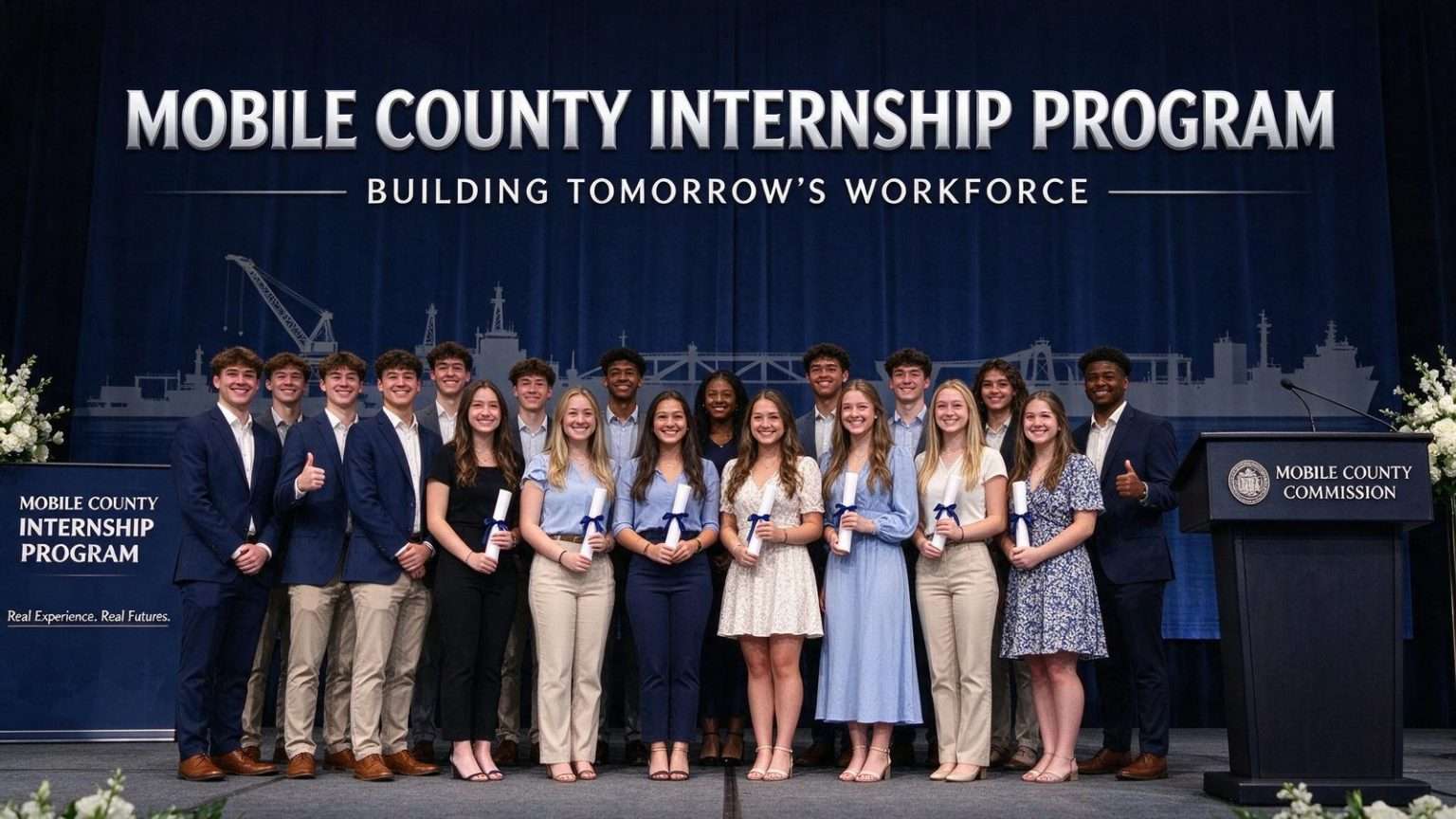
Fifty-five young adults from across Mobile County wrapped up a five-week internship program this month designed to give them real-world experience in the local job market, with several parlaying the opportunity into offers of permanent employment. The group was honored at a luncheon at the Arthur R. Outlaw Convention Center, where organizers, county leaders and local business partners celebrated the interns’ work over the summer. For a program built around first jobs, the luncheon served as a first showcase — a room full of employers, officials, and family members seeing what five weeks of structured placement had produced.
The event featured a keynote from Don Keeler, vice president of human resources at Austal USA, the Mobile shipbuilder that has become one of the region’s largest employers. His remarks focused on the qualities local companies look for as they build out their workforce, a theme that ran throughout the program. Austal’s rise on the Mobile waterfront has made the company a fixture in workforce conversations across the county; the shipyard builds military and commercial vessels and has continually expanded its hiring pipeline for both skilled trades and professional roles.
The Mobile County Job Internship Program is coordinated by Spherion Staffing Services and Workshops Etc., and pairs young people with area businesses for a structured introduction to professional life. Participants spent their first week in intensive job readiness training, covering resume writing, workplace expectations and interview skills, before moving into four weeks of on-the-job placements with local companies. This year about 50 businesses took part, a number organizers say has grown steadily as more employers recognize the value of the pipeline.
The model borrows from the training methods used across the staffing industry: front-load the soft skills, then let the workplace do the teaching. By the time an intern reaches a desk or a job site, the program’s organizers reason, the awkward first questions about dress, punctuality, and email etiquette have already been answered in the classroom. The week of preparation also gives coordinators a chance to spot problems — a shaky interview, a shaky schedule — before they surface in front of a host employer, protecting both the student and the company’s willingness to participate again next summer.
Real assignments, real stakes
Interns took on substantive assignments rather than simple busywork. Among the projects highlighted at the luncheon were an intern who helped streamline an engineering process to reduce costs, others who worked in financial investments, a pair who contributed to engineering projects, and one who built a database and helped re-program a system while working in hospital administration on a nursing floor.
Those are not the errands and filing of the stereotype. An intern who can trace the steps of an engineering process and flag where time and money leak away is doing work companies pay professionals to do, and hospital administration work on a nursing floor puts a young person at the operational center of the region’s largest employment sector, health care.
Employers, for their part, got a five-week audition. A short placement reveals whether a candidate shows up on time, asks good questions, and follows through — evidence no interview can match. Several of this year’s interns converted their placements into offers of permanent employment, the outcome organizers point to first when they describe the program’s purpose.
How the class was chosen
Getting into the program is competitive. Applicants between the ages of 17 and 22 must submit a personal essay, maintain at least a 2.0 grade point average, provide recommendations, sit for interviews, and pass a background check and drug screening. The screening process mirrors what most Gulf Coast employers now require for hiring, which means applicants who clear it have effectively completed a dry run of the region’s standard hiring gauntlet.
This year’s class came from high schools and colleges across Mobile County, with participants ranging from local public school students to a student attending Harvard University. The range says something about the program’s reach: it serves the student who needs a first credential as much as the student with an elite transcript, and employers in both cases get the same thing — a motivated young worker with something to prove.
“This is one way to get our talented and deserving youths into the workforce when experience is a requirement,” said Mobile County Commission President Connie Hudson. “At the same time, we hope to develop the workforce to better meet the needs of our local companies.” The line captures the program’s two-sided logic: young people need experience to get jobs, and jobs need experienced workers, so the county builds the experience itself. Hudson, whose commission district covers much of west Mobile, has championed workforce initiatives as a bridge between the county’s education system and its employers, and the internship program fits squarely in that portfolio.
Mobile County Commissioner Jerry Carl echoed that sentiment, calling the internship program another building block in preparing young people to enter the job market. “Hopefully these experiences will lead these young people back to Mobile when they are making their career choices,” he said, adding that keeping young talent in the region after college or trade school remains a priority for county leaders.
Partners across government, banking, and higher ed
The program is led by the Mobile County Commission in partnership with Mobile Works, PNC Bank and the University of South Alabama. Organizers say the collaboration between government, private industry and higher education has been key to matching students with meaningful placements and giving local businesses an early look at future hires.
Mobile Works, the region’s workforce development board, brings the employer connections and job-training infrastructure that a county commission alone would struggle to assemble, while PNC Bank’s involvement reflects a growing trend of financial institutions underwriting early-career pipelines as a form of community investment. The University of South Alabama supplies both students and institutional weight, linking the program to the campus where thousands of the county’s graduates earn their degrees.
That three-way structure also protects the program from the fate of many summer initiatives, which fade when a single sponsor loses interest. With the county providing direction, the workforce board providing employers, a bank providing resources, and a university providing talent, no single institution carries the whole weight — and each has a stake in the program’s annual survival.
Why retention matters now
Carl’s emphasis on keeping young talent home speaks to a challenge that has shadowed Mobile County for decades: the region educates thousands of capable young people, then watches many of them take those credentials to Atlanta, Houston, or Nashville. Every intern who discovers, at 19, that Mobile companies offer real work and real advancement is one more graduate with a reason to decline the moving truck.
The timing of the argument matters too. With Austal expanding, aerospace growing around Mobile Aeroplex at Brookley, and health care systems adding jobs across the county, the region’s employers have more openings than proven young applicants to fill them. Programs like this one serve as the connective tissue between the schools producing graduates and the employers who need them, and the earlier that connection forms, the more likely it holds.
For the interns themselves, the summer’s value compounds beyond the paycheck. A résumé line with a named employer, a supervisor willing to write a recommendation, and a firsthand answer to the question of what a career might actually look like — those assets follow a young person into every application and interview that comes after.
What comes next for the program
County officials say they expect the program to continue growing in coming years as more employers sign on, giving even more Mobile County students the chance to build skills and connections before they enter the workforce full time. Growth, organizers note, tends to be self-reinforcing: each summer’s success stories circulate among the county’s employers, and each new company that hosts an intern becomes a recruiter for the program itself.
The expansion will also raise the stakes for the program’s selection and training processes. A larger class means more businesses to recruit, more placements to match, and more demand for the first-week readiness training that sets the tone. The coordinating partners — Spherion and Workshops Etc. — will bear most of that load, with the commission’s oversight and the partner institutions’ support carrying the rest.
The interns honored at the Outlaw Convention Center this month, meanwhile, have already moved on: some into permanent jobs, some back to school with a summer of experience behind them, and some into the next round of applications with new confidence and better credentials. The county’s bet is that they will carry those five weeks — and Mobile’s name — with them wherever they go, and that the best place to use what they learned will be here at home.