
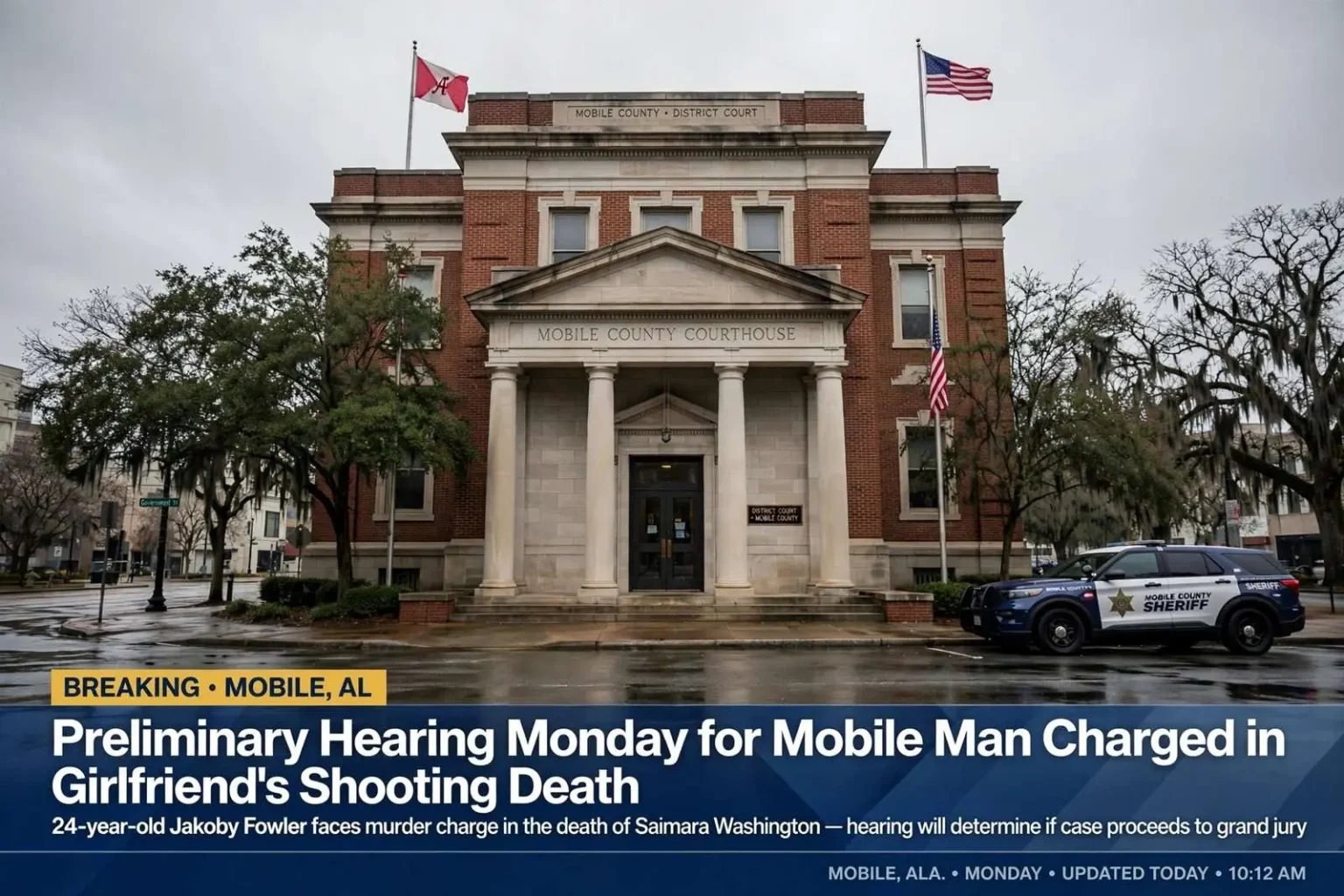
MOBILE, Ala. — A 24-year-old Mobile man accused of shooting and killing his girlfriend is scheduled to appear for a preliminary hearing Monday, the first substantive court test of the case against him. Jakoby Fowler faces a murder charge in the death of Saimara Washington, and Monday’s hearing will determine whether the evidence is strong enough to move the case forward to a grand jury.
Fowler remains held in the Mobile County Metro Jail on a $1 million bond set after prosecutors argued under state law that he should be held without bond entirely. The hearing is expected to draw family members of both the defendant and the victim, who have been following the case closely since the June arrest.
What police say happened
Mobile police officers were called to Hillcrest Estates on Airport Boulevard just before midnight on June 17. Inside an apartment, they found Washington dead from a gunshot wound. The apartment complex sits along one of west Mobile’s busiest stretches of Airport Boulevard, and the late-night shooting call brought patrol officers, investigators, and crime scene units to the scene in the overnight hours.
According to court documents, a neighbor reported hearing Fowler and Washington arguing before gunshots were fired. Investigators said Fowler did not call 911 and remained at the apartment for roughly 30 minutes before officers arrived. Court documents also state that Fowler later confessed to the shooting.
The account laid out in the documents — an argument, gunfire heard through the walls, and the half hour that passed without a call for help — forms the backbone of the state’s showing at Monday’s hearing. Prosecutors are not required to present their full case at this stage, only enough evidence to establish probable cause that a felony was committed and that the defendant committed it.
Bond, charges, and Aniah’s Law
Fowler is charged with murder and remains held in Mobile County Metro Jail. A judge set bond at $1 million after prosecutors asked that he be held without bond under Aniah’s Law. Aniah’s Law, approved by Alabama voters in 2022, allows judges to deny bail entirely in certain violent felony cases, including murder. The provision gives prosecutors an avenue to argue for pretrial detention, but the decision rests with the judge — and in this case the court set a high bond rather than denying bail outright.
Aniah’s Law takes its name from Aniah Blanchard, an Auburn University student and stepdaughter of a UFC fighter who was abducted and killed in 2019, a case that galvanized support across Alabama for changing the state’s bail system. The constitutional amendment that followed was ratified by voters statewide and applies to a defined list of serious violent offenses — among them murder, kidnapping, and certain forms of assault and robbery — where prosecutors can seek to have a defendant held in jail before trial if the state proves by clear and convincing evidence that no conditions of release would reasonably assure the defendant’s court appearance and the safety of the community.
In practice, the law shifted the argument in serious cases like this one. Before the amendment, judges started from a presumption that bail should be available and negotiable; now prosecutors can file a motion asking for pretrial detention, present evidence at a separate hearing, and leave the judge to weigh whether any bond amount can protect the public. A $1 million bond in a domestic-violence-related homicide is the kind of middle outcome that has become common under the law — a figure high enough to be a substantial barrier to release, while stopping short of the total denial prosecutors requested.
A preliminary hearing’s role
A preliminary hearing is not a trial. Its purpose is for a judge to determine whether there is probable cause to send the case to a grand jury. Prosecutors typically present a limited portion of their evidence, often through a single investigator, and the defense gets its first opportunity to cross-examine. Monday’s hearing will therefore be the first time Fowler’s defense attorneys can probe the state’s witnesses in open court, testing the timeline and the basis for the statements attributed to their client.
The stakes run in both directions. If the judge finds probable cause, the case is bound over to a grand jury, which decides whether to return an indictment — the formal charge that allows the case to proceed toward trial. If the judge finds the showing insufficient, the case can be dismissed, though prosecutors retain the option of re-filing if additional evidence develops. Either way, the hearing produces a public preview of the evidence that has until now existed mostly in arrest filings and court documents.
Domestic violence cases occupy a distinct place in the court system, and Alabama has spent years strengthening the tools available to respond to them. A homicide between intimate partners is, in the eyes of researchers and prosecutors alike, the most severe point on a spectrum of escalating abuse, which is why advocacy organizations across the state push for early intervention — protective orders, supervised release conditions, and mandatory arrest policies in misdemeanor incidents. Monday’s hearing, like every case that reaches the courthouse, will be viewed by those advocates as a measure of whether the system’s tools worked as intended.
The Mobile County District Attorney’s Office, which is prosecuting the case, will send one of its attorneys to present the state’s evidence alongside the lead investigator. Defense counsel will have the chance to ask the witness about what was observed at the scene, what neighbors reported, and the circumstances under which the alleged confession was obtained — questions that often foreshadow the suppression and sufficiency issues a defense will press later in the case.
Washington’s family
Washington’s family said they saw no obvious signs of abuse before her death. Her mother described Washington as outgoing, kind and loved by many. The family’s account — that nothing about the relationship publicly signaled danger — reflects a pattern domestic violence advocates describe routinely: abusive relationships can remain hidden from the people closest to the victim, with control and isolation taking forms that never leave a visible mark.
Family members have begun the process that follows every homicide in Mobile County, one that most people never think about until it lands on them — arranging a funeral, dealing with the victim’s belongings, and sitting through the chain of court appearances that will now stretch over months. Relatives said they intend to be present Monday as the case takes its first formal step.
Fowler’s own family, meanwhile, is confronted with the same event from the other side of the courtroom. In cases involving domestic partners, the two families are often connected through shared children, holidays, and years of history, and the aftermath of a killing leaves both navigating grief and disbelief at once.
The hearing is set for Monday in Mobile County district court, where preliminary examinations are conducted. If the judge finds probable cause and the case is later indicted by a grand jury, it will move to circuit court, where the felony track — arraignment, motion practice, and eventually trial — begins in earnest. Whatever Monday’s outcome, it will set the procedural course for everything that follows in the death of Saimara Washington.
For observers wondering why the state invests a full hearing in a case headed to a grand jury anyway, the answer lies in how Alabama’s two-step screening process is designed to work. The preliminary hearing acts as an early filter in open court, where the evidence must be spoken aloud and tested under questioning before any indictment issues. Judges use these hearings to flag weaknesses — gaps in the timeline, hearsay problems, chain-of-custody questions — that prosecutors would rather discover in month one than at trial.
Defense attorneys, for their part, use the hearing to lock witnesses into early accounts. Testimony given at a preliminary hearing can be compared line by line against trial testimony months later, and any shifts become cross-examination material. In a case where a confession and a neighbor’s earwitness account carry the state’s burden, those early accounts matter enormously.
What the coming months hold
If Monday’s hearing results in a bindover, the file moves to the grand jury, which meets in secret and hears only the prosecution’s side. An indictment — a “true bill” in Alabama terminology — sends the case to circuit court for arraignment, where Fowler would enter a formal plea. From there the case enters the familiar rhythm of felony litigation: motion practice over the confession and any searches, discovery exchanges, possible plea negotiations, and, absent a resolution, trial.
Murder in Alabama carries a potential sentence of decades in prison upon conviction. The charge’s seriousness is part of what made the bond argument under Aniah’s Law so consequential at the front end of the case, and it is why the preliminary hearing stage draws attention even though no guilt or innocence is decided there.
For now, the case stands where hundreds of Alabama homicide cases stand each year — at the courthouse threshold. Washington’s family will be watching Monday to see the state’s evidence laid out in public for the first time, and Fowler’s defense will get its first look at how strong that evidence actually is. The hearing begins Monday morning, and the outcome will determine the road the case takes through Mobile County’s court system.


