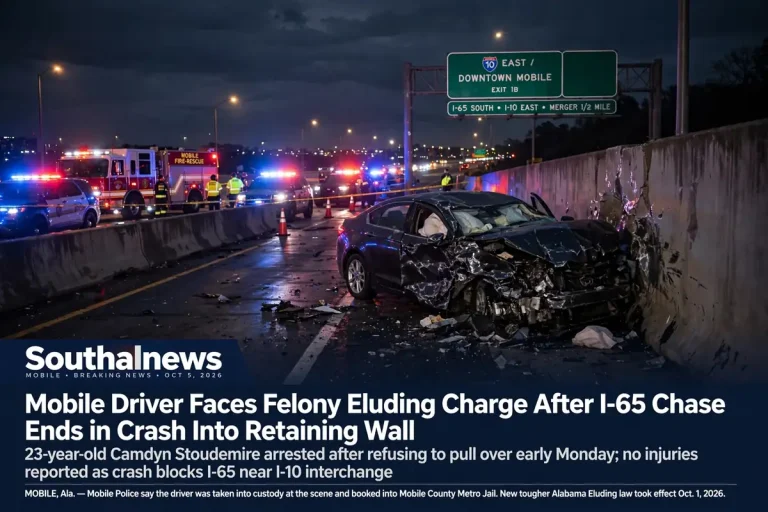
Digital Siren App Turns Mobile County Into Nation’s Largest Police-Chase Alert System
Mobile County leads the nation in Digital Siren deployments, alerting the public to nearby police pursuits via a free app.
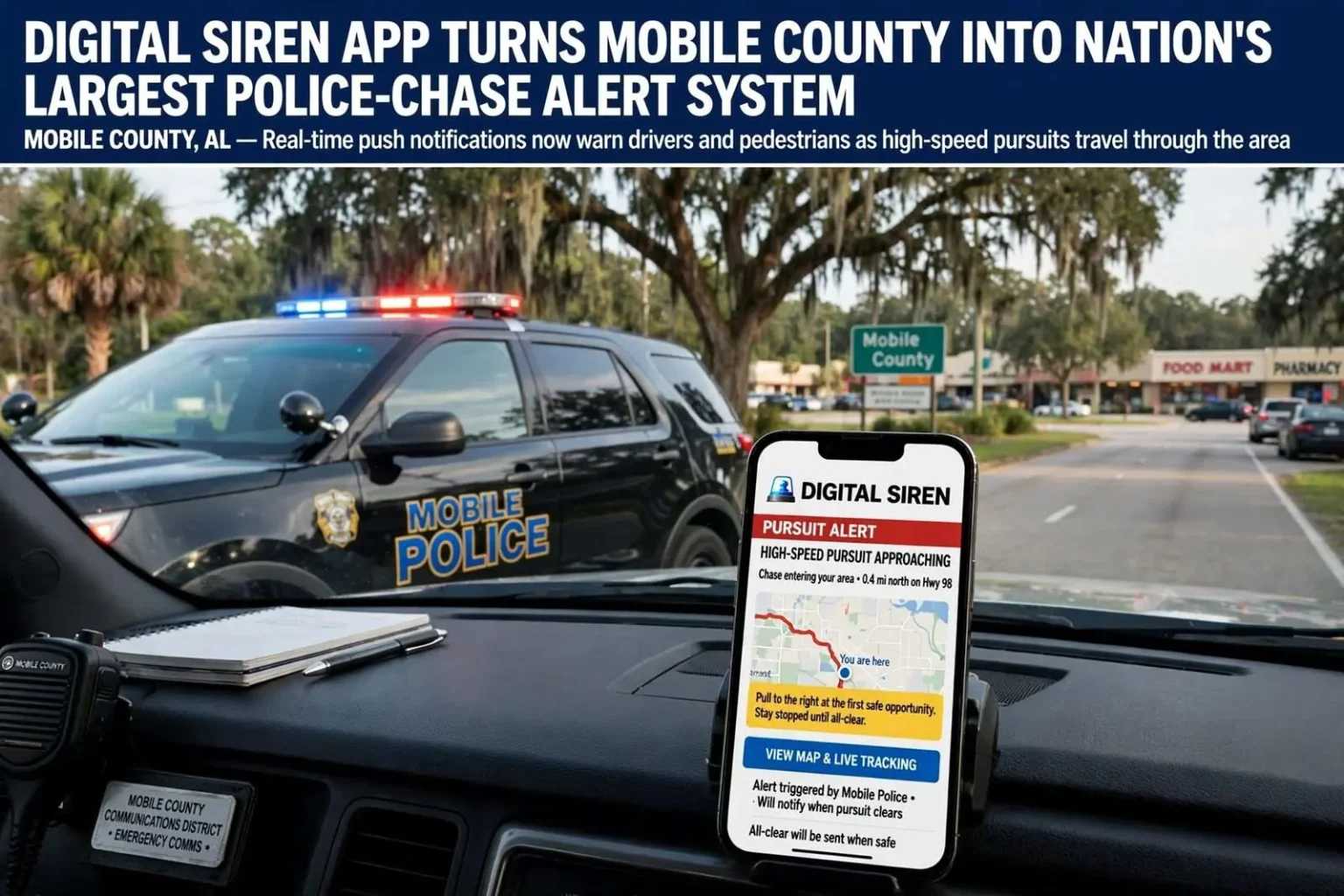
Mobile County now runs the largest deployment of a public police-pursuit alert system in the country, a tool designed to warn drivers and pedestrians when a high-speed chase is moving through their area. The system is called Digital Siren, and it changes the basic dynamics of a pursuit in south Alabama: instead of the only warning being the sound of sirens somewhere behind traffic, every phone user in the pursuit’s path can get a direct push notification telling them to get out of the way.
With the push of a button inside a patrol vehicle, law enforcement can trigger a notification to anyone nearby who has downloaded the free app, telling them to clear the road. The alert also tells users when the pursuit has moved out of their range, so warnings do not linger after the danger has passed. That two-way lifecycle — alert when a chase approaches, all-clear when it moves on — is what separates the app from passive warning methods like radio traffic reports or road signage.
High-speed pursuits are among the most unpredictable events police respond to, because the danger travels at highway speed through intersections, school zones and residential streets that have no way of knowing a chase is coming. A driver pulling out of a shopping center parking lot has seconds to react to sirens they may not hear over traffic. A pedestrian crossing a four-lane road has even less. The app is built for those seconds, pushing the warning directly to the devices of anyone in the pursuit’s projected path.
How Mobile County Scaled It Up
The Mobile County Communications District bought the technology in September 2020, and agencies across the county have adopted it since. The district, which coordinates emergency communications for law enforcement, fire and EMS agencies across Mobile County, made the purchase part of its broader mission of linking the county’s departments onto shared systems rather than leaving each city and agency to build its own.
The Mobile Police Department leads the nation in use, with 289 vehicles equipped and 165 of those activated and in service — more than any other law enforcement agency in the country, according to district officials. The gap between the two figures reflects the practical realities of fleet management: equipping a vehicle is one step, and keeping a unit installed, activated and carried by officers on shift is another. Even so, an active fleet of 165 pursuit-equipped vehicles places Mobile ahead of departments many times its size elsewhere in the country.
“It’s kind of a no-brainer that we can alert the public of a high-speed pursuit that unfortunately kills so many people, innocent people,” said Charlie McNichol, director of the Mobile County Communications District. His framing captures the core argument officials here have made for the system: the people most likely to be hurt in a pursuit are not the suspect or the pursuing officers, but drivers and pedestrians who happen to be in the wrong place when a chase crosses their path.
Each vehicle costs about $100 to equip, a figure that has made scaling the system across a county government budget far easier than most public-safety technology purchases. At that price, the cost of outfitting an entire patrol fleet is comparable to a single new radio or radar unit, and it has allowed smaller departments that could never fund a bespoke warning program to participate anyway.
Other participating agencies include the Mobile and Baldwin County Sheriff’s Offices and the Satsuma, Summerdale, Citronelle and Thomasville police departments. The list shows the system spreading beyond the city of Mobile across county lines: the Baldwin County Sheriff’s Office participation extends coverage across Mobile Bay, while Satsuma, Summerdale and Citronelle represent the smaller north-county and eastern-shore communities where two-lane roads and long response distances make a pursuit warning especially valuable. Thomasville, north of the immediate Gulf Coast in Clarke County, rounds out a participation map that now stretches well beyond the county line where the system started.
Saving Lives, Officials Say
Tim Morgan, co-founder and CEO of Digital Siren, spent more than 35 years in law enforcement and said a single case — a young man killed in a chase — pushed him to build the warning tool. His experience mirrors the argument made by pursuit-reform researchers nationally: most bystander deaths in pursuits are not flukes but the predictable result of drivers and pedestrians having no idea a chase is approaching until it reaches them.
He cites national figures of more than 68,000 high-speed pursuits a year in the United States and roughly one death a day tied to them. Those numbers, drawn from national tracking of pursuit data, mean that across the country a pursuit-related death occurs about as often as a daily event, and that the overwhelming majority happen on ordinary streets to people who were never part of the underlying offense.
Since Mobile Police adopted the app, no bystanders have been injured or killed during a chase, Chief Paul Prine said. He credited the app along with the department’s pursuit policy and experienced officers, a three-part explanation that tracks with how pursuit safety experts describe the problem. The technology warns the public; the policy decides when a chase is worth the risk; and officer training determines how the chase is actually driven.
Prine noted the balance between apprehending a suspect and protecting the public is “never taken lightly.” That framing reflects the tension at the center of every pursuit decision: officers must weigh the seriousness of the suspected offense against the danger a chase creates for everyone else on the road, and the availability of a public warning system changes that calculus by reducing the risk to bystanders.
What It Means For Drivers In Mobile County
For residents, the practical effect is simple: anyone who downloads the free app receives a warning the moment a pursuit enters their area, along with instructions to clear the road, and a second notification when the pursuit has moved on. That is most valuable for drivers approaching intersections, parents with children near busy roads, and people walking in areas where a chase could pass at any moment.
Safety officials recommend that drivers who receive an alert pull to the right at the first safe opportunity, stay stopped until the all-clear arrives, and never try to follow or film a passing pursuit. Emergency vehicles in a pursuit travel in unpredictable lanes at high speed, and the seconds a driver loses by pulling over are far less costly than the collision a startled driver can cause.
The system also feeds a growing pattern in Gulf Coast public safety, in which mass-notification tools built for hurricanes and severe weather are being adapted for street-level emergencies. Mobile County residents are already accustomed to receiving urgent alerts about storm tracks and road closures, and a pursuit warning travels through the same habit of checking a phone when it buzzes.
A Model Other Departments Are Watching
With more activated vehicles than any agency in the country, Mobile Police have turned the county into a national reference point for the technology. District officials say the scale of the deployment gives the county a larger body of real-world data than any other community, from how quickly drivers respond to alerts to how the system performs during multi-agency chases that cross city limits.
The spread to Baldwin County and communities like Satsuma, Summerdale, Citronelle and Thomasville suggests the model is moving beyond its pilot market. Every new agency that equips vehicles extends the coverage area, and the low per-vehicle cost keeps the barrier to entry low for departments whose budgets could never support a larger public-safety technology program.
For the officials who oversee the system, the measure of success is the one Prine pointed to: bystanders uninjured and alive after every pursuit since the county deployed the app. National pursuit figures suggest the danger is not going away — tens of thousands of chases a year, and roughly a death a day — but Mobile County has built the largest warning network in the country to make sure its residents are not the ones who never saw it coming.
The way the alert works in practice is built for speed. When an officer initiates or joins a pursuit, activating the system takes a single button press inside the patrol vehicle rather than a radio request or a dispatch-center relay, so the warning reaches nearby phones in the opening moments of the chase instead of after it has crossed several streets. Users who have the app installed but are outside the pursuit’s range receive nothing, which keeps the notifications from becoming routine noise.
That precision matters for public trust. Alert systems succeed only when people act on the warnings they receive, and officials across participating agencies have emphasized that a pursuit alert is rare and specific — tied to an actual pursuit, in an actual place, with an actual instruction to clear the road. The follow-up message when the danger passes gives users a clear signal that they can return to normal driving.