Mobile County Schools Allocated $33 Million for Construction in 2009
The Mobile County School Board allocated $33 million in mostly stimulus-funded construction work in 2009, including renovations at B.C. Rain and Scarborough schools.
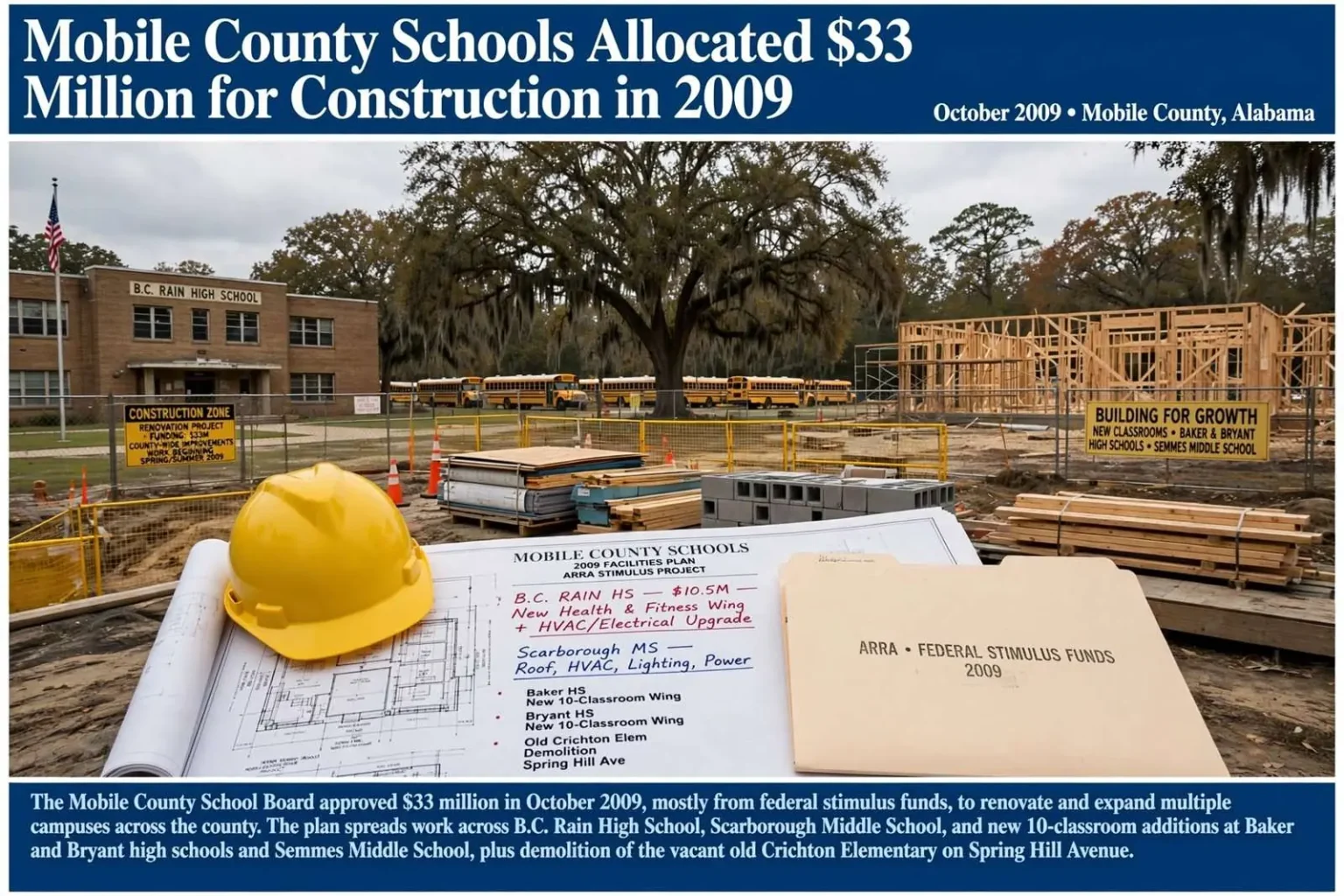
The Mobile County School Board allocated $33 million for school construction in October 2009, using mostly federal stimulus funds for renovations, additions and facility improvements. The spending plan touched campuses across Alabama’s largest school system, from the northern suburbs to the city’s southern neighborhoods, and it arrived at a moment when districts nationwide were deciding how to use the one-time federal money that the American Recovery and Reinvestment Act had sent to states. Mobile County’s answer was to spread the work across several aging buildings rather than concentrate it in one flagship project.
B.C. Rain High School received more than $10.5 million for a major renovation, including a new health and fitness wing. The allocation was the largest single piece of the package, and it aimed at a building whose age had caught up with it in the most practical ways possible. Leaders said the existing building had inadequate heating, cooling and electrical capacity — the unglamorous systems that determine whether a school can function in an Alabama August or a January cold snap, and the ones that are most expensive to retrofit.
The decision to renovate rather than replace
School leaders said the funding was spread across several campuses after deciding against using the money to build a new B.C. Rain High School. The choice weighed the cost of a ground-up replacement — land acquisition, design, construction and the disruption of relocating a student body — against a renovation that could extend the life of an existing campus while leaving money for other schools. Renovation also let the district address multiple needs at once: a new wing at Rain, classroom additions at three other campuses, and systems work at a middle school that had been limping along with failing infrastructure.
The debate over renovating versus rebuilding B.C. Rain reflected a wider question facing school districts across the country in 2009. Stimulus money was a windfall, but it was one-time money, and boards had to balance visible new construction against the plain fact that buildings in a hot, humid Gulf Coast climate devour mechanical systems. Mobile County’s board chose breadth — helping more campuses, faster — over the prestige of a single new high school.
The work list across the county
Multiple campuses were included in the plan. Scarborough Middle School was also scheduled for renovations, including roof, power, lighting, flooring and air-conditioning work — essentially a top-to-bottom refresh of the systems that keep a school safe, dry and comfortable. A new roof addresses leaks before they rot the structure beneath them; upgraded power and lighting bring an older building up to the demands of modern classrooms, which by 2009 already relied far more heavily on computers and networked equipment than the building’s original designers could have imagined.
Baker and Bryant high schools and Semmes Middle School were slated to receive 10-classroom wings. Those additions addressed the other side of the district’s needs: growth. Mobile County’s population had been shifting for years, with new rooftops rising in the county’s western and northern suburbs, and schools like Baker, Bryant and Semmes Middle sat in corridors where enrollment pressure was building. Ten classrooms per campus meant additional capacity for hundreds of students across the three schools without the cost of building new schools from scratch.
Construction was expected to begin in spring or summer and last roughly 14 to 18 months. That timeline meant work would run through multiple school years, and districts planning projects of this kind typically schedule the most disruptive phases — demolition, structural work, major systems replacement — around the academic calendar, using summer months for the loudest and dustiest portions of the job.
The stimulus dollars behind the plan
Most of the $33 million came from federal stimulus funds made available through the American Recovery and Reinvestment Act, the economic package Congress passed in early 2009 to blunt the recession. School construction was among the eligible uses, and the funding window gave districts a rare chance to tackle deferred maintenance that ordinary operating budgets could never absorb. For a district the size of Mobile County’s — which operates schools across a county stretching from the Mississippi line to Mobile Bay — even a fraction of a backlog in roofs, air conditioners and electrical systems adds up to tens of millions of dollars.
The board’s October 2009 approval put that money to work in a mix of visible projects and invisible ones. A health and fitness wing at B.C. Rain would be seen and used by every student who walked through it; a new electrical backbone or air-conditioning system would go unnoticed until the day it prevented a classroom from going dark or a school from closing early on a heat advisory afternoon. Both kinds of projects were part of the same argument: that student learning depends on the buildings as much as the teachers inside them.
Old Crichton comes down
The board also approved demolition of the unused old Crichton Elementary School building on Spring Hill Avenue. Demolishing a vacant school is the unglamorous end of the facilities cycle, but it is a necessary one: an empty building becomes a liability quickly, drawing vandalism and creating maintenance and insurance costs while producing nothing for students. Clearing the Spring Hill Avenue property returned the site to a condition where the district could eventually reuse or dispose of it.
The Crichton decision also illustrated the balance the board was striking that fall. While more than $33 million was flowing into campuses that were open and needed, the district was also culling buildings it no longer used — putting money where students were and reclaiming resources where they were not. Districts of Mobile County’s size manage that portfolio constantly, adding wings where enrollment grows and retiring buildings where it has moved on.
What the projects meant for the schools involved
For the campuses receiving classroom wings — Baker and Bryant high schools and Semmes Middle School — the additions meant relief from crowding and room for the programs that grow as a school does: more science labs, more elective space, smaller class groupings within the same campus. For Scarborough Middle, the planned roof, power, lighting, flooring and air-conditioning work addressed the daily experience of attending school there, where a failing air conditioner in September is not an inconvenience but an interruption of learning.
At B.C. Rain, the more-than-$10.5-million renovation promised the most visible transformation. A new health and fitness wing would give the school facilities that matched the athletic and wellness programs it wanted to run, while the underlying systems work would fix the heating, cooling and electrical shortfalls that leaders said had held the building back. The investment signaled the district’s commitment to the school’s future in its existing location — the practical expression of the decision not to build new.
Timing and expectations
With construction expected to begin in spring or summer and last roughly 14 to 18 months, the board’s October 2009 approval set in motion a multi-year program rather than a single-year fix. Projects of this scale move through design, bidding and then construction, and each phase takes time before a shovel hits the ground. For the schools involved, the intervening months meant planning around staging areas, contractors and the temporary inconveniences of construction — the ordinary cost of getting buildings that will last decades.
The 14-to-18-month window also meant the projects would span school years, with workers on campus during classes and the heaviest work compressed into summers. Districts typically sequence it that way to protect instructional time, accepting a longer overall schedule in exchange for keeping the school year as normal as possible for students and teachers.
The larger picture in Mobile County
Mobile County Public Schools entered the 2009 school year as the largest system in Alabama, educating students across a county that includes the city of Mobile, the suburbs of Semmes and the fast-growing corridors around Baker and Bryant, along with communities down to the Gulf. Facilities planning at that scale is a permanent balancing act: roofs age, air conditioners fail, enrollment shifts from neighborhood to neighborhood, and the money to address it all is never enough. The October 2009 allocation was a snapshot of that balancing act in action.
The federal stimulus period gave districts across Alabama a chance to catch up on work that had been deferred through lean budget years, and Mobile County’s $33 million plan was among the more comprehensive local responses — combining one major renovation, three classroom wings, a full systems refresh at a middle school and a demolition, all in a single approval. It reflected both the scale of the need and the board’s decision to spread the benefit widely.
About this account
This account documents the board’s October 2009 allocation and anticipated work. It does not establish the present condition of the schools, current funding or whether every planned project was completed as originally scheduled. Construction timelines shift, bids come in above or below estimates, and district priorities change as enrollment and budgets move — so readers seeking the current status of B.C. Rain High School, Scarborough Middle School, Baker High School, Bryant High School, Semmes Middle School or the old Crichton Elementary property should consult the school system directly.
What the record shows is clear enough: in October 2009, the Mobile County School Board committed $33 million, drawn mostly from federal stimulus funds, to renovating and expanding campuses across the county — more than $10.5 million of it aimed at B.C. Rain’s systems and a new health and fitness wing, ten-classroom additions at Baker, Bryant and Semmes Middle, a top-to-bottom renovation at Scarborough Middle, and the demolition of a long-vacant elementary building on Spring Hill Avenue. It was, for the schools involved, one of the most significant facility investments of the era.