Historic Downtown Mobile Church Reborn as ‘The Steeple on St. Francis’
New owners are restoring a 19th-century downtown Mobile church, once home to St. Francis Street United Methodist, into an events and music venue.
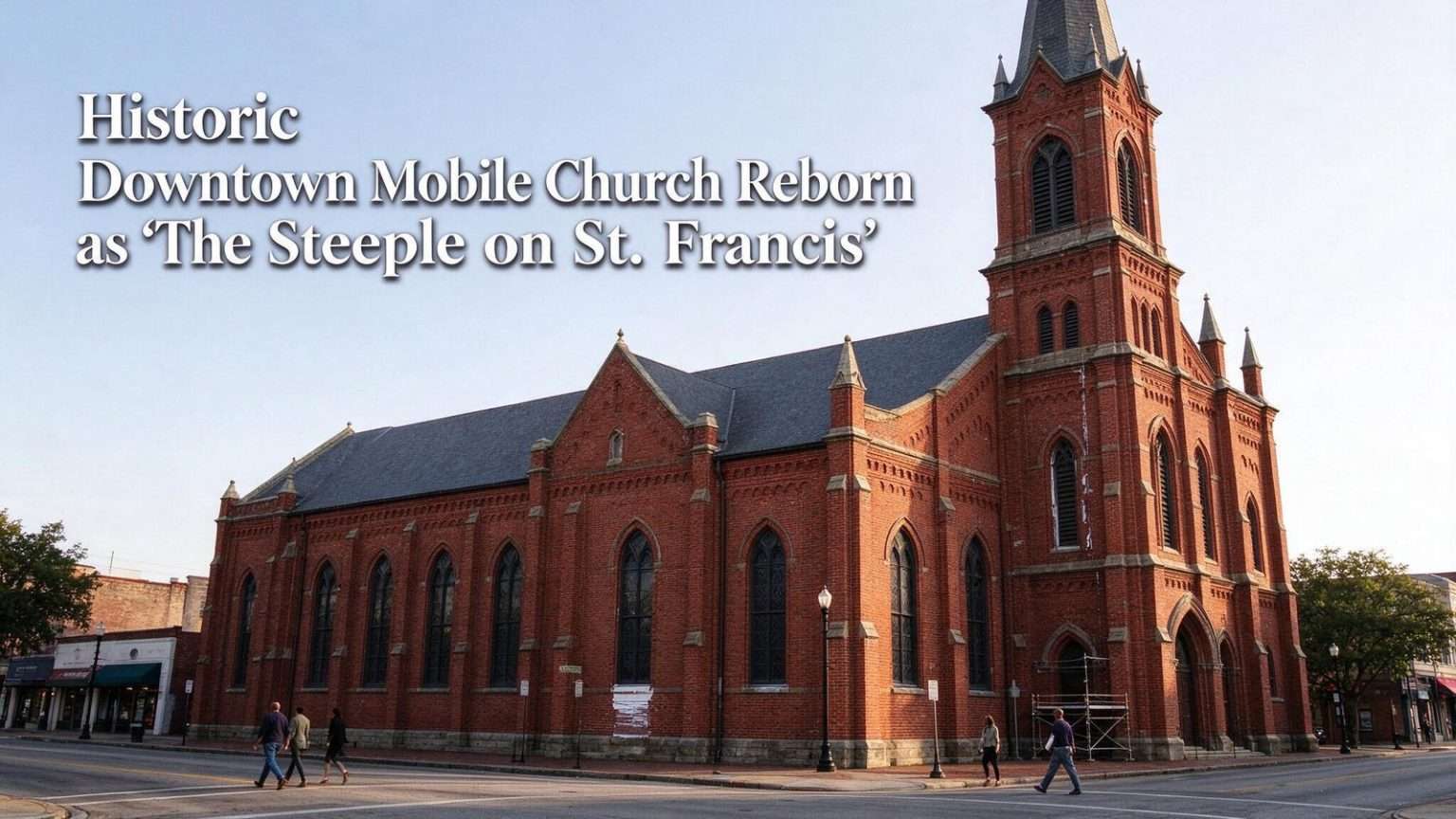
A landmark red brick church at the corner of St. Francis and Joachim streets in downtown Mobile is entering a new chapter after decades of uncertainty, thanks to new owners working to turn the historic building into a venue for music, art and community events.
The building was originally constructed in 1844 as home to St. Francis Street United Methodist Church, itself an offshoot of Government Street United Methodist, sometimes called “The Beehive.” Over the decades, the congregation helped spawn several other Mobile churches, including Ashland Place, Dauphin Way and State Street AME Zion, before holding its final service in 1993.
The sanctuary was rebuilt in 1895 after a fire, and its two cornerstones, dated 1844 and 1895, still mark that history today.
A building with a second mission
After the congregation closed, the building took on a new mission serving people experiencing homelessness, with its former education wing becoming 15 Place, a program that fed homeless men and women in the area. Eventually the property went up for sale, its future unclear.
That changed earlier this year when Clif and Ginna Inge purchased the building, taking on a restoration project the couple compares to buying a piece of Mobile’s living history. Over several months, they stabilized the structure, replaced deteriorating windows, repainted the interior and repaired the steeple atop its 148-foot bell tower, a landmark visible from Bienville Square that inspired the building’s new name: The Steeple on St. Francis.
A century and a half of Mobile church history
The story of the St. Francis Street congregation is, in miniature, the story of how the Methodist church grew across Mobile in the nineteenth and early twentieth centuries. Congregations multiplied the way families do — by sending off members to found new churches as the city expanded. Government Street United Methodist earned its “Beehive” nickname for the swarming activity that produced daughter congregations, and St. Francis Street was one of them. In turn, as neighborhoods like Ashland Place and Dauphin Way developed south and west of downtown, members of the St. Francis Street flock carried the faith with them, founding the churches that still bear those neighborhoods’ names.
That generational chain means an unusual number of Mobile families can trace a baptism, a wedding or a funeral to the sanctuary at St. Francis and Joachim streets, even if their own Sunday allegiance moved decades ago to one of the daughter churches. The two cornerstones facing the street — one laid when the congregation was young, one raised when the fire-scarred sanctuary rose again — bracket the era when downtown churches anchored the city’s civic life, before population shifts pulled congregations toward the suburbs.
The sisters who never let go
The Inges credit much of the project’s momentum to two sisters with deep ties to the church, who spent three years building a nonprofit, the St. Francis Street Church Preservation Foundation, to protect the building. Both sisters were baptized and married in the sanctuary, as were their parents, and one sister’s son was the last baby baptized there before the church closed.
The foundation raised money through yard sales and grants to support preservation efforts even before a buyer emerged.
Their work illustrates how much of historic preservation actually happens: not through grand campaigns, but through a handful of people with personal stakes refusing to let a building slip into dereliction. Three years of yard sales and grant applications kept the roof over the sanctuary and the utility bills paid while the foundation searched for a sustainable future for the property — a future that arrived, at last, in the form of buyers willing to take on the restoration themselves.
Inside the sanctuary
Inside, the sanctuary remains a striking space on the building’s second floor, reached by matching oak staircases, with a balcony, an altar area and stained-glass windows lining the north and south walls. A circular “rose window” surrounded by two dozen miniature panes sits behind the balcony, and tall narrow windows tell Biblical scenes, including one depicting Jesus surrounded by children that has captivated visitors for generations. The building’s pews and a hand-carved marble baptismal font dating to 1907, used for countless Mobile baptisms over the years, are being stored on site during renovations.
The restoration work, month by month
Bringing a 170-year-old building back from years of uncertain ownership is slower than it looks from the sidewalk. Stabilizing the structure meant checking the load paths that carry the tower’s weight through the brick walls, shoring weaknesses, and making sure the roof over the second-floor sanctuary was tight enough to protect the interior from one more season of Gulf rain. The window work alone ran to dozens of openings: the tall narrow sanctuary windows, the two dozen miniature panes around the rose window, and the ordinary sashes throughout the education wing, each needing repair or replacement to keep weather out and character in.
The steeple repair presented its own challenge. At 148 feet, the tower is a construction project in the air, and the steeple that crowns it had weathered more than a century of hurricanes and near-misses since the 1895 rebuild. Repairing it required scaffolding, careful carpentry and a commitment to restoring the silhouette that has defined this corner of downtown since the nineteenth century — the silhouette that gave the venue its name.
Inside, the repainting and repair work has been deliberately conservative, aimed at letting the sanctuary read as itself rather than as a blank event hall. The pews stay. The font stays. The stained glass stays. The new use adapts to the old room, not the other way around.
The second-floor placement gives the sanctuary an acoustical and visual drama rare in modern venues: windows on two sides throw colored light across the room through the afternoon, the balcony wraps the rear of the room, and the tall ceilings that once carried Methodist hymns now stand ready to carry whatever an event promoter or a string section sends up to meet them. Restorers have worked to keep those original features front and center, repairing rather than replacing, so that the room’s character survives the building’s new life.
Music, ministry and a second act
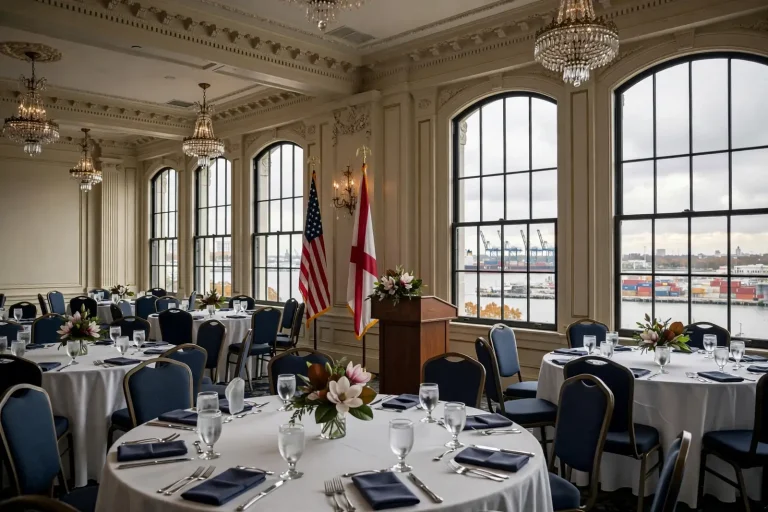
The owners plan to open the space for special events and performances beginning in December, and local groups have already begun using it. A congregation called Apostles in the City has held monthly services in the building and plans to move to weekly gatherings.
The Inges say they have been in talks with the Mobile Symphony, the Mobile Opera and individual musicians about leasing the space, drawing comparisons to how Nashville’s Ryman Auditorium evolved from a tabernacle into one of the country’s most storied music venues.
The Ryman comparison is apt enough to be suggestive. Nashville’s famous hall began life as a gospel tabernacle, spent decades as a church auditorium before becoming the home of the Grand Ole Opry, and proved that a room built for hymns can hold almost any kind of music well. A church sanctuary — high ceilings, wooden pews, hard surfaces that flatter a voice — is by construction a concert hall waiting for programming, and downtown Mobile has fewer mid-size performance spaces than its music scene could fill.
For those with generations-old family ties to the building, the project represents a rare second life for a piece of downtown Mobile’s architectural and spiritual heritage, and a chance for a wider audience to discover what one longtime member called a hidden treasure in the heart of the city.
What it means for downtown
The steeple has watched over this corner of Mobile since before the Civil War, and its survival matters beyond sentiment. Downtown blocks live or die on buildings in active use, and a vacant landmark draws its neighborhood down with it. A building hosting weekly services, concerts and community events puts foot traffic on St. Francis Street in the evenings, gives visitors one more reason to park once and walk, and preserves the skyline that Bienville Square’s strollers have looked up at for generations.
The December opening will test the model — whether a restored sanctuary can support itself on events, leases and a growing congregation. Apostles in the City’s move to weekly services alone brings a steady rhythm back to a room that has been quiet on Sundays since 1993, and each leased concert or event builds the venue’s reputation one performance at a time. But the bones of the argument are already visible: cornerstones from two centuries, stained glass intact, a font that has welcomed Mobile babies for more than a hundred years, and a steeple that points the way. The building has already survived fire, closure and decades of uncertain reuse. A second life as the city’s newest stage may be its most natural chapter yet.