Bess Rich’s Mayoral Campaign Primed for a Late Media Blitz
A week before Mobile's mayoral election, former councilwoman Bess Rich reported more than $64,000 on hand after a heavy advertising push, in a four-way race to succeed Mayor Mike Dow.
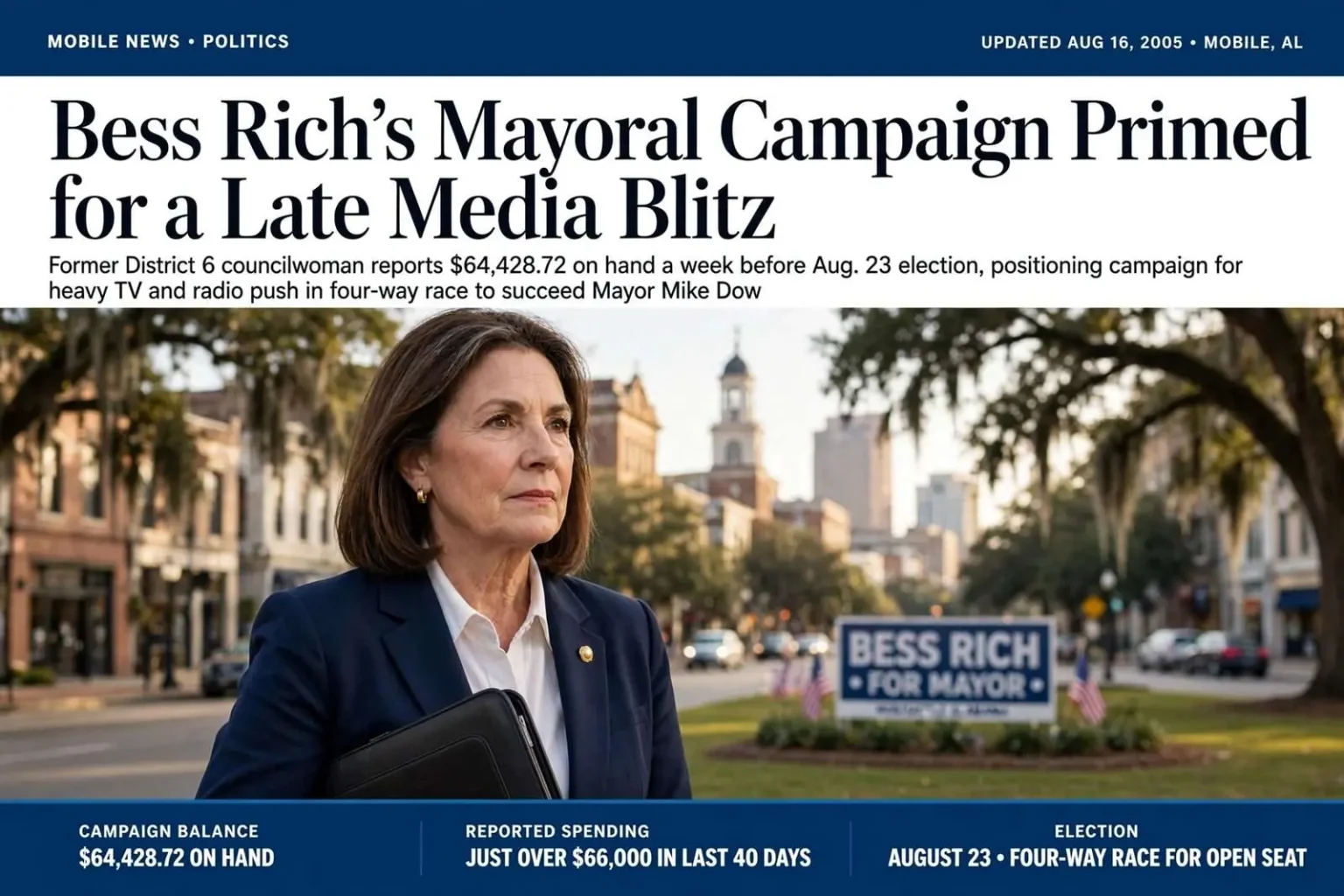
A week before Mobile voters chose a new mayor, candidate Bess Rich’s campaign reported a balance of $64,428.72, according to her final pre-election financial disclosure, positioning the former city councilwoman for a heavy closing advertising push.
The report showed expenditures of slightly more than $66,000 over the roughly 40-day period leading up to the August 23 election. Spending at that pace in the campaign’s final stretch reflected the compressed rhythm of a Mobile municipal race, in which name recognition built over a summer must be converted into votes in a single week of television saturation.
Rich, who represented District 6 on the city council for two terms, had entered the filing period with $115,809.11 in her account, meaning she spent aggressively while still keeping a substantial reserve for the final week. The starting balance placed her among the better-funded candidates in the field, a product of a fundraising base built during two terms representing one of the city’s largest council districts.
A four-way race to succeed Mayor Mike Dow was competing with former state Sen. Ann Bedsole, District 7 City Councilman John Peavy and Mobile County Commissioner Sam Jones to succeed Mayor Mike Dow, who had chosen to leave office after four terms to pursue an opportunity in private business.
Dow’s departure created the first truly open mayor’s race in Mobile in more than a decade and a half. His four terms had spanned the city’s modern renaissance — downtown revitalization, major civic construction and a push to remake Mobile’s image along the Gulf Coast — and each of the candidates offered a different vision of whether to continue that course or chart a new one.
The open seat drew a strong field and, with it, vigorous fundraising and spending across the campaigns. In a race with no incumbent, money functions as the measure of momentum: contributions signal which candidates donors believe can win, and the financial reports filed in the campaign’s closing weeks become the most closely watched scorecard short of the vote itself.
Rich’s Donors
Among Rich’s leading contributors were William H. Brigham at $2,000; FCC PAC and Bratton and Bobbie Rainey, each at $1,000; and a number of $500 donors including Mark S. Brown, Nannetee M. and Michael Worel, Mobile Lumber and Building Materials, and James A. Bixler.
Dozens of smaller contributions, many in the $100 to $350 range, came from physicians, retirees and area families, reflecting a broad base of individual support. That donor profile — heavy on individuals rather than a handful of large checks — is typical of a council veteran whose constituents know her from district service, and it suggests a fundraising operation built on breadth rather than a few deep pockets.
Small-dollar fundraising carries its own strategic value. Contributions in the low hundreds typically come from people who will vote for the candidate they gave to, which means each check represents not only money but a committed vote — and in a four-way race decided by turnout, committed voters matter as much as cash.
Business names on the donor list, such as a local lumber and building materials firm, point to the constituency Rich had cultivated on the council. District 6, sprawling across west Mobile, includes much of the city’s residential and commercial growth, and the area’s builders, retailers and small-business owners formed a natural donor base for a councilwoman who had represented their interests through the city’s expansion years.
Spending on the Airwaves
Rich’s expenditures made clear where the campaign saw the race being won: on television and radio. The report listed roughly $17,700 to one local television station, $12,112.50 to a second, $8,355.50 to a third, $4,316.60 to another media buy, $4,250 to One Media, another $4,250 to the second station, $4,144.60 to that station’s radio arm and $2,000 to WABB.
The concentration of media buys signaled a candidate saving her firepower for the stretch run, when undecided voters typically tune in. Political research has long held that a meaningful share of voters in local races make up their minds in the final week, and campaigns that spend early — before attention shifts to the election — often find their message wasted.
Mobile’s media market shapes how a mayoral candidate spends. The city anchors a market that stretches across southwest Alabama into northwest Florida, and broadcast advertising aimed at the full market reaches many households that cannot vote in Mobile’s election. That inefficiency pushes savvy campaigns toward targeted buys — specific dayparts, news broadcasts and radio formats — where local, civically engaged listeners concentrate.
Radio purchases, including the buy with WABB, a longtime Mobile stations brand, reflect that targeting logic. Drive-time radio reaches commuters who are difficult to reach with evening television, and its lower cost per spot lets a campaign maintain frequency — the repetition that makes a candidate’s name stick — at a fraction of broadcast television rates.
The layered television spending — more than $38,000 across the market’s stations by the report’s tally — represented the campaign’s core wager: that in a race with three rivals sharing the airwaves, share of voice would translate into share of vote. With two other well-known candidates buying time in the same window, the final week’s advertising clutter made frequency and message discipline decisive.
With a crowded ballot and an open seat, the closing week of the campaign would test whether that wager paid off — and whether a council veteran’s broad donor base and late airtime blitz could carry her past rivals with their own bases, their own records and their own reserves.
Alabama’s Disclosure Rules and the Final Report
The financial disclosures that let voters see a campaign’s books are a product of state election law, which requires candidates in municipal races to file periodic reports of contributions and expenditures, including a report in the days immediately before the election. The final pre-election filing is traditionally the most scrutinized, because it reveals not just what a candidate raised but what remains available for the campaign’s last days.
Those reports capture a campaign at its most exposed moment. Expenditures listed by payee — broadcast stations, print outlets, sign printers, consultants — sketch the strategy in numbers, and rival campaigns dissect them for signs of strength or strain. A healthy closing balance means a candidate can keep advertising through election eve; a drained account suggests a campaign that must rely on volunteers and free media to finish.
Rich’s report, showing reserves of roughly $64,000 a week out, indicated a campaign still fully armed as the election arrived. That position was the product of the two-term fundraising base she had built in District 6 — money raised from the district she had represented and from supporters across the city who had watched her council service.
The Job the Candidates Were Seeking
Mobile operates under a mayor-council form of government, with a strong mayor who runs the city’s day-to-day administration and a seven-member council that sets policy and controls the budget. The mayor proposes spending, appoints department heads and serves as the city’s public face — which is why mayoral races in Mobile draw candidates with long records in public life.
The field reflected that. Bedsole brought experience from the State Senate and a career in Alabama politics; Peavy offered years on the council representing District 7; Jones arrived from the Mobile County Commission, with countywide governing experience; and Rich carried her own two-term council record. Rarely does a Mobile ballot combine that much institutional experience in a single race.
District 6, Rich’s home base, takes in much of west Mobile — the city’s fastest-growing residential territory in recent decades, stretching toward the western limits. The district’s growth has made it a bellwether of the city’s expansion, and its voters have a record of turning out in municipal elections at rates that can swing citywide contests.
Municipal elections in Alabama are officially nonpartisan and fall in late summer, a calendar that tends to suppress turnout and place a premium on the voters a campaign can actually identify and move. In a four-way field, a candidate does not need a majority to advance the city’s political math — a plurality can decide the race outright, which sharpens the value of every committed voter and every targeted ad.
That arithmetic is why the closing-week strategy Rich’s report revealed — reserves intact, television and radio saturated — has long been the textbook play in Mobile’s open-seat races. The campaign that ends the strongest, in the air and on the ground, has historically held the edge in a field where the undecided break late.
As election day approached, each of the four campaigns made its final calculations. Rich’s disclosure showed a candidate who had raised steadily, spent deliberately and held her powder dry — leaving the race’s outcome to the voters who would settle it at the polls on August 23.