Bedsole Campaign Spent $160,000 in Final Month of Mayoral Race
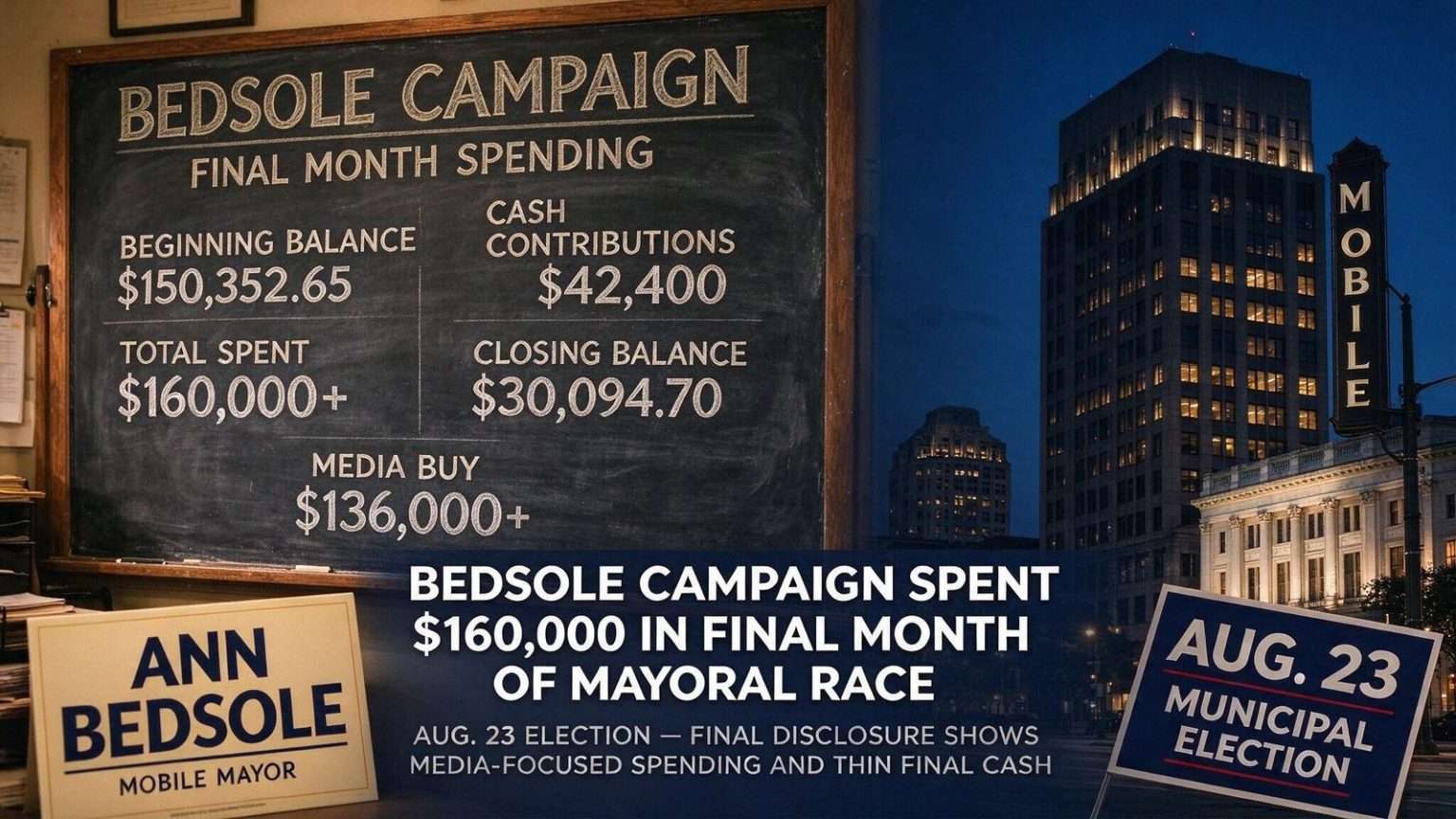
Ann Bedsole's mayoral campaign reported spending more than $160,000 in 30 days, most of it on advertising, entering the final week before Mobile's Aug. 23 election with about $30,000 on hand.
Ann Bedsole’s campaign to become the first woman to lead Mobile spent more than $160,000 in a single month, according to the final financial disclosure filed before the city’s Aug. 23 municipal election — a burn rate that left the former state senator with a comparatively thin balance heading into the last days of the race. The filing offered the clearest picture yet of a campaign that had wagered nearly everything on the airwaves, and it gave voters a final look at who was funding the historic bid before they went to the polls.
The Numbers
The report covered the 30-day period preceding the pre-election filing deadline. It showed a campaign starting from strength and spending down to nearly nothing: a beginning balance of $150,352.65, cash contributions during the period of $42,400, and a closing balance of $30,094.70. Read together, the three figures describe a fundraising operation that was still adding money in the closing month, but not nearly fast enough to offset the cost of the media campaign it was running.
The great majority of the spending went to a single line: roughly $136,000 to Timbes and Yeager, the firm that placed the campaign’s advertising with print, television and radio outlets. In a citywide race, media buying is nearly always the dominant expense, and Bedsole’s report reflected a campaign that had committed its resources to the airwaves in the closing stretch rather than holding money in reserve. Television time in a Gulf Coast market that reaches the entire Mobile Bay area does not come cheap, and a mayoral campaign trying to introduce — or re-introduce — its candidate to every household in the city has few alternatives to buying its way onto the air.
The Contributors
The list of donors during the period ran across Mobile’s professional and business community, with several contributions at the higher end. Among the larger gifts were $5,000 each from Thomas Taul Jr. and from Mr. and Mrs. Matt Metcalfe, and $2,500 from the Alabama Builders PAC — the political arm of the state’s homebuilding industry, whose support signaled the campaign’s credibility with the business establishment.
A long list of $1,000 contributors read like a roster of the city’s real estate, banking and legal leadership: Bill Brigham; Mr. and Mrs. John W. Coleman; David R. Coley III; Nick Holmes Jr.; Edith J. Wilcox; Mr. and Mrs. Robert J. Williams; Mr. and Mrs. Keville Larson; Charles E. McNeil Sr.; Mr. and Mrs. Harold Parkman; Ansley Giddens Green; Thomas A. Horst Jr.; Mr. and Mrs. Ben M. Radcliff Sr.; and Matt Robbins. Donations at that level in a municipal race typically come from donors with long personal relationships to the candidate, and Bedsole — a veteran of decades in Mobile public life — had accumulated many. Her donor base also tracked the geography of the city’s economy: bankers, developers, contractors and maritime interests whose businesses rise and fall with the decisions made inside city hall. In a race with no incumbent, those donors were effectively choosing a partner for the next four years, and their August checks recorded which candidate each corner of the establishment had settled on before the ballots were printed.
Contributions of $500 came from Robert Campbell, Mr. and Mrs. Barton Greer, Thomas Joiner, Lamar Companies, Mobile Lumber, Mabel B. Ward, David S. Conrad, Dwight Harrigan, James Yance, James Yance Jr., Dr. Kenneth Hannon, Elizabeth S. McGowin, Dr. William Urquhart and the Byrum Family Ltd. Partnership, with Arnell DuBose contributing at $400. The names spanned the city’s development community, its professional firms and its long-established families — the constituency that had followed Bedsole from her legislative career into her mayoral run.
Smaller gifts of $250 and $300 came from Joe H. Baker Jr., Catherine Bailey Antiques, Calvin Clay, Red and Ruby Noonan, John and Miriam Anthony Baumhauer, J. Manson Murray, Mr. and Mrs. R.N. Twilley, T.P. Amadi M.D., Sherry Hamilton, Marion S. Adams Jr., Busaba’s Thai Cuisine, Ezra B. Trice and Ralph Compagno. The breadth of the list — from downtown professionals to a Thai restaurant and an antiques dealer — illustrated the coalition a serious mayoral candidate assembles: a few large checks that anchor the budget, and dozens of modest ones that demonstrate the breadth of a campaign’s appeal. Small-dollar donors rarely decide a citywide race on volume, but they matter as a signal: a candidate whose report shows support confined to a handful of major givers reads as a candidacy of interests, while one with contributors across the community’s full range can claim a genuine constituency. In Bedsole’s case, the names ran from the city’s oldest families to small storefront owners, a spread that mirrored the coalition she needed on Election Day itself.
What the contributor list also revealed was the campaign’s reliance on the city’s establishment. Bedsole’s donors were concentrated among Mobile’s business and civic elite, the same network that had funded city campaigns for decades. That brought financial strength — few challengers could match the pace of her spending — but it also shaped the story of the race, in which each of the four major candidates claimed a different base of the city’s electorate and each campaigned on a different reading of what Mobile’s next sixteen years should look like.
A Historic Bid
Bedsole was seeking to become the first female chief executive in Mobile’s three-hundred-year history. A Republican, she had served in both houses of the Alabama Legislature and was among the most recognizable figures in the city’s civic life, with a long record of involvement in education and the arts. Her candidacy carried the weight of a barrier-breaking campaign, and her name recognition — built over years in the Statehouse and in Mobile’s civic organizations — was the asset the August advertising blitz was designed to fully exploit.
She was competing against Mobile County Commissioner Sam Jones, former City Councilwoman Bess Rich and sitting District 7 City Councilman John Peavy, all four seeking to succeed outgoing Mayor Mike Dow, who had declined to seek a fifth term after sixteen years in office. Dow’s departure opened the city’s first genuinely open mayoral race in a generation, drawing a field whose members collectively represented decades of public service across city hall, the county commission and the council.
What the Filing Meant
Alabama’s campaign finance law at the time required candidates to file periodic disclosures, including reports in the final days before an election, so that voters could see who was funding a campaign before casting a ballot. Those filings are among the few genuinely revealing documents produced by a political campaign: they show not only how much money a candidate has raised but where it is going and how fast.
What Bedsole’s final report showed was a campaign that had chosen to spend nearly everything it had. Roughly $30,000 in the bank with a week to go, against $136,000 in advertising placed in the preceding month, described a strategy built on saturating the market before Election Day rather than preserving a cushion for a possible runoff on Sept. 13 — a runoff that most observers expected in a four-way race where no candidate seemed likely to reach the fifty percent required to win outright.
The strategy carried a calculated risk. In a field of four, a candidate who spends to the limit before the first ballot is betting on either an outright victory or the ability to raise fresh money for a runoff campaign against a single opponent. Bedsole’s thin closing balance meant that any second round would begin financially from zero, dependent on a final surge of contributions from the same donor network that had funded the primary push. Campaign veterans in Mobile had seen both outcomes before — candidates who spent everything and won outright, and those who arrived at the runoff exhausted while an opponent’s campaign came alive with two more weeks of television money.
The complete filing, her 5-10 day pre-election report, was available for public inspection in accordance with state disclosure requirements, allowing voters and the press to examine the details down to the individual contributor level in the race’s final week. In a four-way contest to lead a three-century-old city — and to become the first woman ever to hold the job — the document served as the campaign’s financial autobiography: who believed in the candidacy, how much they gave, and exactly how the money was deployed in the fight to succeed Mike Dow.
The report also captured a moment in Mobile’s political and civic history. The donor rolls — Taul and Metcalfe at the top, the $1,000 circle of established families and firms, the $500 tier of developers and companies, the small businesses giving $250 — amounted to a cross-section of who funded city politics at the time. Whatever the election’s outcome, the filing preserved a record of the establishment’s bets in the campaign to succeed a sixteen-year mayor, and of the historic campaign that one of the city’s most accomplished public servants had built in her attempt to break a three-hundred-year barrier at City Hall.