Bishop State Highlighted Mobile Demand for Technical Workers in 2009
Bishop State leaders said Mobile employers continued to need workers in air conditioning, refrigeration and electrical trades during the 2009 recession.
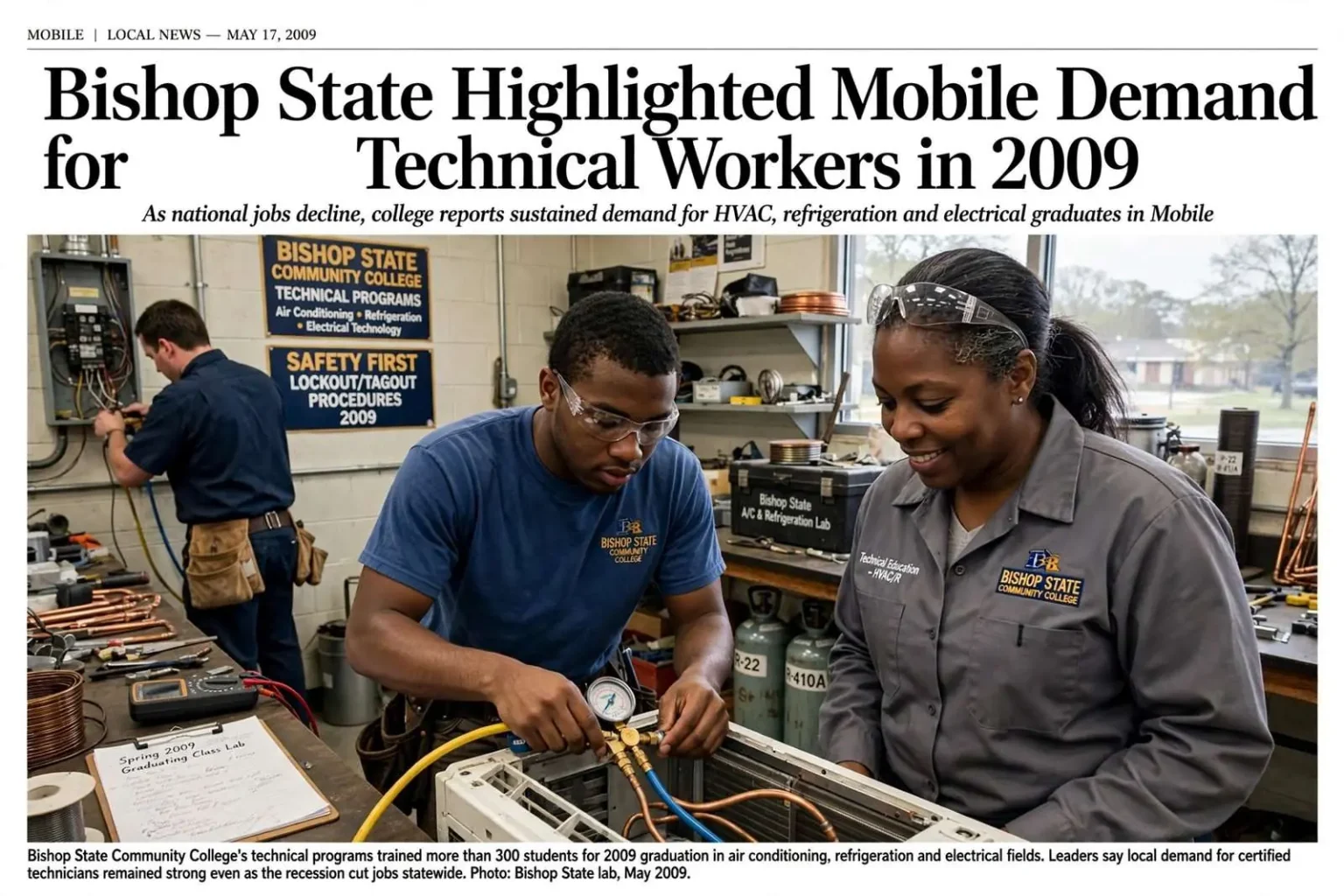
Bishop State Community College leaders pointed to continued demand for technical workers in Mobile during a 2009 graduation season marked by broader economic uncertainty.
While the national economy was shedding jobs at a pace not seen in decades, the school’s technical program reported that employers in the Mobile area still needed trained workers in air conditioning, refrigeration and electrical fields. The demand was not abstract: as the spring graduation season approached, program leaders said students coming out of those tracks were finding work even as other sectors cut back.
The report noted that the seasonal demand for cooling-related work was especially strong in South Alabama. Long, humid summers mean air conditioning on the Gulf Coast is not a luxury but a necessity, and every residential, commercial and industrial system in the region needs installation, service and repair. That creates a recurring cycle of demand for certified technicians — a cycle that does not pause for a recession, because a failed compressor in a Mobile August is an emergency regardless of the economic headlines.
More than 300 Bishop State students received degrees or certificates that year. The graduating class reflected the college’s mission as a two-year institution serving Mobile County with both academic transfer programs and hands-on workforce training, and the technical graduates were among the most immediately employable members of the class.
Graduates finding work in a down economy
Some graduates had already secured work. One electrical-program graduate took a position as a maintenance mechanic for the Mobile Housing Board, joining the public housing authority’s operations staff. Maintenance roles of that kind keep graduates close to the skills they trained in — electrical systems, building equipment and the daily repair work that keeps public housing units functioning for residents.
Another graduate, a longtime Mobile Housing Authority employee, said he was preparing to use his air-conditioning training to pursue a future business of his own. His story illustrates a second path that technical education opens: not just employment, but entrepreneurship. HVAC service is a trade where an experienced, licensed technician can build an independent business serving homeowners and small commercial customers, and the college’s programs have long fed that ambition for working students.
The account illustrated the role workforce education can play during an economic downturn. In 2009, with the housing collapse dragging down construction and layoffs spreading through manufacturing and retail, technical training offered a path toward jobs tied to maintenance, construction and essential building systems — work that continues whether the economy is expanding or contracting, because buildings still break and systems still fail.
Funding worries and accreditation
The graduation season followed a period of concern about cuts to Alabama’s two-year college system. State education budgets took heavy hits as the recession eroded the tax revenues that fund Alabama’s Education Trust Fund, and community college leaders statewide braced for reductions that would force program closures and layoffs.
State leaders said they had avoided reductions to academic and workforce-training programs despite a major funding cut. Protecting instruction while absorbing budget losses typically means cuts elsewhere — administration, deferred maintenance and capital projects — and the pledge was meant to reassure students and employers that the training pipeline would keep producing graduates even in the worst fiscal year in a generation.
Bishop State had also retained its accreditation earlier that year, a milestone of more than symbolic importance. Accreditation from the Southern Association of Colleges and Schools is what allows a community college’s credits to transfer to four-year universities and its credentials to carry weight with employers, and any threat to accreditation is an existential concern for an institution and its graduates. Confirming it in the same season as a recession-era graduation gave the college stability on both the academic and financial fronts.
For displaced workers in Mobile, the technical tracks also represented a retraining route. Two-year colleges across Alabama saw enrollment climb during the recession as workers who lost jobs sought new credentials, and the short, skills-focused nature of programs like air conditioning and electrical technology made them a practical choice for adults who needed to return to the workforce quickly.
The placement of graduates with the Mobile Housing Board and the Housing Authority underscored the relationship between public institutions and the local workforce. Public housing operations require a permanent staff of maintenance and trades workers, and hiring graduates of the city’s own community college keeps those positions filled by people trained on the equipment and building standards they will service.
Bishop State’s role in Mobile
Bishop State Community College has served Mobile for decades as one of the city’s historic two-year institutions, with roots in the city’s African American educational tradition and a modern mission spanning academic transfer, health sciences and technical training. Its campuses and sites across Mobile put short-term workforce credentials within reach of students who might not be able to leave the city for school, and its technical programs have historically been among its most direct links to area employers.
In the Alabama system, two-year colleges occupy a distinctive position: they are simultaneously the open-door transfer route to the state’s universities and the state’s largest provider of job training. When manufacturers, hospitals and service companies in a city like Mobile need certified workers, the community college is usually the institution that produces them — which is why budget cuts to the system are watched as closely by employers as by students.
The 2009 graduation season captured both sides of that mission at once. The academic graduates headed toward university transfer in a year when four-year costs loomed larger for struggling families, while the technical graduates — the air conditioning, refrigeration and electrical students whose job prospects held firm — walked into a labor market that still needed exactly what they had learned.
A snapshot of its moment
This report preserves a snapshot of Mobile’s technical labor market in May 2009. The job needs, school funding situation and program status described here are historical, not current employment or education guidance.
Read today, the account is a reminder of how regional economies absorb national shocks. In Mobile in 2009, the recession rearranged which jobs were safe and which were not, but the fundamentals of Gulf Coast life — the heat, the buildings, the systems that keep both livable — kept a lane of the labor market open for trained technicians. The community college’s role was to keep that lane stocked with qualified workers, even in a year when nearly everything else about the economy was in question.
The HVAC and electrical trades carry a licensing structure in Alabama that shapes how graduates build careers. State licensing for heating and cooling contractors sets experience requirements before a technician can operate independently, which is why the sequencing matters: a graduate first logs years working under a licensed employer or municipal employer like the Housing Authority, building the documented experience the license requires, before striking out on their own. The graduate who spoke of a future business of his own was describing exactly that arc.
Refrigeration training extends the trade beyond building comfort systems into commercial food service, medical storage and industrial applications. Mobile’s economy — restaurants, the port’s cold storage, seafood processing and the healthcare sector — all depend on refrigeration technicians, so the college’s decision to keep the refrigeration track alongside air conditioning reflected the breadth of the local demand rather than a single industry.
Electrical graduates follow a similarly regulated path, from apprenticeship hours to journeyman and then contractor licensing. A maintenance mechanic position with a public housing authority fits that ladder well: daily work on real building systems, under institutional standards, accumulating the hours and breadth of experience that later licensing requires. For the graduate who took that job, the position offered both an immediate paycheck and a step on a longer professional track.
The 2009 graduating class also entered a Mobile economy in transition. The port’s expansion plans, the industrial projects that would reshape the city’s workforce in the following decade, and the region’s steady healthcare and service growth all lay ahead. In the meantime, the class of 2009 did what graduating classes in hard years always do: they took the work that was available, and the technical graduates found that the available work — maintaining, repairing and installing the systems the Gulf Coast cannot live without — was still hiring.
The anniversary value of the report lies in that contrast. National recessions are usually described in percentages — unemployment rates, budget shortfalls, enrollment swings — but the view from a Mobile technical classroom in May 2009 was more concrete. Employers still called. Systems still failed. Students who could solder a line, wire a panel or charge a compressor still got hired, and a public institution still handed more than 300 of them the credentials that made the hiring possible. For the college’s leaders, standing at the podium that graduation season, the message to the community was straightforward: the training that leads to work had survived the worst economy in a generation, and the doors it opened — to jobs, to licenses, to businesses of one’s own — remained open as well.