Baldwin County Schools Reported Rising Flu Cases During 2009 H1N1 Outbreak
Baldwin County physicians and schools reported dozens of flu cases in August 2009, including confirmed H1N1 infections and a growing number of school alerts.
Doctors and school officials in Baldwin County reported a growing number of flu cases in August 2009 as the H1N1 outbreak spread through the region. The timing caught public health planners off guard in one respect — seasonal flu rarely builds momentum this early — but the novel virus behind the outbreak behaved differently, arriving with the start of the school year and moving quickly through classrooms before the traditional flu season had even begun.
The new strain, widely referred to at the time as swine flu, had emerged in the spring of 2009 and been declared a pandemic by international health authorities by summer. By the time students returned to school in Baldwin County and across the Gulf Coast, the H1N1 influenza A virus was the dominant flu strain circulating nationwide, and communities were watching local case counts the way they would later watch other public health metrics.
Physicians were treating dozens of patients, most of them children. Dr. Awadhesh Gupta of Foley said the volume of cases was notable as communities around the country monitored the new H1N1 strain. Unlike seasonal influenza, which historically skews toward hospitalizations among the elderly, the 2009 pandemic strain concentrated its impact among younger people — a fact that put schools at the center of the outbreak from the beginning.
Cases in the Schools
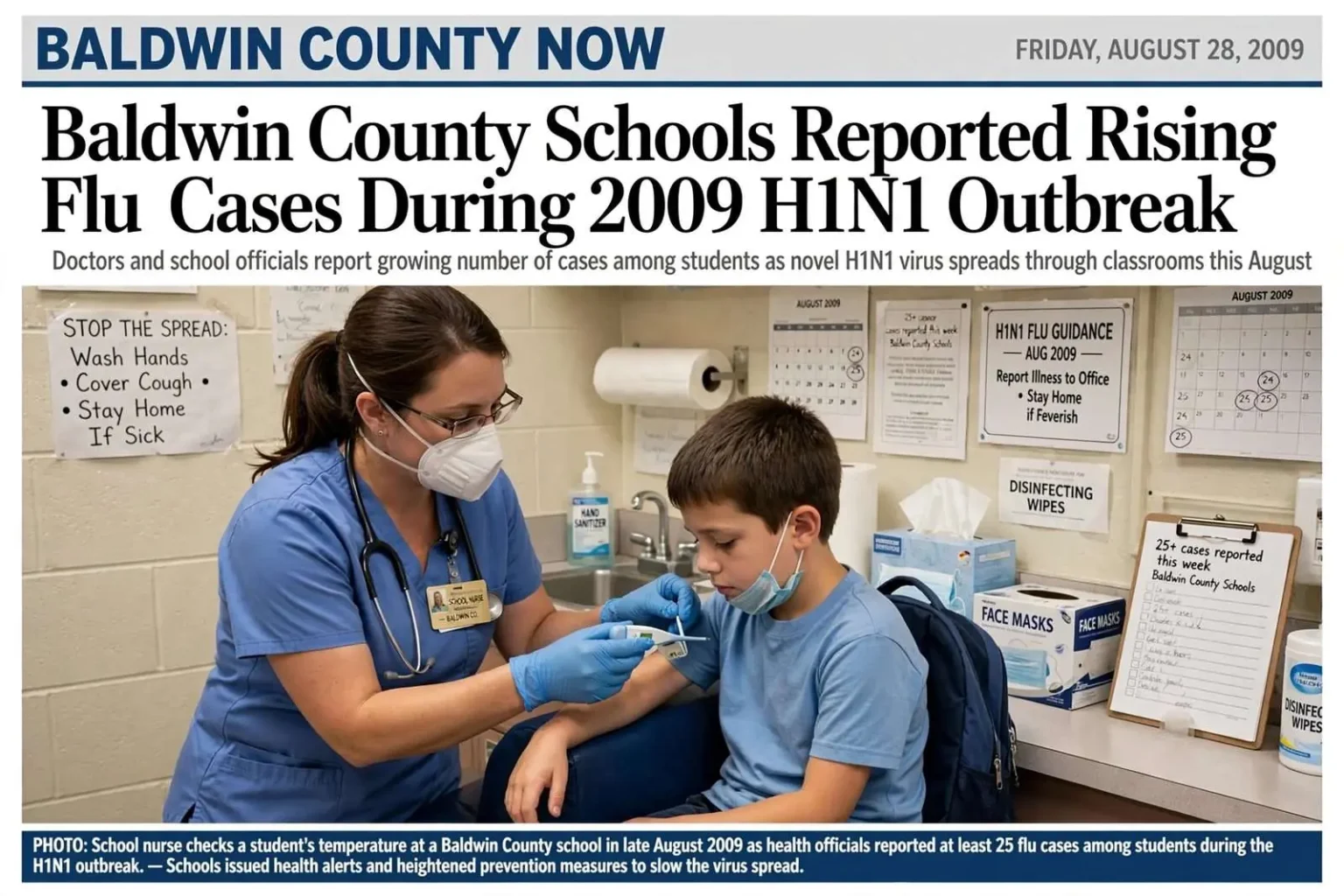
At least 25 flu cases had been reported at Baldwin County schools during that week, with at least one new case reported each day. Some of the illnesses had been confirmed as H1N1, according to the report, while others were probable cases consistent with the strain then circulating. School leaders expected every school in the county to have an active case by the end of the month.
That expectation shaped the response. School nurses wore protective masks, provided masks to sick children and sent health alerts home to parents as they monitored students. Attendance clerks tracked absences for illness, and administrators walked a familiar line: keeping schools open for the families who depended on them while trying to slow transmission inside buildings where children share desks, buses, and everything else.
The county’s school system is one of Alabama’s largest, stretching from communities along Mobile Bay to the beaches and inland towns along the Florida line, and its bus routes and classrooms knit together tens of thousands of students each day. Epidemiologists understood by then that school-aged children were among the most efficient spreaders of influenza, which meant the county’s classrooms functioned as both bellwether and engine for the wider outbreak.
What Doctors Were Seeing
In clinics around the county, the presenting picture was flu as most people know it — fever, cough, sore throat, body aches — but arriving in unusual numbers and in unusual patients. Gupta said patients with Type A influenza tests were considered likely to have one of the novel H1N1 infections circulating at the time, since the rapid tests available in physician offices could identify influenza type A but not distinguish the pandemic strain from seasonal varieties without confirmatory laboratory work.
That diagnostic gap shaped decision-making at every level. Most patients were treated on symptoms and clinical judgment, with antiviral medication prioritized for those at higher risk of complications. Public health guidance emphasized that the overwhelming majority of cases remained mild, while preparing for the smaller number that would not be.
Prevention Guidance at the Time
Doctors emphasized basic prevention measures as families prepared for the school year. Their recommendations included frequent handwashing, avoiding touching the mouth, turning away when coughing, using tissues when sneezing and promptly reporting illness to a doctor. The advice was deliberately low-tech: no vaccine against the new strain was widely available in those early weeks, and the tools that remained were the ones public health had relied on through every influenza outbreak of the previous century.
Schools reinforced the same habits. Handwashing reminders went up beside sinks, custodial schedules shifted toward more frequent cleaning of shared surfaces, and sick students were separated from classmates until they could go home. Families were asked to keep feverish children out of school until they had been fever-free without medication, a request that tested working parents but reflected the single most effective step available for slowing spread among children.
Health officials were concerned that travel and the wide distribution of outbreaks could contribute to cases appearing in new places. Baldwin County’s position along the I-10 corridor — with its steady flow of tourists bound for the beaches, commuters crossing Mobile Bay, and seasonal residents — made the region conscious of how easily illness moved with the people passing through it.
The 2009 Pandemic in Retrospect
The H1N1 outbreak of 2009 became a defining public health event of its decade, and the local response in places like Baldwin County reflected lessons that would be revisited again in later years. The pandemic strain proved less lethal than early fears suggested, but it filled emergency rooms, closed schools across the country, and exposed how quickly a novel respiratory virus could move through a population once it reached school-age children.
A vaccine against H1N1 reached widespread availability in the fall of 2009, and public health agencies mounted an immunization campaign that prioritized young people, health care workers, pregnant women, and others at elevated risk. By the following year, the outbreak had receded into the pattern of seasonal flu activity, with H1N1 joining the strains covered by annual flu shots.
For Baldwin County’s physicians and school officials, the August case counts of 2009 were the first act of an outbreak that would dominate the autumn. The practices they adopted — daily case tracking, home health alerts, mask use in nurse stations, and relentless emphasis on handwashing — became the template for how the community would respond whenever the next novel illness arrived.
A Note for Today’s Readers
This account reflects the local response during the 2009 H1N1 outbreak as it was reported at the time. Guidance and public-health conditions can change, so readers seeking current flu advice should consult today’s health authorities and medical professionals.
The value of looking back lies in the pattern rather than the particulars: respiratory viruses move fastest where children gather, the simplest prevention measures remain the most reliable, and communities that pay attention to early numbers are better prepared for what follows. Those lessons, learned in Baldwin County classrooms and clinics in August 2009, have outlasted the outbreak that taught them.
How the Region Watched the Outbreak
Baldwin County in late summer 2009 was paying closer attention to flu than it ever had in August. Local news tracked case numbers alongside the weather, pediatric offices fielded calls from parents trying to distinguish ordinary summer illness from something worse, and pharmacists reported runs on thermometers and hand sanitizer weeks before the traditional season began. The novelty of the virus — and the wall-to-wall national coverage that accompanied it — kept the outbreak at the center of community conversation even as most cases proved mild.
The county’s geography shaped the response as much as its population did. Communities from Foley to Fairhope, Daphne, Gulf Shores, and Bay Minette each maintained their own clinics and school systems under the county umbrella, and information moved between them as fast as the health alerts did. A case confirmed in one community’s school put the entire county’s nurses on alert, since students and families regularly crossed municipal lines for school, work, and worship.
Neighboring Mobile County watched its own numbers climb in parallel, and the two counties’ public health responses largely mirrored one another, coordinated through state channels. On the Gulf Coast, the memory of hurricane seasons had already taught residents and agencies to communicate early and often about developing threats, and that infrastructure of alerts and cooperation carried over naturally to the flu outbreak.
What Families Were Told
The guidance that reached Baldwin County households was practical and repetitive by design. Wash hands often, with soap, for as long as it takes to hum a birthday song twice. Cover coughs with a sleeve or a tissue. Stay home when feverish, and stay home until the fever is gone without fever-reducing medicine. Call the doctor before going in if symptoms are severe or if a child has asthma, diabetes, or another underlying condition that raises the risk of complications.
Doctors also managed expectations. Antibiotics, physicians explained, do nothing against influenza, which is a virus; they were reserved for secondary bacterial infections that sometimes followed. Antiviral medications could shorten the illness and reduce complications when given early to higher-risk patients, but most healthy children and adults were advised to treat symptoms, rest, drink fluids, and let the illness run its course under a watchful eye.
The consistent message was proportion: be alert, take the basics seriously, and do not panic. The overwhelming majority of H1N1 cases resolved without complications, and the most useful thing an ordinary family could do was follow the prevention basics and watch for the warning signs — difficulty breathing, persistent high fever, confusion, or symptoms that improved and then returned worse — that warranted immediate medical attention.
Lessons That Stayed
When the outbreak receded, Baldwin County kept the habits. School nurses continued sending home health alerts during flu season, attendance tracking for illness became routine, and the coordination between physicians and schools proved durable. Dr. Gupta’s observation about the volume of cases in August 2009 — remarkable for a time of year when flu is normally absent — remained the standard illustration of why public health officials watch school-age illness so closely.
The 2009 experience also left the community with a calibrated understanding of what a pandemic looks like in practice: not a sudden catastrophe, but weeks of steady numbers, careful decisions, and small daily disciplines that add up. As later events would show, that familiarity with the rhythm of an outbreak is itself a form of preparedness, and Baldwin County had already rehearsed it once.