Roussos Restaurant Closed in 2009 After Decades of Gulf Coast Service
Roussos Restaurant closed in 2009 after more than five decades in business, leaving 55 employees seeking work as its owners cited the economic downturn.
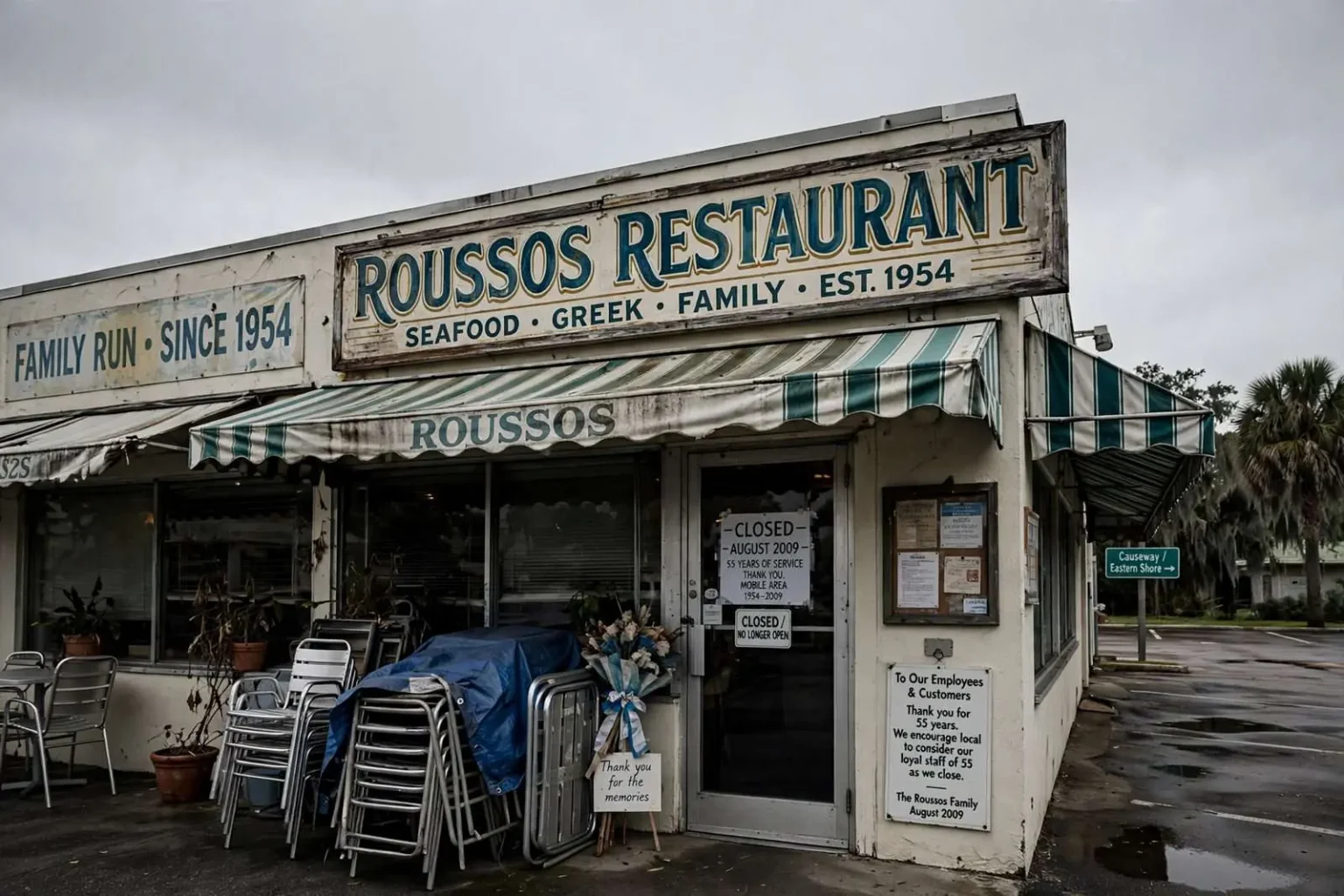
Roussos Restaurant closed in August 2009 after more than five decades serving the Mobile-area community, with 55 employees left looking for work as the family-run institution shut its doors amid the deepest economic downturn in a generation.
Family members said the business began in 1954, and in the years since, the Roussos name became one of the Gulf Coast’s most familiar restaurant brands — a family operation that survived location changes, hurricanes, and shifting tastes before the recession delivered the blow it could not absorb.
Over the years, the restaurant operated at several Gulf Coast locations, including the Causeway, downtown Mobile and the Eastern Shore. That geography traces the family’s repeated reinventions: when circumstances destroyed or displaced one location, the Roussos family rebuilt the business in another.
A Business Rebuilt After Hurricane Frederic
Its Causeway location had been destroyed by Hurricane Frederic before the family rebuilt the business elsewhere. Frederic — the September 1979 hurricane that flattened much of the central Gulf Coast — wiped out many of the landmark businesses along the Mobile Bay Causeway, and Roussos was among them.
The storm’s destruction of the Causeway strip marked a turning point for many family restaurants of that era. Some never reopened; the Roussos family chose to rebuild, moving the operation rather than surrendering the name. That decision extended the restaurant’s life by another three decades and carried its seafood-and-plate-lunch traditions to new generations of customers.
The ability to relocate twice in a restaurant’s history speaks to the loyalty the business commanded. Mobile-area diners followed the family across locations — from the Causeway to downtown to the Eastern Shore — a pattern common for the region’s most established family restaurants, where the name and the food mattered more than the address.
An Emotional Final Day
Owners described the final day as emotional and said the economic downturn had made it impossible to continue the restaurant operation. The closure came as the recession strained restaurants across the region, squeezing the steady lunch-and-dinner traffic that family operations depend on.
Customers recalled returning for years, including regular Sunday meals after church — a ritual that anchored the restaurant’s weekly rhythm across decades. In Gulf Coast dining culture, the after-church Sunday meal is among the most loyal customer habits a restaurant can hold, and its loss was felt as much as the business’s economics.
The closure removed a 55-person payroll from the local economy at a moment when jobs were scarce across the region. Restaurant work at a decades-old family operation tends to be long-tenured, and the employees displaced in August 2009 carried years of experience in the trade.
The Family’s Concern for Its Employees
Family members emphasized concern for the restaurant’s employees, whom they described as loyal and hardworking. They encouraged prospective employers to consider the displaced staff as the closure took effect — a public appeal that reflected both the timing, in the middle of a national recession, and the family’s view of its workforce as an extension of the business itself.
In the restaurant trade, a closing establishment’s staff is often its most valuable asset. Servers, cooks, and kitchen staff with years at a single operation carry institutional knowledge — recipes, routines, customer relationships — that other restaurant owners in the area can put to work immediately. The family’s appeal was directed at exactly that market.
The closure’s timing compounded the difficulty. August 2009 sat near the peak of the recession’s impact on the Gulf Coast economy, with unemployment elevated and hiring slow across most sectors. For 55 restaurant workers, the search for new positions came against some of the worst conditions the industry had faced in decades.
Catering Keeps the Name Alive
The closure did not end the family’s business activity entirely. The owners said they would shift their attention to catering, allowing the Roussos name to continue in a different form. The pivot from storefront restaurant to catering operation is a common survival strategy for Gulf Coast food families, trading the daily overhead of a dining room for event-based work.
Catering also preserved the recipes. A family restaurant’s menu — in Roussos’s case, the Greek-influenced Gulf Coast staples the family had served since 1954 — lives on through the dishes it continues to prepare, even when the dining room is gone. For regular customers, the catering operation offered a way to keep the family’s food part of weddings, receptions, and business gatherings across the area.
The shift underscored a distinction that recurs in family restaurant closures: the end of a location is not always the end of a business. The Roussos family’s 55-year history included multiple relocations already, and the move to catering was one more adaptation rather than a first.
Five Decades on the Gulf Coast
From its 1954 beginnings to its August 2009 closing, Roussos Restaurant spanned the period in which the Mobile area’s dining culture took its modern shape. The restaurant operated through the Causeway’s heyday, through Frederic’s destruction, through the growth of the Eastern Shore, and through downtown Mobile’s long commercial evolution.
Gulf Coast family restaurants of that generation shared a common story: immigrant or first-generation founders, long hours, recipes carried across generations, and a customer base bound by habit as much as hunger. The closing of any one of them removes a thread from that fabric, and the loss of Roussos — with its five decades and its 55 employees — was felt across the communities it had served.
This report documents the restaurant’s closure and its stated economic circumstances in August 2009. It does not establish the current status of the family business, the former restaurant site or its employees. What the record does establish is the arc: a family operation begun in 1954, rebuilt after a hurricane, sustained by loyal customers and Sunday-after-church crowds, and closed by an economy that left its owners unable to continue the restaurant they had run for more than half a century.
The Causeway Era and Frederic’s Blow
The Mobile Bay Causeway of the mid-20th century was one of the Gulf Coast’s great dining strips — a line of seafood houses and family restaurants serving travelers crossing between Mobile and the Eastern Shore. Roussos held a place in that lineup, drawing customers with the Gulf seafood and home-style cooking the family had built its name on.
Hurricane Frederic changed that geography permanently. The September 1979 storm, one of the most destructive in Alabama’s recorded history, came ashore with winds that gutted buildings across the region, and the low-lying Causeway establishments took the full force. Restaurants that had operated for decades were destroyed in a single night, and the strip never fully returned to its former shape.
For the Roussos family, the destruction forced the first of the business’s major reinventions. Rebuilding on the Causeway would have meant starting over on vulnerable ground; instead, the family relocated, first to downtown Mobile and later to the Eastern Shore, extending the restaurant’s reach across the bay rather than confining it to a single site.
The Sunday Tradition
The regular Sunday meals after church that customers recalled were more than a scheduling detail — they were the core of the business’s identity. Across the Gulf South, the after-church meal is a family institution, and restaurants that become part of that routine inherit a weekly ritual that can sustain them through lean years.
Roussos held that place for decades. Families who first came as children returned with children of their own, ordering from menus that changed little because they did not need to. That kind of intergenerational loyalty is the asset family restaurants accumulate most slowly and lose most painfully, and customers’ memories of those Sunday tables were central to the final day’s emotion.
The ritual also illustrates what the recession took. Economic downturns hit discretionary dining in ways that ripple through exactly these habits — the weekly family meal out is among the first expenses a strained household cuts, and when hundreds of households make that cut at once, even a beloved institution cannot absorb the loss.
A Name That Endured
By the time the doors closed in August 2009, the Roussos name had served the Mobile area for more than 55 years — a span that covered the Causeway’s golden era, Frederic’s destruction, and the growth of the Eastern Shore communities the family later served. Few family businesses of any kind cross the half-century mark, and restaurants rarely do.
The family’s move into catering kept the essentials of that legacy intact: the recipes, the service standard, and the name that Mobile-area diners had trusted since 1954. For the 55 employees, the closure marked the end of a workplace; for the family, it marked the end of a dining room but not of the business’s life.
The closing of August 2009 thus stands as the end of a chapter rather than the end of the story — the moment when a restaurant that had already survived relocation, hurricane, and reinvention chose adaptation one more time, and the Gulf Coast’s dining community lost a table it had shared for five decades.