Grace Lutheran Marked 150 Years in Mobile in 2017
Grace Lutheran Church marked its 150th anniversary in Mobile in 2017, reflecting on its 1867 founding and its role as Alabama's oldest Lutheran congregation.
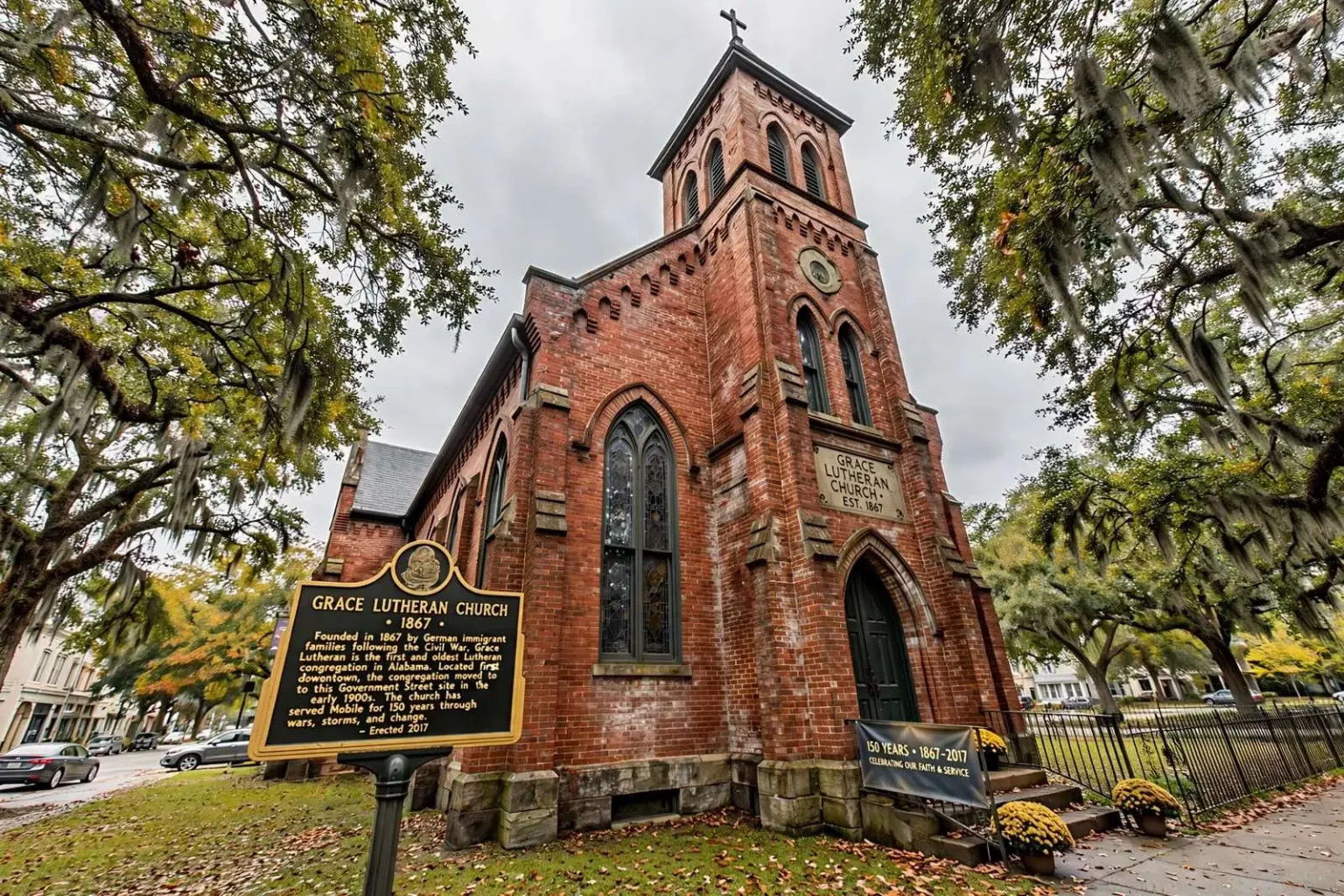
Grace Lutheran Church marked 150 years in Mobile in 2017, an anniversary that reached back to the aftermath of the Civil War, when a German Lutheran pastor and a small group of German immigrants established the congregation in 1867. A century and a half later, the church stood as a survivor of wars, hurricanes, economic upheavals and the steady transformation of the city around it — and as living proof of the immigrant communities that helped build Mobile in the nineteenth century.
Pastor Wayne Miller said the church was the first and oldest Lutheran congregation in Alabama. That claim places Grace Lutheran at the head of a denominational history that has since spread across the state, from congregations in Birmingham and Huntsville to churches along the Gulf Coast. Every Lutheran church in Alabama, by that measure, traces its lineage back to the small group of German families who gathered in Mobile in the years just after the war, seeking to worship in their own tradition in a city where their language and liturgy were foreign.
The congregation’s original location was on St. Francis Street downtown, placing the young church in the commercial heart of the city. Downtown Mobile in the late 1800s was a bustling port district, and a church on St. Francis Street would have stood among the shops, warehouses and offices that served the cotton and lumber trades. The congregation later moved to Government Street in Midtown, following the residential migration that carried Mobile’s families out of the dense downtown grid and into the leafy neighborhoods that developed along Government Boulevard in the early twentieth century.
German Roots in a Gulf Port City
The story of Grace Lutheran’s founding is inseparable from the story of German immigration to Mobile. Throughout the nineteenth century, German immigrants arrived in Gulf Coast ports and established communities across the region, bringing trades, crafts and strong church traditions with them. In Mobile, German families established businesses, civic organizations and congregations, and their Lutheran faith was central to communal life. Services in the early years would have been conducted in German, with English gradually taking over as the generations born in Alabama came of age.
A Lutheran congregation in 1867 Mobile would have faced the practical challenges common to immigrant churches: raising funds to build or buy a building, calling a pastor, maintaining a parochial school in some eras, and preserving a denominational identity in a region where Baptist, Methodist and Catholic traditions dominated. That Grace Lutheran endured while so many small congregations dissolved is itself a testament to the staying power of the founding families and their successors.
The 150-year milestone in 2017 carried particular resonance for Lutherans beyond Mobile. That year marked the 500th anniversary of the Reformation, the event that gave the Lutheran tradition its start, and congregations across the world were observing the quincentenary. For Grace Lutheran, the coincidence folded the congregation’s own century and a half into a much longer story of the denomination’s history — from Wittenberg to the Atlantic crossing to the Gulf Coast.
An Anniversary Season Shaped by a Storm
The congregation planned a worship service and a historical marker as part of the anniversary, and the service stood as the centerpiece of the observance. Historical markers anchor a congregation’s story in its physical setting, telling passersby on Government Street that the brick and mortar beside them carry a century and a half of baptisms, weddings and funerals. The planned marker would formally record Grace Lutheran’s place as the oldest Lutheran congregation in the state, a distinction that had previously lived mostly in denominational records.
The celebratory dinner, however, fell victim to the 2017 hurricane season. Hurricane Nate, which moved through the Gulf of Mexico in early October 2017 before making landfall near the Mississippi River delta and sweeping across the Gulf Coast, forced the postponement of the dinner. When the congregation later weighed whether to reschedule, the event was ultimately canceled — and those who had planned to attend were encouraged to direct the funds they would have spent toward disaster relief and the church’s community ministry.
The decision was fitting in more ways than one. Gulf Coast congregations have long understood that their buildings and budgets are secondary to their neighbors’ needs when storms strike, and Nate’s passage through the region left cleanup and repair needs across south Alabama and coastal Mississippi. A church celebrating 150 years of service chose to mark the milestone not with a banquet but with a contribution to the recovery — turning a hurricane’s disruption into a practical act of ministry.
Hurricane Nate was, by Gulf Coast standards, a comparatively modest storm, but its approach shut down bridges along the Eastern Shore, prompted evacuations in low-lying areas and reminded coastal residents how quickly a season can turn. The 2017 season had already produced Harvey’s catastrophic flooding in Texas and Irma’s sweep through Florida, so Nate’s arrival in October found Gulf Coast communities weary and alert. Mobile area churches, which routinely serve as collection points and shelters during coastal emergencies, were again pressed into that familiar role.
A Ministry Built on Relationships
Miller described the church’s role as building relationships, offering service and worship, and staying connected with people across generations. That description captures what a 150-year-old congregation actually does for a city. Over its history, Grace Lutheran has performed the ordinary sacramental work that binds a community — marrying couples whose grandparents were married in the same sanctuary, burying members whose parents were baptized there, teaching generations of children the same hymns their great-grandparents learned on St. Francis Street.
Congregations that reach such milestones tend to be institutions of quiet continuity in neighborhoods that change around them. Midtown Mobile’s Government Street corridor has evolved through eras of streetcars, postwar growth, suburban migration and recent renewal, and Grace Lutheran’s presence through all of it has given the neighborhood a fixed point. Members who moved away often return for milestone services, and the anniversary observance drew together members past and present from across the Gulf Coast and beyond.
The church’s community ministry extends its reach beyond the sanctuary doors. Congregations of Grace Lutheran’s age typically accumulate partnerships — food programs, disaster response, support for local schools and charities — and its members’ tradition of service has been woven through Mobile’s civic life for generations. Encouraging anniversary dinner funds toward that ministry kept the celebration consistent with the church’s self-understanding: an institution that measures its age not in years but in relationships sustained.
Looking Back From 1867
To appreciate the founding, it helps to recall what Mobile looked like in 1867. The city was emerging from the Civil War and occupation, its port trade damaged and its population strained by wartime losses and upheaval. Into that uncertain setting came German immigrants and a pastor determined to establish Lutheran worship. Founding a church in such circumstances required optimism and stubbornness in equal measure — rents, building costs and a small membership all pressed against the venture — yet the congregation took root.
That root has since grown into a lineage. Every Lutheran congregation established in Alabama in the century and a half since owes something to the example of the first one, which demonstrated that the tradition could flourish on the Gulf Coast. Grace Lutheran’s 2017 anniversary was therefore more than a birthday for one Midtown church; it was a commemoration of the beginning of an entire denominational history in the state, observed by a congregation that had every reason to look back with gratitude — and, after Nate, every reason to look outward in service.
The Historical Marker and What It Preserves
The historical marker planned as part of the anniversary deserves attention in its own right. Markers of this kind compress a congregation’s history into a few hundred words for the benefit of everyone who passes by, and they become permanent records for researchers, students and curious neighbors. For a congregation tracing its founding to 1867, the marker formally documents facts that members know by heart — the German immigrant founders, the St. Francis Street beginning, the move to Government Street and the distinction of being Alabama’s first Lutheran congregation.
Mobile’s tradition of historical markers runs deep, with plaques across downtown and the historic districts noting everything from colonial sieges to civil rights landmarks. A marker on Government Street adds a religious and immigrant chapter to that public record, reminding residents that the city’s history is not only one of battles and commerce but also of families who crossed an ocean and built institutions that outlasted them. For Grace Lutheran’s members, seeing their history cast in metal on the street where they worship is a quiet form of civic recognition.
What 150 Years Means for a Congregation’s Future
Anniversaries prompt reflection, and a 150th prompts more than most. Congregations that reach such milestones typically confront a pair of realities at once: gratitude for endurance and the challenge of carrying an aging institution into new generations. Miller’s description of the church’s role — relationships, service, worship, connection across generations — reads as a mission statement suited to exactly that moment, defining success not in membership totals but in the quality of connection the church maintains with Mobile.
The response to Hurricane Nate offered a small but vivid illustration of that mission in practice. When the celebratory dinner fell away, the congregation redirected the intended spending toward disaster relief and community ministry, converting a social occasion into tangible help for neighbors recovering from the storm. Members who had planned to attend were encouraged to give the money they would have spent on the meal — an appeal that matched the season’s need and the church’s 150-year habit of service.
From the founders’ German-language services on St. Francis Street to a Midtown congregation directing anniversary funds to hurricane relief, the arc of Grace Lutheran’s story covers most of Alabama’s history as a state. The congregation has outlasted yellow fever epidemics that once swept the port city, two world wars, the Great Depression, hurricanes from Camille to Frederic to Ivan to Nate and the steady economic transformation of Mobile from cotton port to diversified Gulf industrial center. Each generation of members inherited the institution from the last and passed it on — the quiet mechanism by which a church becomes 150 years old.
The 2017 observance, shaped by the season’s storm, ended up capturing that continuity better than any banquet could have. A worship service gave thanks for the past; a historical marker secured the record for the future; and a canceled dinner redirected celebration into service, which was the work the congregation had been doing since 1867. This account records the congregation’s 2017 anniversary and historic background, preserving the milestone for readers who pass the Government Street church and wonder how long its story runs.