2008 Report: Baylinc Buses Helped Eastern Shore Commuters Cut Fuel Costs
A historical WKRG report described how Baylinc bus riders from Fairhope, Daphne and Spanish Fort used transit to reach downtown Mobile as fuel prices climbed in 2008.
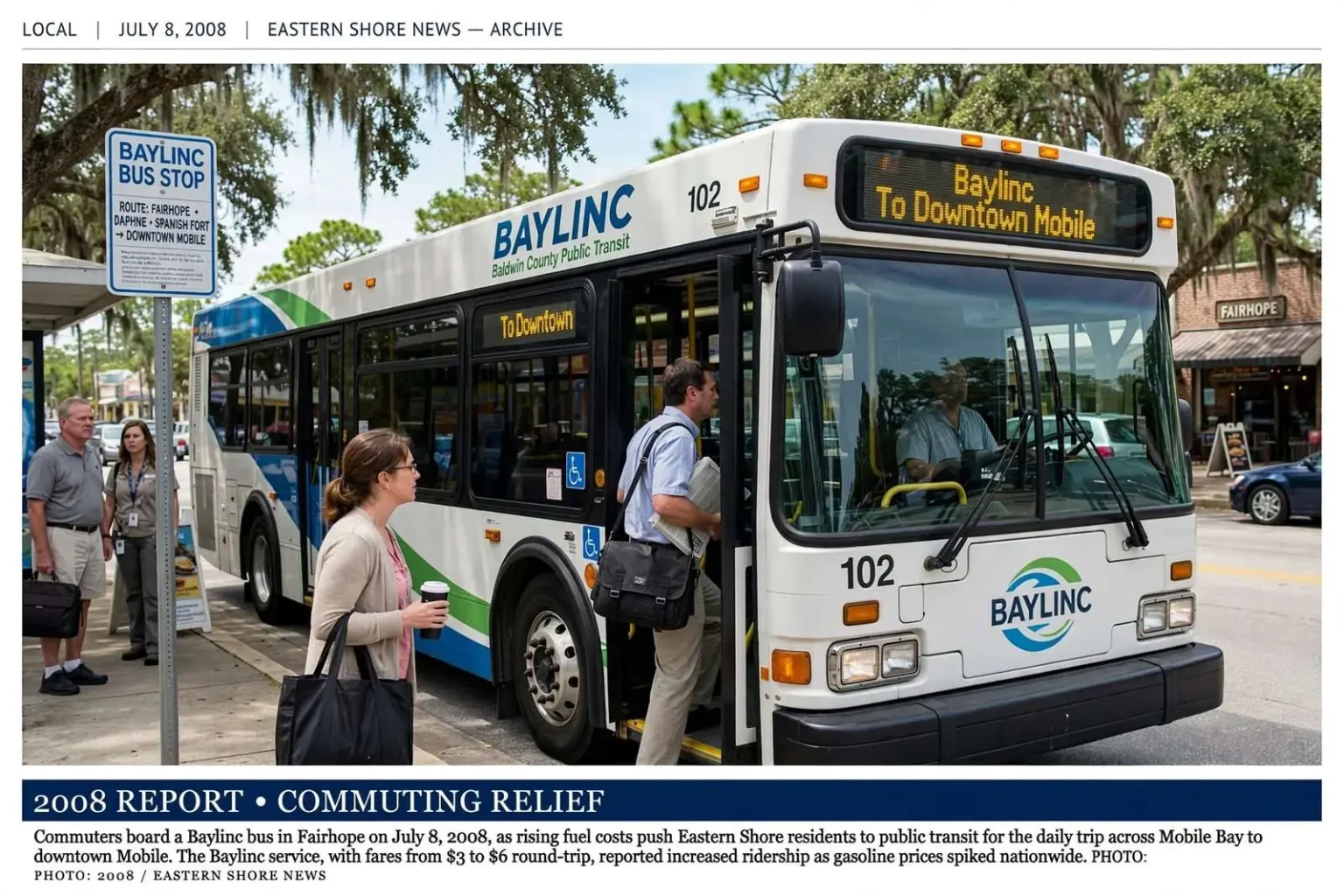
As gasoline prices climbed in 2008, some Eastern Shore commuters found relief in an unlikely place: the seats of Baylinc buses, according to an archived local news report from the oldest available 2008 capture. The station reported that riders were using the service to travel between Baldwin County and downtown Mobile, trading the daily drive across Mobile Bay for a bus trip that stopped in Fairhope, Daphne, and Spanish Fort before delivering passengers to Bienville Square in the heart of the city. Round-trip fares listed in the report ran from $3 to $6, a figure that stood out sharply against the cost of filling a tank during one of the worst fuel-price years in memory.
The timing was no accident. Gasoline prices rose steeply through the first half of 2008, and national averages eventually surged well above levels commuters had ever planned for, squeezing household budgets across the Gulf Coast. For workers who lived in Baldwin County but earned their paychecks in downtown Mobile, the drive across the Bayway and through the tunnel twice a day had long been a fixed cost of the Eastern Shore lifestyle. When fuel prices spiked, that fixed cost ballooned, and commuters began looking at alternatives they might previously have dismissed. Public transit, long a marginal option in a region built around the automobile, suddenly made financial sense for people watching what each commute cost them.
The route described in the report traced the main population centers of the Eastern Shore. Riders could board in Fairhope, the bayside city known for its downtown and its commuting population, or pick up the bus in Daphne and Spanish Fort as it worked its way toward the Interstate 10 corridor and the bay crossing. The final destination, Bienville Square, placed riders within easy walking distance of government offices, banks, law firms, and the other downtown Mobile employers that draw workers from across the bay each morning. That endpoint mattered: a commuter bus is only useful if it lands passengers where they actually work, and Bienville Square sat at the center of Mobile’s business district.
How Baylinc fit into the regional transit picture
Baylinc was Baldwin County’s public transportation service, created to bring fixed-route bus travel to a county that had grown rapidly while remaining almost entirely car-dependent. The service connected with WAVE transit in Mobile County and BRATS transit in Baldwin County, according to the report, forming a chain of connections that allowed riders to move across county lines without relying solely on a personal vehicle. That interconnection was significant for a region where public transportation had historically been fragmented, with each jurisdiction running its own operations and few formal links between them.
WAVE, Mobile’s public transit system, operated the city’s bus network and connected neighborhoods across Mobile County, while BRATS, the Baldwin Regional Area Transit System, served communities throughout Baldwin County. A commuter riding from the Eastern Shore into downtown Mobile could, in principle, ride a Baylinc bus across the bay and then transfer to a WAVE route to reach a destination beyond the central business district. Similarly, riders from elsewhere in Baldwin County could use BRATS to reach a Baylinc stop. Each connection extended the practical reach of transit in a metropolitan area where the bay and county line had long divided transportation planning.
The commuters the station interviewed gave the service a straightforward endorsement. Two Fairhope residents who worked in downtown Mobile told the station that the bus was convenient and helped them avoid the expense of driving each day. Their testimony captured the core value proposition in a year of record fuel prices: every round trip made on a $3 to $6 bus fare was a round trip not made on a tank of gasoline that had become painfully expensive to refill. For a worker commuting daily, the arithmetic compounded quickly across a month of driving, parking, and wear on a vehicle.
Convenience, the riders suggested, was more than just a matter of money. Commuter bus travel handed the responsibilities of the bay crossing to a professional driver, sparing riders the stop-and-go of the Interstate 10 corridor and the tunnel, and freeing the time aboard for reading, resting, or preparing for the workday. For Fairhope residents in particular, whose city sits at the end of a scenic but sometimes slow stretch of the Eastern Shore, a scheduled bus that gathered riders and carried them directly to downtown Mobile condensed a routine that could otherwise consume a meaningful part of the day.
The 2008 fuel crisis and commuter behavior
The surge in Baylinc ridership reported in 2008 reflected a broader shift that rippled across the country that year. When gasoline prices reached unprecedented levels, drivers responded in familiar ways: they consolidated trips, traded vehicles, worked from home where possible, and, most relevant here, tried public transit, some for the first time in years. Transit agencies in metropolitan areas nationwide reported ridership gains during the price spike, and smaller services in car-oriented regions, like Baldwin County’s, saw the same pattern play out locally. The Eastern Shore commuters described in the report were part of a national experiment in whether high fuel prices could change transportation habits that decades of cheap gasoline had cemented.
For Baldwin County, the moment carried particular weight. The county had been one of the fastest-growing in Alabama, its population drawn by the Eastern Shore’s quality of life, but much of that growth assumed a car for every worker and a road for every car. The Bayway and the George Wallace Tunnel funneled thousands of cross-bay commuters through a corridor with limited capacity, and congestion there was a chronic fact of life. A commuter bus that removed even a modest number of private vehicles from that corridor offered benefits beyond the individual rider’s wallet, easing pressure on infrastructure that had been strained by growth for years.
The report’s account of the service also illustrated how public transportation succeeds or fails on details that seem minor from the outside. Stops in three Eastern Shore cities meant the route could serve riders in Fairhope’s neighborhoods, Daphne’s subdivisions, and the newer developments around Spanish Fort without requiring anyone to drive far to a park-and-ride. Fares set low enough to compete with the cost of driving meant the service was accessible to the office workers, government employees, and service workers who made the daily cross-bay commute. An endpoint at Bienville Square meant no last-mile problem once riders reached Mobile.
The Baylinc service described in the 2008 report also told a story about coordination among public agencies. Baldwin County’s own transit operation, WAVE’s routes in Mobile County, and BRATS’ countywide network each covered a piece of the region, and the connection between them, as the report noted, was what made a true cross-bay commute possible without a car. Regional transit planners had long identified those gaps as the hardest problem on the Gulf Coast: Mobile Bay is both the region’s defining feature and its most stubborn transportation barrier, crossed by a single interstate corridor that carries commuters, freight, and tourists alike.
For the commuters quoted in the report, the calculus was simple, but the service’s existence depended on years of less visible work. Public transit in Baldwin County required county government investment in vehicles and routes, coordination with Mobile’s transit authority on the other side of the bay, and fares priced to attract riders without pricing the service out of its own budget. Every commuter who boarded in Fairhope or Daphne was the end product of that planning, and the fuel crisis of 2008 gave the service an audience it had never fully enjoyed before.
What the report means for readers today
Archived reports like this one serve as a reminder of how transportation in the Mobile area has evolved and how external forces, like a fuel price shock, can suddenly elevate options that riders had overlooked. The details in the report, including the stops in Fairhope, Daphne, and Spanish Fort, the $3 to $6 round-trip fares, the Bienville Square terminus, and the connections with WAVE and BRATS, describe the service as it operated in 2008 under the conditions of that year.
This article reflects conditions reported in 2008 and is not a current route, fare, or schedule notice. Fares, routes, and service arrangements may have changed, as the report’s own editor’s note cautioned. Public transit systems routinely adjust routes, revise fares, and restructure services in response to ridership, funding, and regional planning decisions, and any reader seeking current information about cross-bay commuting options should consult the transit authorities serving Baldwin and Mobile counties directly rather than relying on this historical account.
What the 2008 report preserved, beyond the particulars of the route, was a moment when Eastern Shore commuters discovered that the region’s geography was not fixed fate. The same bay that divided Baldwin County from downtown Mobile could be crossed on a bus, at a fraction of the cost of driving, with stops close to home and an endpoint in the center of the business district. The commuters from Fairhope who praised the service’s convenience and savings were describing a regional option that existed before the crisis and proved its worth during it, a quiet example of public infrastructure doing exactly what it was built to do when the moment finally demanded it.