2008 Report: Mobile Businessman Received 80-Year Sentence in Child Sexual-Abuse Case
A historical WKRG report said a Mobile businessman was sentenced to 80 years in prison in 2008 after convictions involving the sexual abuse of a child.
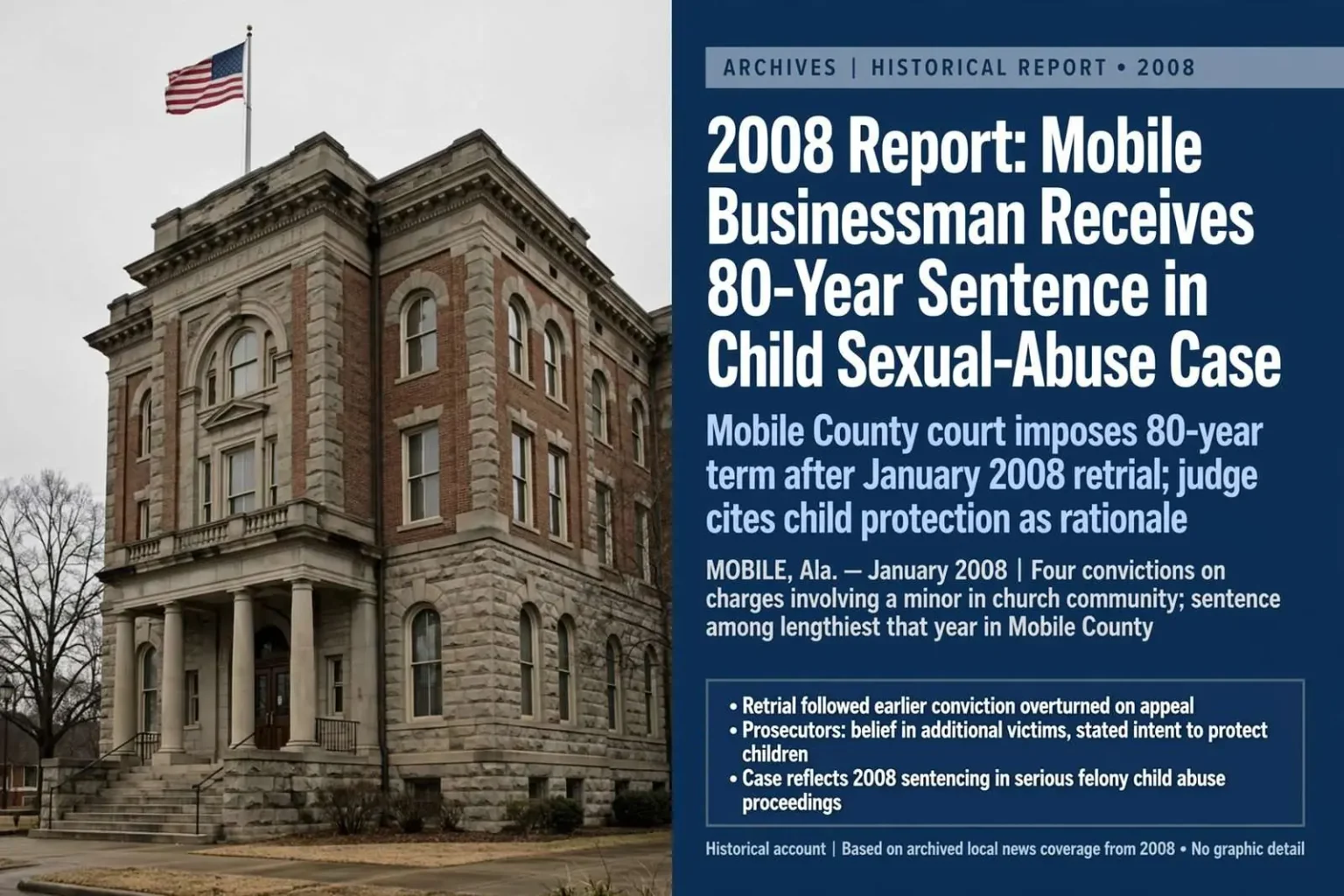
Content note: This historical court report concerns child sexual abuse. It avoids graphic detail and is based on archived local news coverage from 2008.
A Mobile businessman received an 80-year prison sentence in 2008 after convictions on four charges involving the sexual abuse of a child, according to a local news report. The report said the charges involved a boy connected to the defendant’s church community, and the sentence — among the lengthiest imposed in a Mobile County criminal case that year — reflected both the severity of the offenses and the court’s stated intent to ensure the defendant would remain incarcerated for the remainder of a typical lifetime.
Prosecutors told the court they believed there were additional victims, while the sentencing judge said the lengthy sentence was intended to protect children. Those two statements, preserved in the archived coverage, framed the proceeding’s gravity: a prosecution that extended beyond a single case and a judicial decision explicitly reasoned in terms of public protection rather than rehabilitation potential or the defendant’s age and standing in the community.
The station reported that the defendant had previously faced similar allegations and an earlier conviction that was later overturned on appeal. The earlier conviction’s reversal meant that the 2008 proceeding effectively restarted the legal process against him, and the outcome — four convictions followed by an 80-year term — represented the second time a Mobile County jury had weighed accusations of this kind against a man the community knew as a businessman.
The 2008 sentencing followed the convictions reported that January. This is a historical account of a reported court proceeding. It does not add graphic details or attempt to report subsequent appeals, custody status or other later developments.
How the case moved through the courts
The path from the January convictions to the sentencing followed the standard sequence of a serious felony case in Mobile County. After a jury returned guilty verdicts on the four charges, the case moved to a sentencing hearing before the circuit judge, where prosecutors presented the state’s position, the defense presented mitigating arguments, and the court weighed Alabama’s sentencing framework for child sexual abuse offenses. Crimes of this category carry substantial statutory ranges, and judges have discretion within those ranges to shape sentences that reflect the circumstances presented at the hearing.
An 80-year sentence functions in practical terms as a life sentence for most defendants, regardless of age at conviction. Alabama’s sentencing structure for repeated or multi-count offenses allows terms to run consecutively, and courts considering evidence of multiple victims or prior similar allegations frequently construct sentences intended to remove the possibility of release within a normal lifespan. The judge’s stated rationale — protecting children — aligns with that structure and explains the court’s choice to impose a term far exceeding the span of a typical adult life remaining.
The earlier conviction that was overturned on appeal also shaped the 2008 proceeding. Appellate reversals of this kind can arise from trial errors, evidentiary rulings or jury instruction problems, and when they occur the state retains the option of retrial. A retrial places victims and witnesses through testimony a second time, and prosecutors who choose to proceed again do so knowing the case’s history — a decision that, in this instance, culminated in the January convictions and the sentence that followed.
The community context
That the charges involved a boy connected to the defendant’s church community gave the case a dimension the archived report acknowledged without elaboration. Cases in which trusted community or religious figures are accused of abusing children present particular challenges for prosecution: families hesitate, institutions are protective of their standing, and victims often delay disclosure for years. Prosecutors’ statement to the court that they believed additional victims existed is consistent with the pattern such cases typically follow, in which a first conviction encourages others to come forward.
Mobile County’s circuit court handled a significant docket of child abuse prosecutions during the 2000s, supported by the district attorney’s specialized units and by advocacy centers established across Alabama to coordinate interviews, medical evaluation and victim services in a single child-appropriate setting. The multicounty coordination matters in cases like this one because testimony from children requires careful handling, and the state’s approach — trained interviewers, multidisciplinary teams, and prosecutors experienced in abuse cases — aimed to secure convictions without re-traumatizing witnesses.
The defendant’s standing as a Mobile businessman made the case a topic of community conversation when the January convictions were reported. Local coverage of such trials generally avoids naming victims, publishing graphic testimony or speculating beyond the court record, and the archived report followed that practice. What could be reported — the convictions, the sentence, the judge’s rationale and the prosecutors’ belief in additional victims — formed the public record on which this historical account rests.
Sentencing in Alabama abuse cases
Alabama law treats sexual abuse of a child among the most serious offenses on its books, with penalty ranges that escalate based on the charges, the ages involved and the defendant’s history. Consecutive sentencing across multiple counts is the mechanism by which courts construct terms of many decades, and the practice became increasingly common in the late twentieth and early twenty-first centuries as legislatures lengthened statutory ranges and judges responded to evidence of repeat offending.
The judge’s statement at sentencing — that the length was intended to protect children — reflects the protective rationale courts articulate when evidence suggests a defendant poses continuing risk. In practical effect, a sentence of 80 years serves three purposes at once: punishment proportionate to the offenses, incapacitation of a defendant believed likely to offend again, and a message to the community about the consequences of child abuse. Prosecutors and victims’ advocates in the period routinely cited such sentences in explaining why they retried cases after appellate reversals rather than negotiating reduced resolutions.
For the appellate history that preceded the 2008 sentencing, the sequence is worth noting for what it shows about the system’s self-correction. An initial conviction overturned on appeal means an appellate court found legal error requiring a new proceeding; it does not establish innocence, and it returns the case to the trial court for a second effort. The state’s decision to retry, the second jury’s convictions, and the sentence that followed completed a cycle that stretched across years — a common duration for serious felony cases that travel the full appellate route.
Why the record ends here
The archived report does not include subsequent appeals, custody status or other later developments, and this account deliberately leaves those threads unexplored. Criminal cases of this type can continue through post-conviction motions, appellate review and parole proceedings for decades, and a historical summary that speculated about outcomes beyond its source would add nothing reliable. What the 2008 record establishes is what happened in the courtroom that year: four convictions, an 80-year sentence, a judge’s protective rationale and prosecutors’ belief that more victims existed.
That record also preserves the victim-centered purpose that animated the proceeding. Child abuse prosecutions exist, in the end, to protect children — the people least able to protect themselves from trusted adults — and the sentence reported in 2008 expressed that purpose in the clearest form a court possesses. The historical account stands as documentation of a Mobile County proceeding that a local newsroom considered significant enough to report at the time, presented here without graphic detail and without extrapolation beyond the facts the archived coverage preserved.
Reporting on cases of this kind
Newsrooms covering child abuse prosecutions follow conventions that shape what the public record contains. Victims are not named, testimony is summarized rather than quoted, and the reporter’s attention stays on the proceedings — charges, verdicts, sentences and the court’s statements — rather than on the underlying acts. The archived 2008 coverage of this case followed those conventions, which is why its account reads in measured terms: the number of charges, the connection to a church community, the prosecutors’ belief in additional victims and the judge’s stated rationale. That restraint is deliberate, and this historical account preserves it.
The January convictions and the sentencing hearing months later marked the two moments local coverage typically returns to in such a case: the verdict, which establishes what a jury found, and the sentence, which establishes what the court did about it. Between those moments, most of the work — presentence investigations, victim impact statements, defense motions — happens out of public view. The presentence process in an 80-year case would have included the department’s report on the defendant’s history and the victims’ statements to the court, both standard components of Alabama sentencing hearings in serious felony matters.
The stakes for victims and families
For the family at the center of the case, the proceedings represented years of engagement with the justice system, spanning the original investigation, the first trial, the appeal and its reversal, and the retrial that produced the 2008 convictions. Research and victim advocacy literature consistently identify that duration as among the heaviest burdens abuse cases impose on the people harmed by them, and the prosecutors’ choice to pursue the case a second time reflects both confidence in the evidence and a judgment that the outcome justified the cost to those who had to testify again.
The statement to the court that additional victims were believed to exist serves, in the public record, as an invitation as much as an assertion. Prosecutors in such cases encourage others to come forward, and the possibility of further proceedings remains open when they do. Whether anyone did so after the 2008 sentencing is outside the archived report, and no claim is made here in either direction.
The case’s church-community dimension also illustrates why institutions figure so prominently in abuse reporting generally. When the accused person’s standing rests on trust within a congregation, disclosure becomes harder for victims and the institution’s response becomes part of the story. The archived report did not describe any institutional response, and this account adds none; it simply notes the connection that the coverage preserved.
A documented moment in a long process
Stripped to its verifiable elements, the 2008 record shows a Mobile County circuit judge imposing one of the most severe sentences available in practice for child sexual abuse convictions, after a retrial that followed an appellate reversal, in a case involving a businessman accused of abusing a boy from his church community. Each element carried institutional weight: the jury’s verdict, the appellate court’s earlier correction, the prosecutors’ persistence, the judge’s protective rationale.
Preserved now as historical documentation, the account demonstrates how seriously the local justice system treated offenses of this kind during the period, and how the combination of appellate review, retrial and lengthy sentencing functioned in a real case. It ends where the archived coverage ended, with the sentence imposed and the court’s words on the record — a boundary respected here, as the original report respected it, in keeping with the care such cases demand of everyone who writes about them.