Mobile Police Chief Takes ‘You Have a Choice’ Program to 12 High Schools
Mobile Police Chief James Barber launched evening sessions at 12 high schools aimed at steering young people away from criminal activity.
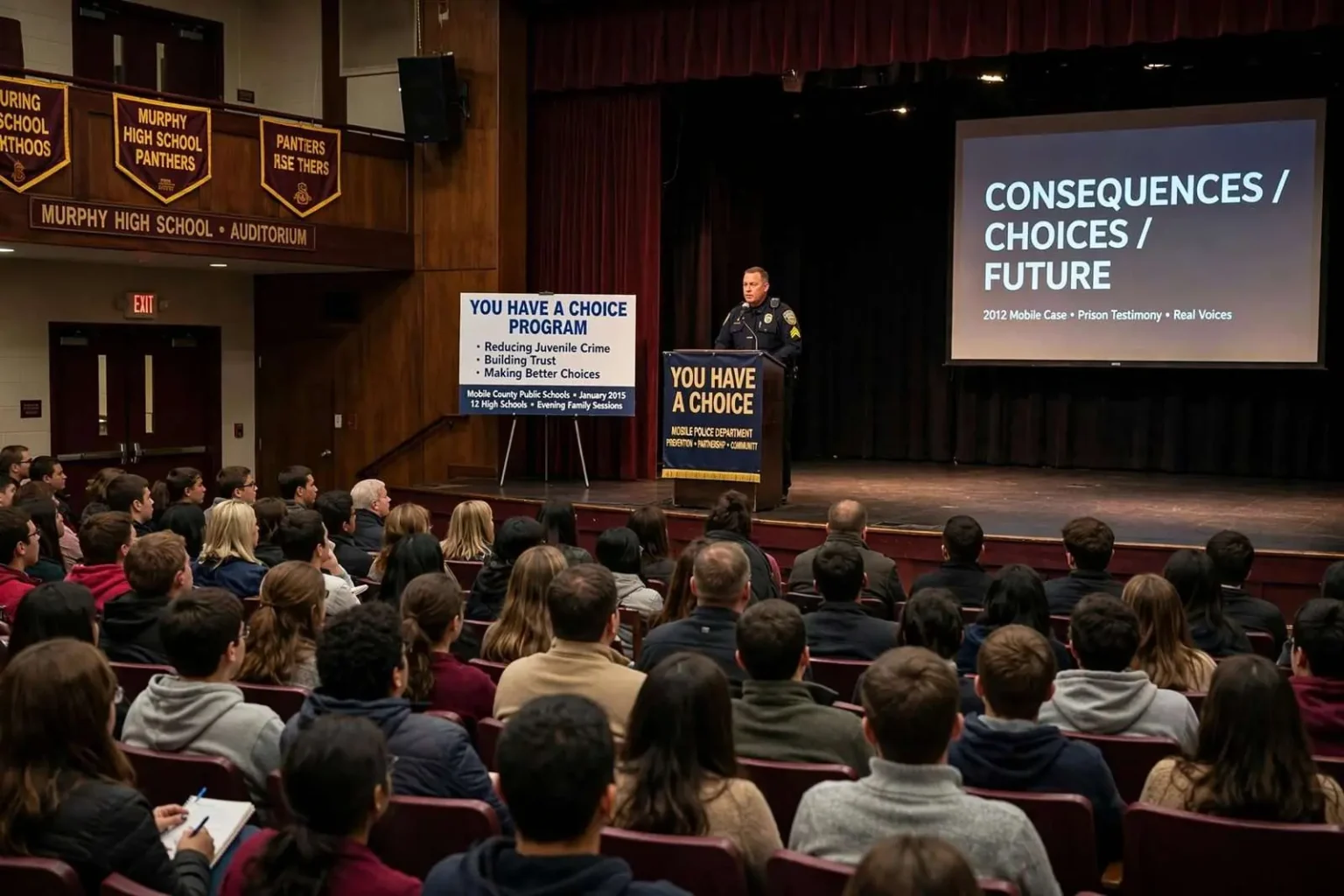
Mobile Police Chief James Barber began a series of evening presentations at Mobile County high schools in January 2015, part of a department initiative called “You Have a Choice” designed to reduce juvenile crime and build stronger relationships between police and young people. The program was first introduced to the Mobile County school system’s roughly 90 principals the previous October, laying the groundwork for a school-by-school rollout that continued into the new year.
The premise was direct. Rather than waiting for arrests to connect officers with young people, Barber wanted to bring the consequences of violent crime into the same auditoriums where students spend their days, and to do it with their parents sitting beside them. The January start put the rollout in the middle of the school year, giving each high school’s administration time to schedule the evening session, notify families and prepare for the discussion that followed each screening.
Barber framed the effort as a response to the limits of doing things the way they had always been done. “We have got to do something today so that we’re not doing the exact same thing five, 10, 15 or 20 years from now,” he told principals when the program was introduced. “We have got to do something different. We can’t keep doing the status quo expecting different results.”
Inside the Program’s Video
Each session includes a roughly 17-minute video that combines a dramatized reenactment of a 2012 Mobile homicide case with interviews recorded at the Julia Tutwiler Prison for Women and the Holman Correctional Facility. The goal is to give students a direct, unfiltered look at the consequences that can follow violent crime, both for victims and for those who end up incarcerated.
The two prisons featured in the video sit at opposite ends of the Alabama prison system, and each carried its own weight in the presentation. Julia Tutwiler Prison for Women, in Wetumpka, is the state’s prison for female inmates, and Holman Correctional Facility, in Atmore, holds men serving long sentences, including many who arrived there as young adults. Hearing inmates describe, in their own words, the decisions that put them behind bars and the years of regret that followed was the program’s central device — a message delivered not by police, but by people living at the end of the road the program warns against.
Pairing those interviews with a dramatized account of a real Mobile homicide case gave the video a local anchor. The 2012 case was not an abstraction from a distant city; it happened in the same community where the audience lived, and its retelling made the connection between a single decision and a permanent loss impossible to dismiss.
An Evening Format Built for Families
The sessions, held at 6:30 p.m., are open to high school students and their parents, with middle school students also welcome to attend. The evening hour was a deliberate choice: it put the program outside the school day, allowed working parents to attend alongside their children, and framed the presentation as something a family experienced together rather than an assembly students filed into alone.
Involving parents recognized a reality of juvenile crime prevention: the students most at risk rarely change course because of a single school assembly. Families who hear the same message, see the same footage and leave the same room with a shared vocabulary are better positioned to have the harder conversations at home, which is where the program’s influence ultimately has to take root.
A Rollout Across the County
The rollout stretched across nearly a dozen campuses over several weeks, starting with Murphy High School and continuing through Baker, Citronelle, B.C. Rain, Bryant, Davidson, Williamson, Theodore, Blount, LeFlore, Mary G. Montgomery and Vigor high schools.
The school list itself was a portrait of the county. Murphy, in midtown Mobile, is one of the system’s flagship campuses; Baker and Davidson draw from west Mobile’s growing neighborhoods; Citronelle sits far to the north near the Washington County line; B.C. Rain serves the communities around Brookley on the peninsula; Bryant and Mary G. Montgomery anchor the western suburbs along Highway 98; Williamson, Blount, LeFlore and Vigor stand in the city’s neighborhoods where the homicide rate has historically hit hardest; and Theodore covers the communities south of the city toward Tillman’s Corner. Taking the program to every one of them, rather than only the highest-crime zones, made the message countywide and avoided marking any single community’s students.
The Mobile County Public School System is the largest school district in Alabama, which meant the rollout was among the largest such partnerships a police department in the state had attempted with a school system. Each campus session required coordination between school resource officers, principals, and the department’s command staff, and the October introduction to 90 principals gave the district’s leadership time to fold the program into the schools’ event calendars before the first session opened in January.
Prevention as a Policing Strategy
Programs like “You Have a Choice” reflect a broader strategy among law enforcement agencies to intervene before young people become involved in the criminal justice system, rather than relying solely on enforcement after a crime has already occurred. By pairing a police chief’s direct presence with graphic, real-world testimony from people currently serving time for violent offenses, the department aimed to reach teenagers at the age when decisions still have the power to change the direction of a life.
The logic is practical as well as moral. Every violent crime a city prevents is an arrest it never has to make, a trial the courts never have to hold, and a family — on either side of the crime — that never has to bury its future. Prevention programs cannot be measured by the crimes that fail to happen, which makes them harder to fund and evaluate than enforcement operations, but departments across the country have increasingly treated them as a core function rather than a sideline.
The evening sessions also served the officers who attended. Working a school auditorium full of families is very different from working a patrol shift in the same neighborhood hours later, and officers who field questions from students about their jobs, their training and their view of the community come away with a better sense of how their department is seen — feedback that no internal report provides. Departments that run programs like this one consistently report that the relationships built in those rooms pay off in the field, in tips that solve cases, in de-escalations that end without arrest, and in the slow work of rebuilding trust in the neighborhoods that need it most.
Relationships Beyond the Auditorium
The second half of the program’s stated goal — building stronger relationships between police and young people — addressed a problem that plays out in every city: many teenagers meet an officer for the first time during the worst moment of their lives, whether as a victim, a witness or a suspect. An evening program in a school auditorium gives officers and students a very different first meeting, and one in which the officer is there to talk rather than to enforce.
Barber’s message to principals made that dual purpose explicit. The status quo, in his telling, was producing the same outcomes year after year — the same neighborhoods losing young people to violence, the same cycle repeating into the next generation — and a department that only responded to crime was choosing, by omission, to keep repeating it. “You Have a Choice” put the department on record as trying something different, and it did so in the schools, where the county’s young people spend more of their waking hours than anywhere else.
For the school system, the partnership fit within an existing commitment to keeping students connected to their classrooms. The district’s high schools already hosted resource officers and career programs, and an evening session that parents could attend extended that presence into the hours when students are most likely to be unsupervised and most exposed to the risks the program describes.
What Attendance Meant
The measure of a program like this is not a single night’s turnout but whether the conversation it starts continues. A student who watches a 17-minute video about a 2012 Mobile homicide and hears a Holman inmate describe the day his choices caught up with him does not leave unchanged; whether that impression lasts depends on the adults — parents, teachers, coaches, officers — who reinforce it in the weeks after.
By carrying the presentation from Murphy to Citronelle, from Theodore to Vigor, across campuses separated by an hour’s drive and by deep differences in circumstance, the department and the school system committed to the idea that every student in Mobile County deserves the same direct conversation about choices and consequences. The January 2015 rollout gave them that conversation, one high school auditorium at a time, with parents in the seats beside their children and a police chief making the argument that the status quo could no longer stand.