Mobile Police, Schools Launch Joint Push to Curb Juvenile Crime
Mobile police introduced a new juvenile crime prevention program to nearly 90 school principals, aiming to build trust before trouble starts.
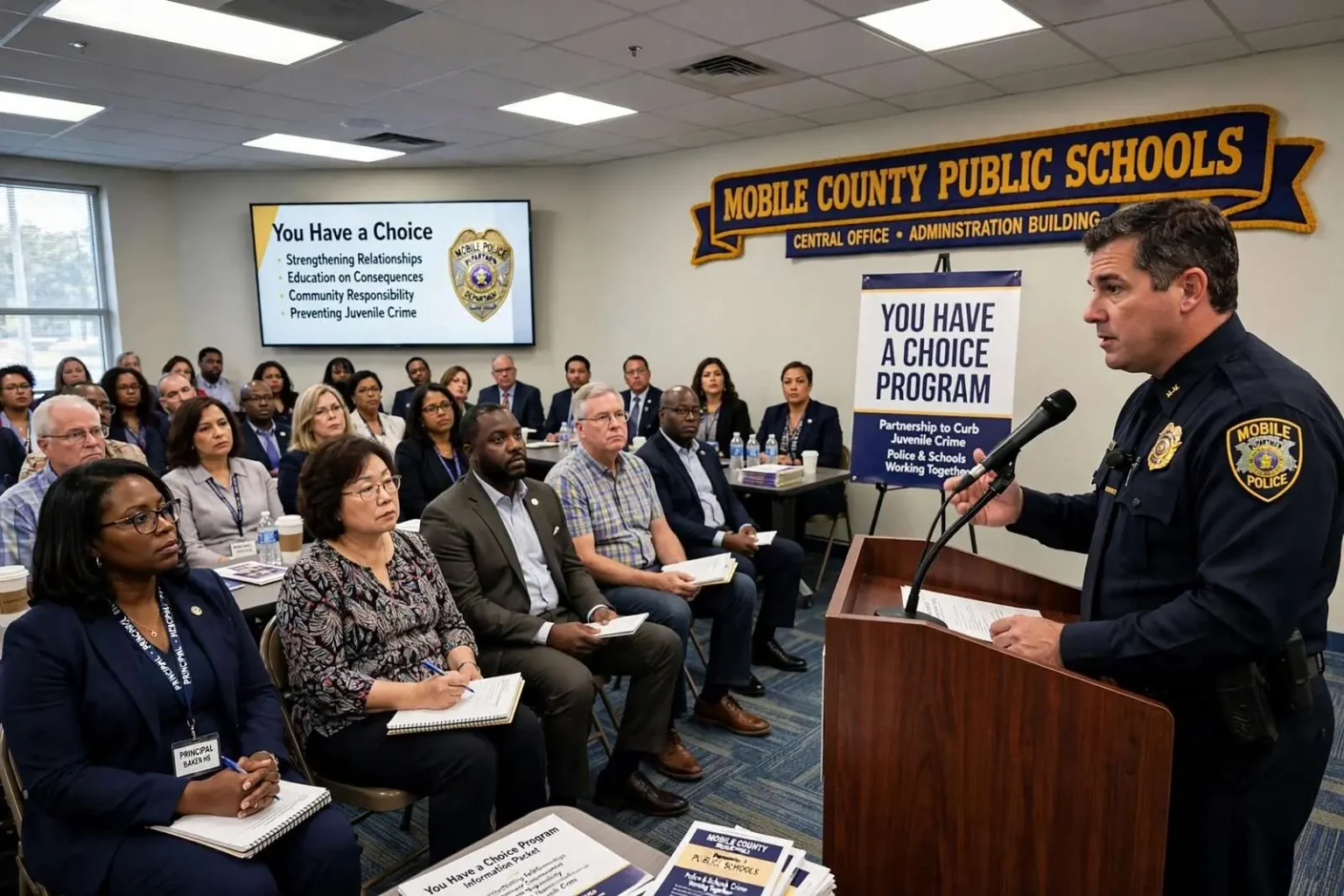
Roughly 90 principals from Mobile County’s elementary, middle and high schools gathered at the district’s central office this week for a first look at a new police department initiative aimed at curbing juvenile crime before it starts.
Mobile Police Chief James Barber told the assembled principals that the status quo wasn’t working and that schools and law enforcement needed to change course together. “We have got to do something today so that we’re not doing the exact same thing five, 10, 15 or 20 years from now,” Barber said. “We have got to do something different. We can’t keep doing the status quo expecting different results.”
The gathering introduced principals to the “You Have a Choice” program, which Mobile police unveiled earlier in the month. The initiative aims to strengthen relationships between officers and young people while educating students about the consequences of criminal activity and the reach of law enforcement.
Inside the ‘You Have a Choice’ Program
Central to the program is a roughly 17-minute video that reenacts a 2012 homicide in which a Mobile woman was killed, paired with interviews recorded at two Alabama state prisons for men and women. Principals watched the video during the session and heard remarks from Barber, a federal prosecutor, the sergeant who leads the police department’s Family Intervention Team, and the mother of the woman killed in the case depicted in the video.
The victim’s mother told the group that losing her daughter to gun violence has left a permanent void in her family, including two grandchildren who are growing up without their mother. “Having a 17-year-old student pick up a gun and in a moment make a decision that would shatter our lives forever,” she said, describing why she believes every student needs to see the video and understand its real-world stakes.
Building a Partnership Between Police and Schools
Barber asked the principals for input on how the department could deepen its relationship with schools, suggesting officers make more regular, informal visits to build trust with students rather than only appearing during incidents. He acknowledged the limits of what schools and police can control on their own. “The reality is, some parents you aren’t going to make parents out of,” he said, adding that a large share of the young people his department encounters are growing up without a father figure at home.
Mobile County Public Schools Superintendent Martha Peek said a form would be distributed to principals allowing them to request either a police visit or a screening of the video for their students, with department leadership offering to attend in person when scheduling allows.
Officials with the department’s Family Intervention Team, which works with students after school-related incidents such as fighting, said the broader goal is to reach young people before they end up in that kind of situation at all, describing the effort as a communitywide responsibility rather than one that falls solely on police or schools.
Mobile County Public Schools, whose principals attended the session, is the largest public school system in Alabama.