Mobile County Speeds Up Employee Raises, Adds $500 Bonus
Mobile County commissioners moved up a scheduled employee pay raise by two months and tacked on a $500 bonus after fuel savings boosted the budget.
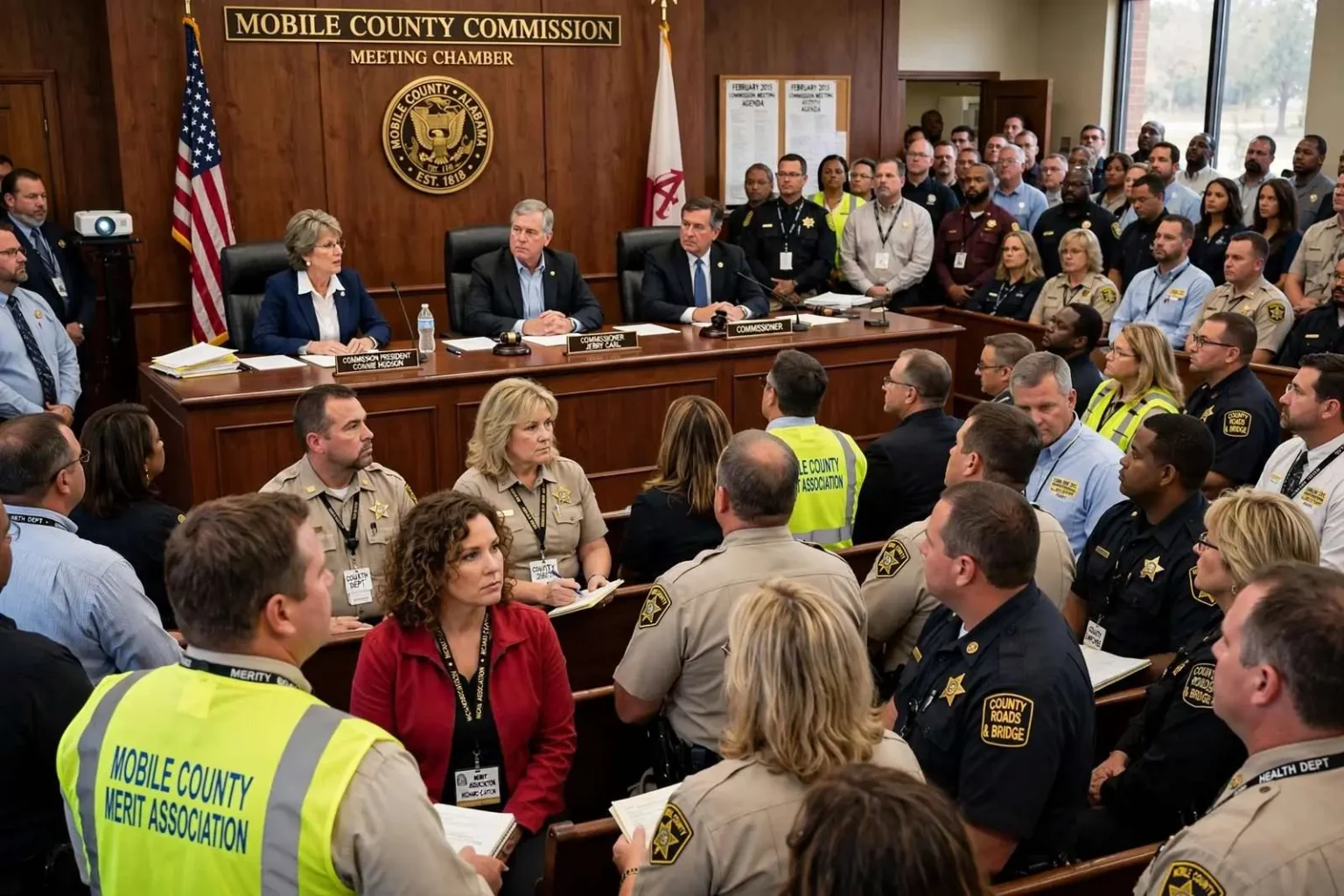
MOBILE, Alabama — More than 50 members of the Mobile County Merit Association packed a recent Mobile County Commission meeting to hear officials confirm that a previously scheduled employee raise would arrive two months early, along with a one-time $500 bonus for the county’s roughly 1,600 employees. The county had already given workers a 2.5 percent raise in the fall of 2014, with a second 2.5 percent increase originally set for April. Merit association leader Richard Cayton asked commissioners to move the second raise up, noting the county had saved more than $100,000 on fuel costs as gas prices fell. Commissioners agreed, and the raise is now set to take effect in the first pay period of February, pending formal approval from the county personnel board. The $500 bonus will follow later that month.
The show of attendance was itself part of the message. When more than 50 county employees fill the commission chamber, the merit association is signaling that its membership is watching, and the packed room gave the request a visibility that a letter or phone call would never carry. Cayton’s argument to commissioners was built on arithmetic the county’s own budget office had confirmed: fuel expenditures running well under budget as gas prices declined across the country, savings he asked the commission to share with the workforce that had done without raises through several lean budget years.
The decision to accelerate the raise rather than simply promise it for spring reflected the timing of the county’s own fiscal calendar. Mobile County closes out each fiscal year with a formal review of revenues and expenditures, and the results of that review determine what money is genuinely available to commit. Acting before the closeout was complete would have meant budgeting on estimates; acting after it meant commissioners could move the raise knowing the savings were real and banked. The February start date, in the first pay period of the month, put the increase in employees’ checks a full two months before the April date originally promised, and the $500 bonus followed close behind it.
Commission President Connie Hudson said the earlier-than-planned raise stemmed largely from savings identified when the county closed out its fiscal 2014 budget, a review process that takes roughly three months to complete. She said the fund balance improved due to higher sales tax revenue, lower personnel costs and proceeds from the sale of county assets — and that falling gas prices, while helpful, played a comparatively small role in freeing up the money. Hudson’s accounting was notable for how it distributed the credit: sales tax growth pointed to a strengthening local economy, while lower personnel costs and asset sales reflected decisions the commission itself had made in prior budget cycles.
Fuel Budgets and Falling Prices
Commissioner Jerry Carl said the county typically budgets fuel costs at $3 a gallon and buys gas monthly, allowing savings to accumulate as prices dropped. “It’s nice when all three of us can agree,” Carl said of the unanimous decision. “It was an easy sell.” The mechanics Carl described explain why the fuel savings Cayton cited were so visible. A county government the size of Mobile County operates hundreds of vehicles — sheriff’s patrol cars, road department trucks, sanitation equipment, ambulances and inspector vehicles — and a purchase cycle that resets each month meant declining pump prices translated into immediate, measurable savings rather than being locked into annual contracts priced months earlier.
The unanimity Carl described carried its own weight in a three-member commission that does not always speak with one voice on budget priorities. A unanimous vote to move up a raise and add a bonus signaled that all three commissioners regarded the employee compensation request as the right use of the windfall, and it spared the merit association the uncertainty of negotiating through a split vote. For county workers who had watched budget constraints hold raises back in earlier years, the agreement of the full commission on both the timing and the bonus was the more meaningful part of the announcement.
The 2.5 percent raise itself, while modest in percentage terms, reached every corner of a workforce that spans nearly every function of county government. Mobile County’s roughly 1,600 employees staff the Sheriff’s Office, the county’s road and bridge crews, the health department, probate courts, revenue office, animal shelter, and the sprawling engineering and sanitation operations that serve an area covering more than 1,200 square miles. Many of those positions had absorbed years of tight budgets, and the merit association exists precisely to advocate for them — tracking pay scales, arguing for adjustments and keeping compensation on the commission’s agenda between budget cycles.
Cayton thanked commissioners for acting on the request and said the merit association’s next priority is examining the county’s current health care plan for employees. “We have a line of communication and hopefully we can work other things out,” he said. The framing signaled a broader agenda. Health insurance costs had been rising across local governments nationwide, and for many county employees the growth in premiums and out-of-pocket costs could consume a meaningful share of any raise. By naming health care as the association’s next target, Cayton made clear that the February raise was a first installment on a longer conversation about total compensation rather than the end of the association’s requests.
A Good Year Built on Conservative Budgeting
The announcement offered a rare bit of good financial news for county government employees heading into the new year, with officials citing conservative budgeting practices as the reason the county could afford to move up both the raise and the bonus without new revenue sources. The pattern Hudson and Carl described — budgeting fuel at a conservative price point, closing out the fiscal year methodically, and banking the difference — is the standard playbook of local government finance, though not every jurisdiction executes it as cleanly. Mobile County’s ability to fund the accelerated raise from operations, without a tax increase or a budget amendment debate, was the detail that made the announcement unusual.
The timing also aligned with a broader economic backdrop that had improved for local governments across the Gulf Coast. Rising sales tax receipts, which Hudson cited as the largest contributor to the improved fund balance, tracked with the recovery in consumer spending and construction across the Mobile area, from the industrial expansions along the Mobile River to the steady growth of retail corridors in western Mobile County. When sales tax revenue climbs, a county government with a diversified economy captures the growth across every category of taxable spending, and the gains compound across a full fiscal year.
For the employees who packed the commission chamber, the practical effect of the votes arrives on regular paydays. The 2.5 percent raise compounds into every subsequent check and every future benefit calculation that is tied to base pay, from retirement contributions to overtime rates, which is why merit association members weigh each percentage point carefully. The $500 bonus, arriving later in February, functions differently — a one-time payment that recognizes the workforce without permanently changing the budget base. The combination of both, delivered two months early, was the package the association had asked for and the one the commission delivered.
The episode also offered a snapshot of how county government and its employee association conduct business when the relationship works. A request grounded in documented savings, presented by an association leader with a working relationship across the chamber, answered unanimously by commissioners who could point to a closed-out budget that justified the expense — the sequence is what both sides point to when they describe the county’s labor-management culture at its best. With the raise set for the first pay period of February pending personnel board approval, and the health care plan already named as the next item on the association’s agenda, the conversation Cayton described as an open line of communication promised to continue well beyond this vote.
The personnel board approval that remains before the raise takes effect is a standard step rather than an open question, but it matters to the calendar. The county personnel board signs off on compensation actions affecting the classified workforce, and its February agenda will carry the commission-approved increase for formal adoption. Once approved, the payroll changes flow through the county finance office in time for the first pay period, and the bonus follows in the payroll run later in the month. County employees will see the change reflected not just in their checks but in their official pay records, where the new rate becomes the base for everything calculated afterward.
For the merit association, the vote capped a request made at exactly the moment leverage favored it. Fuel savings were documented, the budget closeout was complete, the economy was generating sales tax growth, and the workforce was in the room watching. Commissioners could approve the request without touching the county operating reserves or its capital plans, and the goodwill of an early raise carried no hidden cost. It was, as Carl put it, an easy sell — and the kind of outcome the association will try to repeat when the health care plan discussion reaches the commission chamber next.