Why Mobile’s Carnival Season Traditionally Begins on January 6
Mobile's Carnival season traditionally opens on Epiphany, Jan. 6. Here is the history behind Twelfth Night and the city's New Year's Eve parading societies.
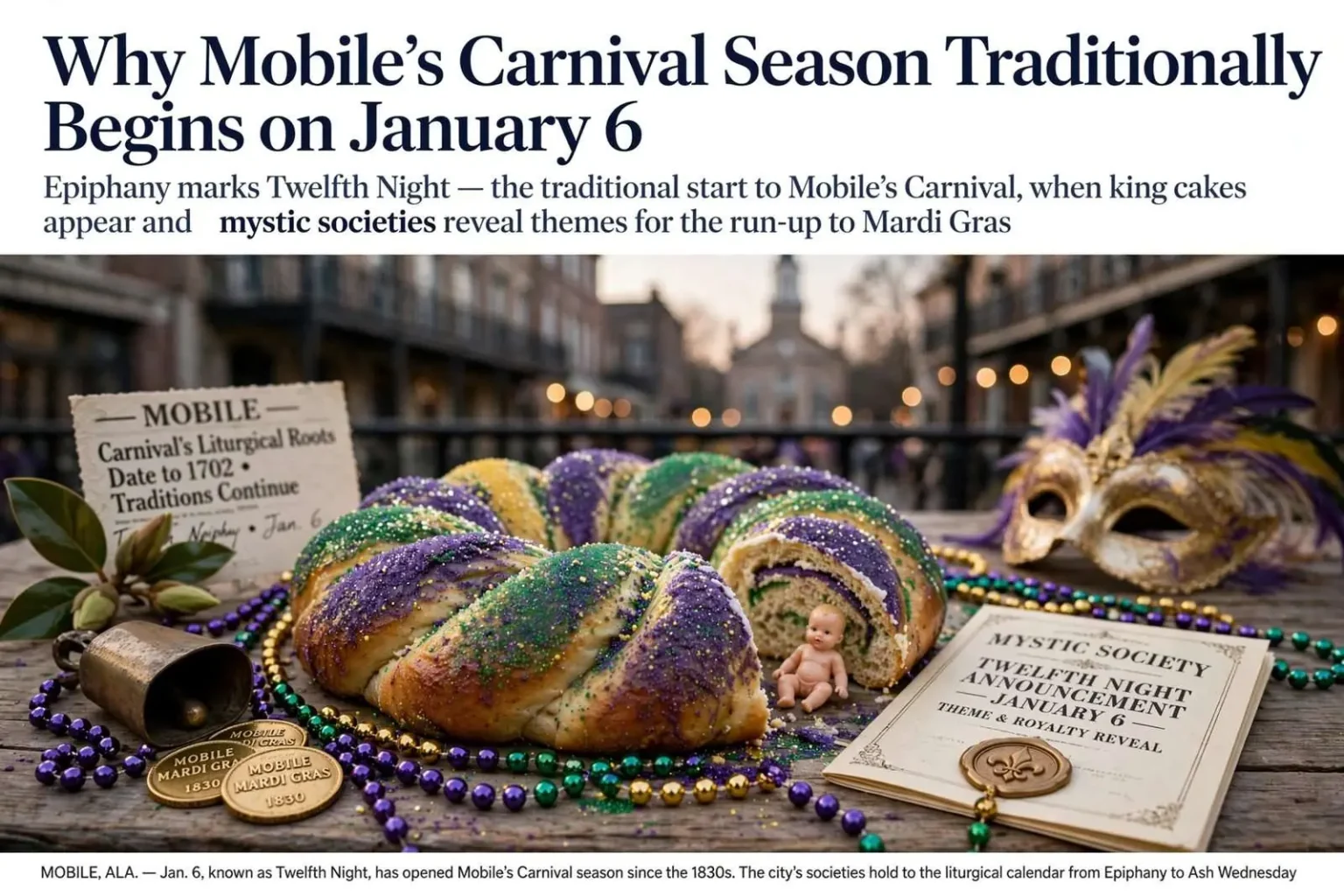
When does Carnival begin? In Mobile, the answer most locals give is Jan. 6 — Twelfth Night, or Epiphany, the feast marking the visit of the Magi to the Christ child. It is the night the first king cakes appear on bakery shelves, the night secret societies announce their themes and royalty, and the night the season’s long countdown to Mardi Gras formally begins. For Mobilians, the calendar is not just paperwork; it is the hinge between two of the city’s great traditions, Christmas and Carnival.
Tradition holds that celebrating Carnival or eating king cake before Epiphany invites bad luck: it will rain on Mardi Gras. The superstition is repeated every year with varying degrees of seriousness, but it underscores a point that older Mobilians take as gospel — the pre-Lenten season belongs to the weeks between Twelfth Night and Ash Wednesday, not before. Purists who spot king cake displays in the last days of December consider it a small act of calendar heresy.
The date closes out Christmastide and opens the pre-Lenten season, the run-up to the final blowout before Ash Wednesday. Epiphany, twelve days after Christmas, has been observed by Christian churches for centuries as the revelation of Christ to the Magi, and the “twelve days” of the familiar carol run from Christmas Day to Twelfth Night. Mobile, with its deep Catholic roots dating to the city’s French colonial founding in 1702, absorbed that liturgical rhythm into its Carnival culture more thoroughly than any other American city.
No official start, by design
But there is no single governing body that sets an “official” start to the season. Carnival has evolved from many traditions, and communities celebrate on their own terms — whether that is Epiphany, the first parade, or Jeudi Gras and Vendredi Gras, the Thursday and Friday evenings that some organizations treat as their own opening acts before the weekend schedule builds. The point, as Mobile revelers like to say, is to have a good time.
That flexibility is worth remembering because claims about when Carnival “really” starts can carry an agenda. Recently a regional outlet suggested Mardi Gras begins before Thanksgiving, tying the season to the debutante balls that date to the 1950s. But Mobile’s Carnival long predates that graft. The carnival calendar the city actually follows is built on parades, balls and the church calendar — not on the social season of the mid-twentieth century.
The argument over start dates matters to the people who keep Mobile’s mystic societies running, because the season’s length shapes everything from float-building schedules to rehearsal calendars to the city’s planning for road closures downtown. A season that begins in November is a different practical proposition from one that begins on Twelfth Night, and the societies themselves have generally held to the traditional timeline.
Cowbellions and the New Year’s Eve roots
The city’s first mystic societies paraded on New Year’s Eve — most famously the Cowbellions de Rakins, formed in 1830 or 1831 — decades before New Orleans’ Comus rolled in 1857. The Cowbellions began when a group of young Mobile men, celebrating the new year with cowbells and rakes, paraded through the streets in impromptu fashion, and the improvised procession grew into the city’s first organized Carnival society. Their New Year’s Eve parades established the pattern that Mobile’s later organizations would follow: costumed marchers, a theme, torchlight and a celebration tied to a fixed date on the calendar.
Those early societies mattered because they gave Mobile a claim no other American city can quite match — an organized, costumed, themed celebration that predates New Orleans’ famous Comus by more than two decades. When observers argue about which city owns Mardi Gras, the Cowbellions are Mobile’s first exhibit.
At the same time, Mobile does not “invent” Mardi Gras, and the city’s own historians are quick to say so. Carnival stretches back to medieval Europe and spread worldwide through colonial and immigrant communities, from the masked balls of France to the street celebrations of the Caribbean and Latin America. French settlers brought the pre-Lenten custom to the Gulf Coast in the early 1700s, and it took root in Mobile’s civic life long before parades became organized institutions. What Mobile can claim is a distinct, homegrown tradition rooted in the liturgical calendar and the New Year’s Eve parades of its earliest societies — a continuous, organized celebration that has run, with interruptions for wars and epidemics, since the 1830s.
Deciding when the party starts
So as the king cakes return to the shelves after Twelfth Night, Mobile can celebrate knowing the story behind the season — and decide for itself when the party starts. Some households cut the first slice on Epiphany; others wait for the first parade roll. The societies stage their own openings on the Thursdays and Fridays of the season, and downtown bars host Jeudi Gras crowds.
King cake and the shape of the season
Twelfth Night also belongs to king cake, the brioche-style ring frosted in purple, green and gold that functions as the season’s edible calendar. Baked with a small plastic baby hidden inside, the cake carries its own folk rules: whoever finds the baby in their slice is said to receive luck — and the obligation to supply the next cake. Local bakeries begin taking orders as Epiphany approaches, and for many households the first king cake of the year is as reliable a marker of the season’s opening as any parade date.
From there, the season builds in a rhythm locals can recite. Society announcements and unveiling parties fill January. Parades begin rolling in the weeks before Mardi Gras, with downtown streets closing for processions in February, and the schedule intensifies into back-to-back parades across the final weekends. Balls run parallel to the parades, since many mystic societies stage invitation-only presentations the same night they ride. Ash Wednesday closes it all with a near-universal sigh and the traditional plate of red beans and rice.
The structure is decentralized but not random. Each mystic society sets its own parade night and theme, coordinating through long-standing practice so that downtown Mobile can absorb multiple processions on peak nights. The city’s Mardi Gras season is frequently described as family-run and family-friendly — lawns and folding chairs along Government Street and Dauphin Street, coolers full of juice boxes beside the beer, and children working the barricades for MoonPies and beads.
A tradition Mobile keeps arguing about, affectionately
That homegrown character explains why Mobilians guard the calendar so jealously. The season is stitched into school schedules, family reunions and business plans downtown; florists, printers, float builders and costume shops all count on it. Generations of families have held seats on the same parade routes, and society memberships are passed down like heirlooms. When an outside story proposes moving the start of the season to Thanksgiving, it reads locally as an attempt to rewrite a calendar the city has been following since the Cowbellions rang their bells in the 1830s.
The claims also matter for civic identity. Mobile and New Orleans have argued for decades about which city’s celebration is older, and the historical record — Mobile’s organized societies parading in the early 1830s, New Orleans’ Comus arriving in 1857 — is central to that rivalry. What the argument obscures is how much the two cities’ traditions share: French colonial roots, the same liturgical clock, and a taste for masking, music and moonlit processions in the dead of winter.
Within Mobile, meanwhile, the season’s opening is genuinely plural. Catholic parishes mark Epiphany on the church calendar. The mystic societies hold their own Twelfth Night events, revealing themes and royalty in January. Some neighborhoods simply start celebrating when the first float rolls past. Jeudi Gras and Vendredi Gras — the Thursday and Friday before the final weekend — have become miniholidays of their own for the organizations that ride on them. The lack of a single “official” start is not sloppiness; it is how a tradition assembled from many streams has always worked.
Twelfth Night itself has grown into a minor local holiday, with churches, schools and neighborhood groups marking the date that hands the city over from Christmas to Carnival. Bakery counters that stood empty of king cakes through the holidays fill up almost overnight, and social media fills with photographs of the first cakes of the year — purple, green and gold sugar still bright from the shaker. For families with deep parade-route roots, the day carries the same quiet anticipation that Thanksgiving Eve does elsewhere.
The organizations that drive the season spend the weeks before Twelfth Night in a sprint of preparation. Float barns along the Mobile River and in the industrial districts finish repairs and paint work; captains finalize themes that have often been guarded since summer; costume shops and seamstresses work through fitting deadlines; and the societies’ lieutenant lists circulate for invitation-only balls. All of that activity pivots on Jan. 6, the date by which the city mentally transitions into carnival mode even though most parades are still weeks away.
The season’s deep roots also explain its durability. Mobile’s celebration has survived the Civil War, yellow fever epidemics, the Great Depression and wartime blackouts, and it has absorbed new societies in nearly every era — including organizations founded in recent decades that reflect the city’s full population. The calendar has bent over the years, with parades added on weekends that once sat empty, but the spine of the season has stayed where the Cowbellions put it: rooted in the church year and the turn of the calendar.
That history gives the current debate its edge. When a claim circulates that Carnival “really” begins before Thanksgiving — or that another city owns the holiday outright — Mobilians respond the way people do when someone rearranges their family furniture. The season is measured in generations of seat-holding along Government Street, in floats a grandfather helped build and grandchildren now ride, in MoonPies thrown from the same corners year after year. No tourism calendar can manufacture that, and no rebranding can move it to November.
So as king cakes return to the shelves and the societies make their January announcements, Mobile can celebrate knowing exactly what it is celebrating: a homegrown season, centuries of borrowed custom made distinctively local, and the freedom to decide for itself when the party starts. Whether the first slice is cut on Epiphany or the first parade rolls later in the month, the destination never changes — the weeks of parades and balls that end on Fat Tuesday, and the quiet of Ash Wednesday that follows. Happy Mardi Gras!