
Charge Against Metro Jail Corrections Officer Dismissed at Preliminary Hearing
A judge found no probable cause and dismissed the promoting prison contraband charge against a Mobile County Metro Jail corrections officer.
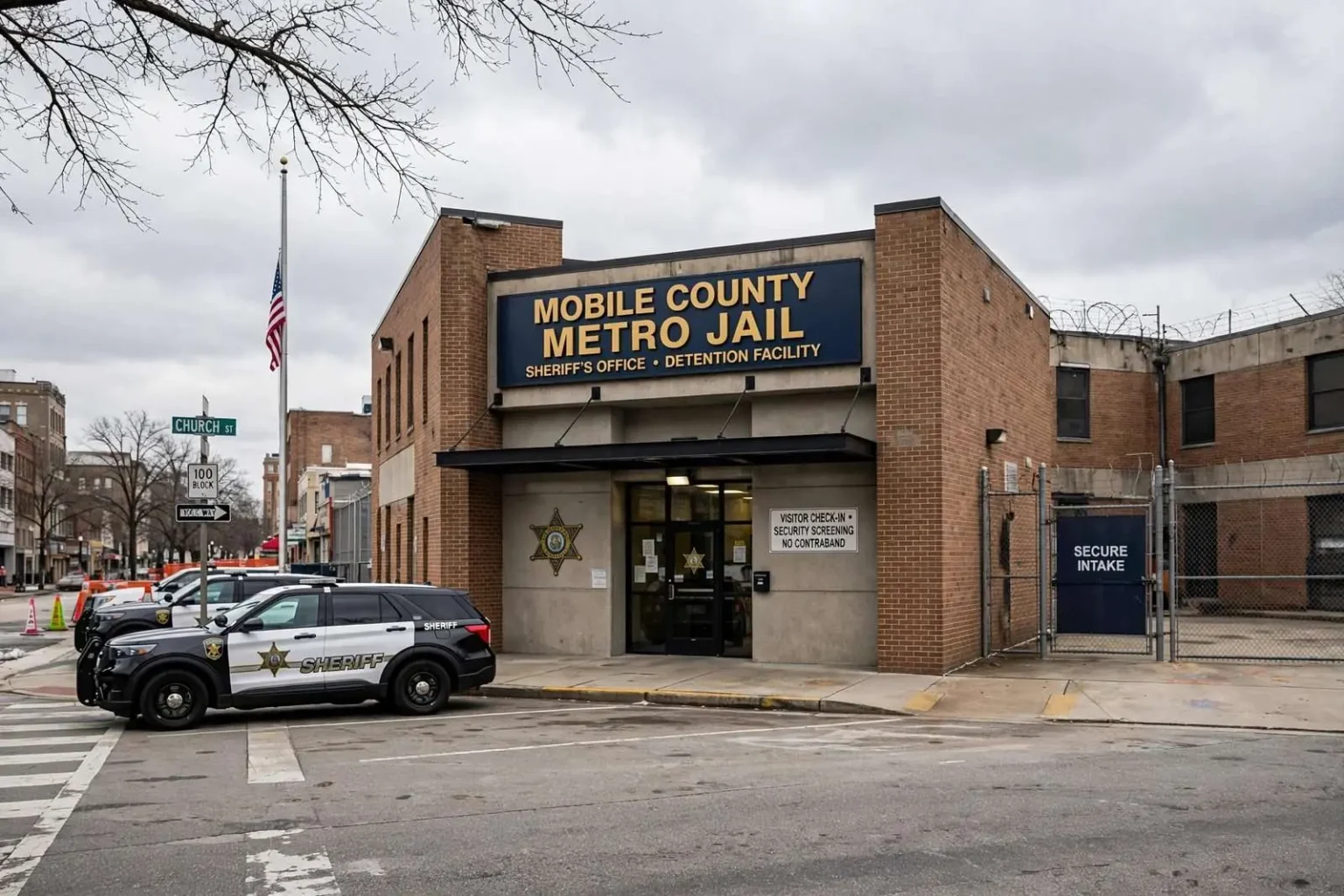
MOBILE, Ala. — A criminal charge against a Mobile County Metro Jail corrections officer accused of smuggling contraband into the facility has been dismissed. Court documents show the first-degree promoting prison contraband charge against Kimberly Henderson was dropped Wednesday after a preliminary hearing, where the court found no probable cause to support the charge.
Henderson had been arrested and charged in September in connection with an alleged smuggling operation at the downtown Mobile jail. She had worked as a corrections officer since 2016, according to the department. The dismissal at the preliminary hearing stage means the case against her ended before trial, unless prosecutors find a way to revive it through the grand jury process.
What a Preliminary Hearing Decides
A preliminary hearing is not a trial, and it does not decide guilt or innocence. It is a screening mechanism: the state presents enough evidence to persuade a district court judge that a crime was probably committed and that the defendant probably committed it. If the judge finds probable cause, the case is bound over to a grand jury for indictment consideration. If the judge does not — as happened here — the charge is dismissed, and the defendant walks out of the process without a felony case moving forward.
That is what the court concluded in Henderson’s case on Wednesday. The finding of no probable cause means the evidence presented fell short of the low but real threshold Alabama law requires, a threshold lower than the reasonable-doubt standard for conviction but not zero. Defense attorneys sometimes waive such hearings; when a defendant chooses to hold one and wins it, the victory is significant, because the state’s case was tested in public and found insufficient at its earliest stage.
The Charge: First-Degree Promoting Prison Contraband
Under Alabama law, promoting prison contraband in the first degree — codified at Section 13A-10-19 of the criminal code — is a Class C felony when the contraband involved is a deadly weapon, a dangerous instrument, or a controlled substance such as drugs. The statute’s second degree covers lesser items. The charge reaches anyone who knowingly takes contraband into a detention facility, and it applies with particular force to corrections employees, whose access makes them the population most often charged when drugs, phones, or weapons appear inside a jail.
Prosecutors across Alabama have brought the charge against corrections officers with some frequency in recent years, as the flow of cellphones and synthetic drugs into detention facilities has become a statewide problem. A conviction carries potential prison time, and the career consequences — permanent loss of employment in corrections and a felony record — follow regardless of sentence.
The September Arrest and Alleged Smuggling Operation
Henderson was arrested in September after investigators alleged she was involved in smuggling contraband into the Metro Jail. The Mobile County Sheriff’s Office, which operates the facility on Church Street in downtown Mobile, handles internal investigations of employee misconduct, often with assistance from outside agencies when the allegations involve staff — a separation designed to keep the inquiry credible within a jail full of people who know its routines.
According to the department, Henderson had served as a corrections officer since 2016 — roughly five years of service at the time of her arrest. She joined the jail’s staff during a period when Alabama detention facilities, like those nationwide, were contending with the wave of synthetic drugs and contraband cellphones that transformed contraband enforcement inside American jails.
Contraband Inside Alabama’s Jails
The problem the charge was meant to address is one of the hardest in American corrections. Jails and prisons screen visitors, scan mail, and search cells, yet drugs and phones still arrive — thrown over fences in tennis balls and drones, concealed in legal mail, and carried in by staff and contractors, the one population that moves through security without being searched. Corrections departments respond with drug-detection K-9s, body scanners, and criminal prosecutions of employees who cross the line.
Alabama’s corrections system has been a focal point of the problem. The state Department of Corrections has prosecuted dozens of staff and civilian smuggling cases in recent years, and county jails — which hold pretrial detainees and short sentences — face the same pressure with fewer resources. In Mobile County, the Metro Jail houses a population that changes daily, and every new intake is an opportunity for contraband to enter if screening fails. Employee prosecutions are the visible edge of a wider enforcement effort that includes interdiction at the door and monitoring of staff movements inside the facility.
The Constitutional Frame of the Case
The dismissal in Henderson’s case illustrates the constitutional machinery that constrains smuggling prosecutions. An arrest is an accusation; it requires only probable cause to believe a crime occurred. But a preliminary hearing demands that the state put evidence before a judge, and when that evidence is thin — an informant’s account without corroboration, a search that turned up nothing, a chain of events with gaps — the court can end the case on the spot.
Defense counsel for Henderson evidently chose to test the state’s proof rather than waive the hearing, and the strategy succeeded. The finding of no probable cause is a legal determination, not a declaration of innocence, but its practical effect is the same as far as the criminal case is concerned: the charge is dismissed, and the defendant is entitled to the presumption of innocence that every accused person holds.
What Happens After a Dismissal
An outright dismissal at preliminary hearing can be final. Prosecutors retain the theoretical option of taking the case to a grand jury directly — Alabama allows a prosecutor to seek an indictment without a preliminary hearing — but re-presenting a case that failed a probable-cause hearing is uncommon unless new evidence emerges. Absent that, the dismissal ends the criminal proceeding.
The employment consequences run on a separate track. The Sheriff’s Office, which employed Henderson as a corrections officer, would have placed her on leave at the time of her arrest, and the dismissal of the criminal charge does not automatically restore her position — the department may conduct its own administrative review, and its decision on her employment is governed by personnel rules rather than criminal standards. Agencies sometimes terminate employees whose charges are dismissed, and sometimes reinstate them; the record here shows only the service history the department confirmed, from 2016 to her arrest.
The Metro Jail and Its Challenges
The Mobile County Metro Jail is the largest detention facility in southwest Alabama, housing inmates for the county, the city of Mobile, and surrounding municipalities in a downtown facility on Church Street. Its staff of corrections officers works one of the region’s most demanding public-safety jobs: managing a population that turns over constantly, many of whose members face serious charges, in a facility designed decades ago and operating under the pressures that all Alabama county jails face.
Recruiting and retaining corrections officers is a chronic struggle for the Sheriff’s Office, as it is for detention agencies nationwide. The pay is modest, the work is dangerous, and the allegations of misconduct that occasionally surface against staff — smuggling, excessive force, improper relationships — are the ones that draw headlines, while the uneventful professionalism of the majority goes unreported. Henderson’s five years of service, beginning in 2016, is a tenure longer than many officers achieve in the profession.
Why These Cases Are Hard to Prove
Smuggling prosecutions against corrections staff present distinctive proof problems. The contraband usually has to be caught in transit — on the officer’s person, in a vehicle, at a handoff — because once it is inside and circulating, tracing it to a specific staff member is difficult. Investigators often rely on informants inside the jail, whose reliability is open to challenge, and on surveillance that may or may not capture the critical moments. The gap between suspicion and proof is wide, and preliminary hearings are where those gaps get exploited.
The Wednesday dismissal of Henderson’s first-degree promoting prison contraband charge is a case study in that gap: an arrest in September on allegations of participation in a smuggling operation, five months of proceedings, and then a judge’s finding that the evidence presented did not establish probable cause. For the state, it is a case that failed at the first test; for the defense, it is the outcome every criminal defendant seeks — the charge gone before a trial was ever necessary.
The Broader Enforcement Picture
The Mobile County Sheriff’s Office continues to pursue contraband enforcement at the Metro Jail through the standard toolkit: searches at intake, monitoring of the facility’s perimeter, coordination with prosecutors on cases against both inmates and staff, and the internal investigations that follow whenever contraband surfaces in a place it should not be. The dismissal of one charge does not signal a retreat from that work; it signals the ordinary friction of the criminal process, in which allegations are tested and some do not survive testing.
For the corrections profession, the case sits in familiar territory. The vast majority of officers never face such allegations, and those who do are entitled to the same process any defendant receives — a process that, on Wednesday, concluded for Henderson with the dismissal of the charge that had shadowed her since September. The court documents record the outcome plainly: first-degree promoting prison contraband, dismissed after a preliminary hearing, no probable cause found. The investigation’s allegations were never tested at trial, and the presumption of innocence that accompanied her arrest now stands as the final word on the criminal case.
The Sheriff’s Office has not indicated whether any administrative action will follow. What the public record shows is what it showed Wednesday: a corrections officer of five years’ service, charged in September, cleared of the charge in court in the spring, and — as of now — presumed innocent, as the law requires.


