2008 Report Detailed Major Mobile County Drug Seizure
A historical WKRG report said Mobile County deputies described a 2008 seizure of thousands of Ecstasy pills, cocaine, guns and other property after an undercover investigation.
Editor’s note: This is a historical account based on the oldest available archived local news report from 2008. It describes allegations and charges at the time, not any later court outcome.
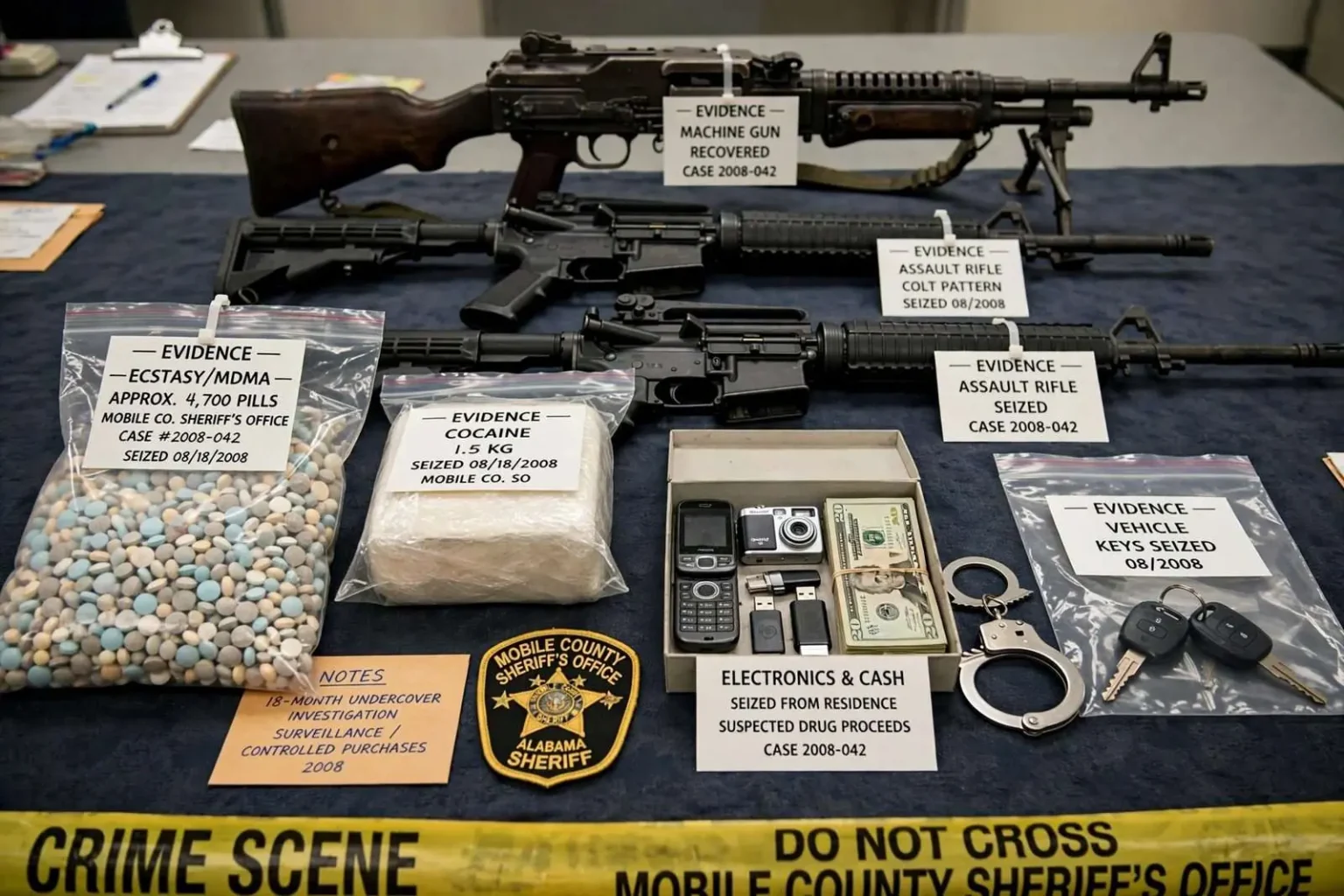
Mobile County deputies said they made what they described as the county’s largest seizure of Ecstasy pills after an 18-month undercover drug investigation in 2008. According to the archived report, deputies seized more than 4,700 pills, about 1.5 kilograms of cocaine, a machine gun and two military-style assault rifles. Authorities valued the drugs at about $250,000.
The scale of the seizure made it notable on its own terms, but the details that accompanied it gave the case additional weight in the eyes of investigators. A machine gun and military-style rifles recovered alongside a drug supply pointed to violence as a built-in feature of the operation, not a hypothetical risk. Weapons of that category are not common in routine street-level arrests, and their presence in a stash — combined with the volume of pills and powder involved — is what typically distinguishes a trafficking operation from casual distribution in the eyes of both prosecutors and the public.
The report said deputies also took a vehicle and electronics from a residence, believing the electronics had been bought with drug proceeds. That element of the case reflects a standard feature of modern drug enforcement: asset seizure, in which authorities take property they can tie to illegal activity. The logic is straightforward — disrupting a drug operation means more than removing its inventory, since cash, vehicles and equipment simply get replaced unless the profits themselves are stripped away. Seizures of this kind also generate headlines for a reason visible to any taxpayer: they signal that the cost of the investigation can, at least in part, be recovered from the operation it targeted.
An 18-Month Investigation
Investigations of the length described in the archived report represent a significant commitment of resources. An 18-month undercover operation means months of relationship-building, controlled purchases, surveillance and coordination among investigators, all conducted in a way that protects the integrity of the eventual prosecution. Undercover drug work is slow by design; officers must work their way into distribution networks without exposing themselves or tipping off targets, and a premature arrest cuts short the visibility investigators need to reach the top of a supply chain.
For the Mobile County Sheriff’s Office, cases of this scale also serve a broader purpose within the county’s enforcement strategy. Southwest Alabama sits along the Interstate 10 corridor, one of the primary east-west drug pipelines in the country, and the Port of Mobile has long made the area a point of interest for federal and local agencies tracking narcotics movement. County-level investigators work alongside those larger efforts, and seizures like the 2008 one documented the local footprint of networks whose supply lines stretched far beyond the county line.
Ecstasy, the drug at the center of the record pill seizure, occupied a particular place in the narcotics trade of that era. Known chemically as MDMA and associated primarily with party and club settings, the drug surged in popularity during the late 1990s and 2000s, and pills were typically pressed and branded with logos before being distributed in bulk. A haul of more than 4,700 pills was not a user’s supply but a distributor’s inventory, sized for resale across a network rather than a single neighborhood. The 1.5 kilograms of cocaine recovered in the same case pointed in the same direction: this was a multi-product operation with the reach and organization that implies.
The Arrest and the Charges
A 26-year-old man was arrested later that day and charged with trafficking cocaine and trafficking a controlled substance, according to the report. Trafficking charges in Alabama are weighty by design: they are triggered by the weight or quantity of the drug involved rather than by evidence of sales alone, and they carry prison terms measured in years that scale upward with the amount seized. Prosecutors treat the statutory thresholds as a way of distinguishing commercial-scale operators from users and small-time sellers, and the quantities described in the archived report placed the case squarely in trafficking territory.
The weapons recovered in the operation would typically compound the legal exposure in a case like this, since federal and state law both add penalties for firearms possessed in connection with drug trafficking — and a machine gun, as a fully automatic weapon, sits in the most restricted category of all. The archived report did not document what additional charges, if any, were filed in connection with the weapons, and this account makes no claim beyond what the 2008 report stated.
How Cases Like This Move Through the Courts
An arrest at the end of an undercover operation is the beginning of a legal process, not its conclusion. After booking, a defendant faces an initial appearance, and prosecutors must then carry the case through grand jury indictment, pretrial proceedings and — unless a plea agreement intervenes — trial. Defense attorneys in trafficking prosecutions routinely contest the legality of the searches and seizures that produced the evidence, and long undercover investigations generate extensive opportunities for such challenges. Every item listed in a seizure announcement, from the pills to the electronics, must survive that scrutiny before it can be used at trial.
That is why the disposition of the 2008 case matters to how it should be read today. Charges are accusations, and a substantial arrest announcement does not establish what the evidence ultimately proved, what pleas may have been entered, or what sentence — if any — a court imposed. The archived report that this article preserves did not include a follow-up, and no claim about guilt or final outcome should be inferred from it. What the report does document is a significant moment in the county’s enforcement record: an investigation measured in months and years, a seizure valued in the hundreds of thousands of dollars, and the arrest of a suspect facing trafficking charges at a time when Ecstasy was pouring into communities across the Gulf Coast.
What the Seizure Meant Locally
For residents of Mobile County in 2008, an operation like this one landed within a familiar set of anxieties. The region had spent years watching the intersection of drug distribution and violence play out in its neighborhoods, and each large seizure was presented by authorities as evidence of progress against that pattern. Beyond the enforcement symbolism, the practical effects of removing thousands of pills, kilograms of cocaine and automatic weaponry from circulation were real, if difficult to quantify: supply lines disrupted, profits stripped, and one distribution network — however briefly — taken out of commission.
Nearly two decades later, the case stands as a snapshot of its era: the scale of the Ecstasy trade in the late 2000s, the enforcement tools agencies brought to bear against it, and the emphasis on measuring success in pills seized and dollars recovered. This article preserves authorities’ statements and the charges as reported in 2008. The archived material does not establish guilt or document the eventual disposition of the case, and readers should understand it as a historical record of allegations — a window into a particular investigation at a particular moment in Mobile County’s history.
Undercover Work on the Gulf Coast
The 2008 case also illustrates the working reality of county-level drug enforcement, which differs sharply from the image most residents carry from television. Undercover narcotics work involves long stretches of waiting punctuated by moments of genuine risk, and it demands patience from agencies that operate under public pressure to show results. A deputy assigned to an 18-month investigation spends that year and a half maintaining a double identity, documenting every transaction for eventual court testimony and coordinating with colleagues who provide the surveillance and backup that keep the operation safe. When the arrest finally comes, it is the end product of a ledger of evidence built transaction by transaction.
The Sheriff’s Office and other Mobile County agencies also work within a layered enforcement environment. Federal partners from the Drug Enforcement Administration and the FBI, state bureaus and neighboring county sheriff’s offices all operate in the same region, and large seizures frequently involve coordination across those lines. A case wholly investigated at the county level, as the 2008 report describes, demonstrates the local capacity to run a sophisticated operation independently — an important capability in a region where the I-10 corridor and the port keep the volume of incoming narcotics consistently high.
The timing of the seizure placed it in a period when prescription pill and club-drug enforcement was intensifying across Alabama. Agencies statewide were adapting to distribution models that relied less on open-air markets and more on pressed pills moving through social networks, and the record Ecstasy haul reflected that shift in the market. The cocaine recovered alongside the pills showed the operation was not a specialist one: networks that moved multiple products were harder to disrupt, because losing one supply line did not end their business.
Reading a Historical Report Today
Archived reports like the one this article draws on carry their own obligations for readers. News reports of arrests are necessarily written from the authorities’ side of the case, in the hours or days after a seizure, before any court has weighed the evidence. The numbers are impressive and the charges are serious, but the document reflects a single moment from a single perspective. Responsible historical accounts — including this one — preserve that record while stating plainly that it does not establish what happened next.
That caution is not a technicality. People named in arrest reports can see charges reduced, evidence suppressed or cases dismissed entirely, and some are ultimately acquitted. Others plead guilty to lesser counts or face trial and are convicted. Without documentation of the outcome, an honest account can only report what was alleged and charged, which is exactly what the 2008 archived report allows and what this article confines itself to.
The historical value of the report lies in what it documents about enforcement priorities and drug-market conditions in Mobile County at the time: the emphasis on large-volume seizures, the focus on weapons recovered alongside drugs, and the practice of valuing seizures in dollar terms as a measure of impact. For readers researching the county’s history — or tracing how drug enforcement narratives have changed since 2008 — the case remains a useful marker of its moment, preserved here with its allegations intact and its limits acknowledged.